“The Bone of Kings”
A Cool Bob Studios tale of mountain ritual, primal force, and silver-wrought truth.
Cool Bob felt it before the wind shifted—before the pines ceased their whispered tongues and the very breath of the mountain hushed in reverence. On the rugged ridgeline, where the ancient spruce stood sentinel, he had just laid a fresh casting upon the stone slab—a bear claw wrought in silver, still steaming in the thin mountain air—when the knowing came. Not a thought, nor mere instinct, but a pulse older than memory itself. The world had turned its gaze. Something was arriving. Or perhaps, something long forgotten was ready to rise anew.
He had retreated from the forge’s fire, wandering beyond the reach of trails and maps into the wild, uncharted heart of the high Rockies. There were no roads here, only rivers unnamed, paths that vanished with the morning frost, and stones that remembered the first steps of creation. Time unraveled into fluidity—hours folding into nights, and nights into days, beneath the great dome of stars that spun with the slow cadence of cosmic breath.
He fashioned a lean-to from spruce boughs, brewed tea from the mountain’s pine needles and wild mint, and listened to the mountain’s quiet song—the voice of earth’s deep pulse, calling from beneath the skin of the world.
On the third night, under a waning silver moon, he stumbled upon a ring of black stones, naturally arrayed around a spring no wider than a teacup’s rim. He knelt, hands tracing the warm water, feeling the heartbeat of the earth beneath.
And then the bear came—not of flesh and blood, but of myth. Towering and solemn, eyes like galaxies spinning in silent vastness. It moved soundlessly across the snow, immense and unshaken by mortal fear. Bob sat still by his fire, breathing in rhythm with the mountain’s ancient song. No words were exchanged. No bows made. He simply waited.
The bear bowed—not in submission, but in solemn offering—and from its spirit belly drew forth a long, curved bone, white as glacier milk and glowing with the unbroken lineage of untamed time. The baculum.
Bearer of life’s primal force. The sacred root. The ancient phallus—yes—but something more. Something older. Something eternal.
Within it coiled the genesis of worlds—the unwavering axis of will and wildness. No mere organ of flesh, but a symbol sung through the oldest mythologies: the Greeks carried it in Dionysian rites as emblem of divine madness and fecundity; the Egyptians etched it in temple stone as an eternal scepter of life; in pre-Vedic hymns it thundered as fire’s generative spark. The phallus was never flesh alone. It was a bridge between realms, a sacred axis where creation’s mysteries unfold.
Not bound by notions of gender or form, it was source. It was force.
Then, as silently as it had come, the bear vanished into wind and frost.
Days later, Bob found the tangible echo of that myth—nestled beneath a storm-felled pine, wrapped in snow’s stillness. The bear’s passing was clean: no violence, no decay, just silence folded like a prayer. The flesh was gone—whispered away by spirits unseen—and only the skeleton remained, pure and sacred.
Within it lay the baculum—cradled like a wand awaiting its wielder.
Bob did not recoil. This was no mere artifact. It was remnant and resonance—the key left behind by a creature who had fully crossed into the unseen.
Back at his mountain studio, he made no attempt to polish or sheath the bone in silver. Some truths must remain whole, untouched, inviolate.
Instead, he prepared his ancient sand-casting bed—lined with volcanic ash and river grit. He pressed the baculum into the yielding grains, capturing every subtle ripple, every gentle taper, every nuance of lived form.
From this sacred echo, he fashioned the master mold.
And from this master, he wove the ritual of lost wax casting.
Each wax form was hand-carved from wild beeswax, gathered from hidden mountain hives—then surrendered to flame in the crucible’s fierce embrace. In its place, Bob poured his secret metal, Moonlight Silver—an alloy whispered into being by solitude and starlight, forged only beneath certain moons, under still air, in silence broken only by breath and intention.
The outcome?
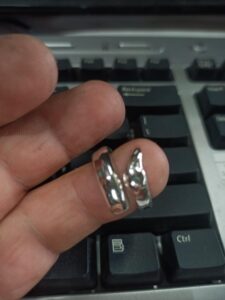
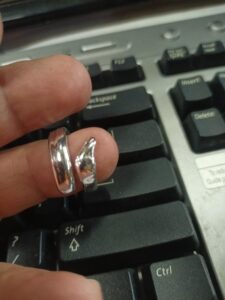
Rings—not mere adornments, but vessels.
Each bore the gentle curve and living flow of the bear’s baculum—subtle, smooth, unbroken. Not a literal copy, but a channel of energy so potent it caused the skin to tingle, the soul to stir. The charge of the wild, the ancestral fire, the heartbeat of the undomesticated.
Each ring was a talisman of the ancient power behind the phallus—a conduit of creative will, fierce balance, sacred vitality, and sovereign presence. For women, especially, it was a restoration—a reclamation of elemental strength long shrouded or diverted. Not a token of masculine power, but an affirmation of the primal feminine’s own generative fire—wild, unashamed, whole.
Because the baculum solidifies and magnifies the phallus’s power, when transmuted by Bob it became more than symbol. It became embodied power—a wellspring of grounded authority. It summoned clarity, boundaries, intuition, and alignment with ancient currents. Not all could wear it. But those who were called knew at once.
They wore it during the travail of birth, the fierce battles of justice, the crafting of words and the tending of quiet altars. One woman carried hers in a canoe crossing icy northern seas; another returned hers to the earth beneath a redwood’s roots after a lifetime of protection.
Across the world, the legends were older than memory.
In ancient Mesopotamia, the god Enki bore a sacred rod—a phallic staff wrought of living water and divine wisdom. Wherever he pointed it, the land bloomed and women conceived. Silver priestess rings, shaped in the likeness of his scepter, were worn during lunar rites to call forth healing, not submission. The phallus here was not domination—it was irrigation of soul and soil.
In India, long before stone shrines and icons, the lingam stood not just as a symbol but a cosmic fulcrum. Shiva’s phallus, encircled by the sacred yoni, represented the friction that births galaxies—the ecstatic stillpoint where chaos meets form. Pilgrims bled from the soles of their feet walking hundreds of miles, not to worship power, but to kneel before the mystery of balance.
In West African cosmology, carved ashera totems embodied ancestral virility and deep continuity. Miniature versions were passed from grandmother to granddaughter during puberty rites—small but weighty, bound in leather, worn close to the heart. They were not male relics; they were fierce vessels of life-force, as essential as drum and fire.
In the high Andes, Quechua mythology told of Kuntur Illa, the celestial condor whose silver talon pierced the earth and raised the first mountains. That talon—curved, gleaming—was not claw but seed. Women mined silver beneath its sacred peak and carved rings bearing its shape, etching them with thunder sigils. They called them “bones of sky fire.”
The Norse told of Freyr, god of fertility, who wielded a golden phallus so potent it stood on its own and went to battle without him. It was said to be a rune made flesh, a sigil of sovereignty. In the north, some women still carve runes into silver rings to echo its defiance.
In Japan, the Kanamara Matsuri—Festival of the Steel Phallus—welcomed maidens and crones alike to honor the sacred masculine. But the deeper current ran through the hands of shrine maidens who polished steel effigies with reverence. Their prayers were not for men’s virility—they were for ancestral flame, for the steel-willed strength to birth, heal, and carry.
Cool Bob knew none of these traditions explicitly. But the mountain did. The bone did. And the forge listened. Their whispers carried across ages and languages, drawn to Bob’s fire like moths to a candle burning in the heart of time.
Seekers found it.
And most of them were women.
They came from far places, drawn not by advertisements or exhibitions, but by a pulse—an ache in the bones, a dream they could not shake, a whisper rising from beneath the noise of the world.
One came from the volcanic highlands of Iceland, a woman named Svana. Her grandmother had told her tales of Freyr and the golden phallus, but it wasn’t mythology that drew her to Bob—it was a dream of a silver bear walking through ash and fire. She arrived wearing wool and sorrow, carrying a polished obsidian cabochon in the shape of a raven’s eye. Bob took her measure in silence, letting her presence guide the weight and shape. When the ring cooled on the anvil, Svana wept—not for pain, but for the return of something lost in her bloodline.
Another came from the coast of Ghana—Ama, a healer and midwife whose dreams were filled with thunder and sky bones. She brought a piece of raw blue kyanite wrapped in cloth, its edge sharp with clarity. “This one,” she said, placing it in Bob’s calloused hand. “It carries the truth of water.” Her ring sang as it cooled, and when she slipped it on her finger, the wind outside shifted. Later, she would say it whispered when danger neared and glowed during births.
The third woman came from Kyoto. Her name was Rei, and her silence carried centuries. She bowed low, then offered Bob a piece of moonstone smoothed by river time. “No words,” she said. “Only need.”
Bob did not speak either. He simply lit the forge and let the mountain decide. Her ring shimmered like ice smoke. When she placed it on her hand, the shadows in the corners of the studio leaned in, then respectfully withdrew.
Bob kept the master mold in a hidden place—wrapped in bear hide, marked with a single symbol scratched in with a thorn. He did not speak of it. He did not display it. But when the right ones came, the forge knew. And the mountain approved.
So the rings continue—each one a fragment of a forgotten whole. Not merely worn but lived. A myth reclaimed in silver, in bone, in fire.
And the bear watches still, somewhere beyond the ridge, waiting for the next whisper to rise.