
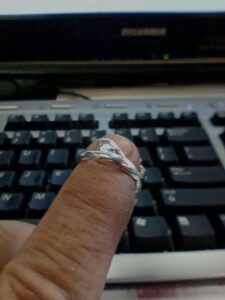
The Silver Twig of the Mountain Cherry
A Cool Bob Studios Story
Cool Bob had come to Japan not for business, not for ritual, but for friendship.
Fuji and Rin had extended the invitation weeks earlier—handwritten on rice paper, folded into a crane, then packed inside a weathered envelope with the smell of camphor and pine. The script was spare and elegant.
Come when the snow begins to melt. You will find us on the mountain.
No address. No return stamp. Just a single mark drawn in ink: the symbol of a blooming sakura.
Bob packed light—just his overalls, a thermos of pine needle tea, and the silver tsuba he had forged for Rin’s katana. That piece had taken shape under the cold moons of Colorado, a three-week trance of hammering, casting, and hand-polishing. The silver bore no markings but shimmered like still water. Bob had heard, months later, that the blade now resided not in a temple or home, but among the slopes of Mount Kurama—where martial tradition and mysticism braided into the wind.
That wasn’t the only reason he came.
For months now, Bob had felt the pressure build inside his hands—a subtle tension, not of pain, but of readiness. As if something was waiting to be made, but the silver didn’t yet know what shape to take. Dreams had grown vivid. He often woke to the scent of cherry blossoms, though none grew near his cabin. In one dream, he stood barefoot on a wide ring of moss, and a silver branch arched down and brushed his forehead. In another, he saw Rin’s face reflected in a bowl of water, only to watch her dissolve into drifting petals.
When Fuji’s letter arrived, he didn’t hesitate.
Bob flew into Tokyo, caught a northbound train to the edge of the Kyoto basin, then hired a driver to take him partway up the mountain. But the roads turned to gravel, and the gravel gave way to mossy trails. Bob disembarked without hesitation. The air was colder than expected. As always, he trusted the path beneath his feet.
His pack was simple: a pouch of tools, a few squares of wax, one tightly rolled apron, and a jar of snowmelt sealed last spring. The rest he’d find along the way.
The climb was not easy. The mist thickened the higher he went, and the trail veered into silence. For a while, he heard only the cawing of a crow overhead and the soft rhythm of his boots in mud. Once, he saw a fox disappear between two stones, its white tail like a signal.
Three days passed. He didn’t find Rin. He didn’t find Fuji.
What he found instead was mist.
Thin and luminous, it slid between the cypress trees like a spirit looking for its name. Bob moved slowly, one hand always near the pendant under his shirt—the old Silver Rattle. The path curved and narrowed, then disappeared altogether. He followed a crow’s call to a stone stairway slick with rain.
At its top stood a village so small it seemed carved out of memory—just six homes, a teahouse, a weathered shrine, and an open-sided smithy that still smelled of iron and charcoal.
There, an old man with a topknot and gray hakama stood waiting beside a forge. He bowed once. Bob bowed back.
The man spoke only a small amount of English. Bob spoke only the kind of Japanese you pick up from menus and subtitles. But when Bob reached into his chest pocket and pulled out the velvet pouch, the tsuba inside gleamed like moonlight. The old smith’s eyes widened. His hand went to his heart, understanding it belonged to Rin. And then, smiling faintly, he gestured for Bob to follow him.
They walked past the shrine. Past the old bell tower. Past a split torii swallowed by ivy. Deeper into the forest.
The trail grew thinner, then vanished entirely. They moved like water between the trees. At one point, the swordsmith paused and placed his hand on a moss-covered stone inscribed with a single kanji—kokoro. Heart.
The cherry tree was nearly invisible.
It stood beside a narrow spring that gurgled from a crack in the black stone. The trunk twisted like a dance mid-motion. The bark was silver-gray and soft as breath. Its blossoms had not yet opened, but the buds pulsed with some quiet life—like they were waiting for a name to be spoken.
“This is the tree,” the old man said in a whisper. “The spirits dwell here when the veil is thin. Not kami. Older.”
He crouched beside the spring and ran his hand through the water. For a moment, his reflection shimmered into the shape of a stag, then returned.
Bob didn’t speak. He didn’t need to.
He removed his boots, stepped barefoot onto the moss, and knelt.
A breeze passed, and a single blossom opened.
That night, he stayed in the village. The old swordsmith offered him a guest mat, a bowl of hot barley rice, and a sip of homemade umeshu. Then, without words, he gestured to the tatami ring.
Aikido randori. A test of flow.
Bob stood and followed.
The old man moved like wind. Soft. Circular.
Bob moved like river rock. Slow. Anchored.
They danced—not to win, not to break—but to echo.
When it ended, the master pressed his palm to Bob’s chest.
“You have earned one twig,” he said.
In the morning mist, the swordsmith returned to the tree. He stepped into the spring and waited. When he emerged, his hand was closed around a single silver-tipped twig, no longer than a finger, curved like a crescent moon.
The offering was made with full ceremony. Bob received it with both hands. He did not smile. He did not speak. But something in him shook loose.
Bob did not leave Japan immediately.
The swordsmith led him to a trailhead marked only with a blue ribbon tied to a tree root. It twisted through cedar groves and opened, at last, to a stone path lined with mossy lanterns. Bob followed the scent of roasted barley and river smoke until he heard a familiar laugh.
There sat Fuji, sipping matcha from a wide black bowl. Rin was beside her, slicing pear with a tiny ivory-handled knife.
“You took the long way,” Fuji said with a wink.
Rin said nothing, only offered him the knife to take a piece of fruit.
They spent the next season together. Spring melted into early summer.
They hiked high ridges above cloudline, where the stars bled into the forest canopy. They soaked in cedarwood baths, traded quiet stories, and laughed over sweet red bean cakes. In Kyoto’s back alleys, they slipped into old teahouses where the tatami creaked and the steam smelled of sea and soil.
Bob brought his pine needle tea and shared it with the hosts. He was offered in return an aged sencha grown on mist-covered slopes, and once, a tea so pale and clear it tasted like the memory of rain.
They never spoke of the cherry tree. They didn’t need to.
Back in Colorado, Bob prepared the sacrificial fire. Not for offering, but for the sacred burning away—his technique for transforming plant material into silver.
He took the twig given to him by the swordsmith and encased it in a mixture of clay, sand, and volcanic ash—gathered from his own mountain slopes—forming a sealed crucible around its delicate form. He placed the mold deep into his forge and let it burn overnight. The fire consumed the twig entirely, leaving behind only its hollow absence.
At dawn, he poured molten silver into that void.
Thus the master was born.
He used lost-wax casting with mountain wildcrafted beeswax. He shaped the wax model to echo the silver branch exactly—no adornment, no interruption. He wrapped the model with white cotton thread and buried it in clay mixed with volcanic ash.
When the mold was ready, he whispered the mountain’s name.
Kurama.
The silver filled the void.
When cooled, he polished it with cherry bark and snowmelt water stored since his return. The ring he shaped from that twig bore no symmetry, no stamp, no hallmark. It curved unpredictably, like thought. At one point it split into two branches, which rejoined in a spiral knot that felt like breath held in a dream.
It did not shine. It shimmered.
The Cherry Ring is offered on Bob’s online portal: coolbobstudios.com.
Sometimes it appears in the shop window—resting on a piece of soft cedar bark. Sometimes it is gone for weeks.
Those who wear it report dreams of deep forests, silver blossoms, and unseen springs that sing without sound. One woman claimed she heard an old swordsmith whispering her name. Another returned to say she met a crow who told her to kneel.
Bob does not explain the ring.
He only nods and pours more pine needle tea.
But those who’ve worn it say more.
Some claim the ring hums faintly during thunderstorms. Others say it grows cool in moments of clarity, and warm when choices must be made. One man wrote that while wearing it, he found an old photograph in his attic—one that shouldn’t have existed—of his grandfather standing under a cherry tree that matched the one in Bob’s story.
Another woman, a violinist from Prague, described a dream that came the night after she put it on:
She stood in a forest of singing trees. Each blossom was a bell. She followed a fox made of mist down a trail lit by silver lanterns. At the end, the trail opened into a clearing with a stone ring. There, kneeling beneath a blooming cherry tree, was a version of herself she had forgotten—barefoot, smiling, unafraid. The two locked eyes. And then she woke with tears and a single petal in her hand.
No one can explain it.
But those who know, know.
The mountain watches.
The cherry waits.
And when the veil thins—
You’ll know.
The Other Story !
A Cool Bob Studios Story – Version Two: Wild Mysticism and Ancient Lore
Before time was time, before the word cherry ever touched a tongue, the tree had already bloomed.
It grew on a mountain that had no name—only a resonance. The monks called it Utatane, the “Place of Drowsing Spirits.” But the old women who lived on its lower slopes knew better. They whispered its truer name: Tsukimikusa no Mori—the Forest of Moonbound Grass. It was said that on nights when both moons rose (though Earth has only one), the mountain opened, and the oldest roots drank dreams instead of water.
Somewhere in that high misted cradle grew the cherry tree. But it was not a tree. It was a guardian. A witness. A spine between worlds.
No one could approach it unless they had walked backward through memory.
Cool Bob had not meant to walk backward through memory. He had only come to visit Fuji and Rin.
He never reached their cabin.
The forest around Mount Kurama shifted—paths folding in on themselves, birds circling in spirals that never landed. The more Bob tried to follow the paper map, the more the world seemed to forget its own shape.
Then came the snowfall that wasn’t snow.
Tiny white blossoms fell in utter silence, though it was not spring. They melted not on skin but in air. The trail ahead turned silver. Bob stepped forward—and the next moment, he was elsewhere.
The forest was ancient. Everything breathed.
Crows with copper eyes watched from above. A black snake slid between cedar roots and vanished. The light did not change. It only thickened.
Bob followed nothing, and still he arrived.
A ring of stones surrounded a tree that flickered faintly with inner flame. Its bark was cracked like the shell of an egg, silver-gray with the faintest veins of violet. Petals floated around it, never landing, and beneath it sat a woman whose face blurred as if water ran across it constantly.
She spoke not aloud but into the air.
“You carry the mark of the Rattle. And the memory of the tsuba. You are known.”
Bob knelt. He didn’t understand, but he didn’t need to.
“You seek not knowledge,” she said, “but essence.”
She reached behind her and withdrew a twig—not from the tree, but from a satchel carved of moonbone. It shimmered with a soft echo.
“This branch has already burned,” she said. “Its memory remains. Shape it.”
Bob bowed. When he looked up, she was gone.
He awoke in a cave of quartz.
His hands were closed around the twig. A silver moth clung to its end. When it lifted away, it disintegrated into vapor.
He walked out of the cave and found that the sun had not moved. Or perhaps time had curled.
There was no village. No swordsmith. Only the sense of having passed through the spine of something vast.
His clothes were different—still his overalls, but older. Mended. Worn at the seams as if they had lived through another man’s life. He checked his boots. They bore the prints of a hoof, not a sole.
The trail back to the world was easier. As if the land itself had exhaled.
He walked for a day without seeing a road, then crested a hill and found a tea house where Fuji sat sipping from a wooden bowl. Rin was beside her, carving a dragon into a gourd. They looked up but did not appear surprised.
“You look changed,” said Fuji.
Rin handed him a plum.
No one asked what had happened.
Bob stayed a while in Japan. Not in any one place. The land moved beneath his feet. Some nights he slept in forest shrines where the wind whistled in five tones. Some nights he drank tea brewed over driftwood fires. He wandered alleys where the shops sold nothing visible, only scents and murmurs.
Once, an old woman with opal eyes handed him a mask carved from cherry bark. It bore no expression. When Bob placed it over his face, he heard voices beneath the ground. When he removed it, she was gone.
He did not try to explain.
He only returned to Colorado when the twig began to hum.
Bob prepared the fire—not in his forge, but on a ridge above his studio. He used mountain sand, red clay, and ash from a fallen juniper. Into this, he placed the twig, encased in memory and minerals.
He placed the sealed mold into his night-forge and fed it pine branches and whispers until dawn. The fire burned violet-blue and gave off no smoke.
When he cracked the mold, there was no twig inside—only a perfect hollow.
He melted silver by moonlight and poured.
The master was born.
He formed a wax model from mountain wildcrafted beeswax. The wax softened in his hands as if remembering itself. It twisted into a spiral and then split in two. He guided, not shaped.
He cast it again. Let it cool beneath a bowl of river stones.
He polished it with crushed obsidian and morning dew. Wrapped it in linen dipped in pine resin and laid it beneath a stone for three days. Each night he dreamed of falling through petals.
When he unwrapped it, the ring shimmered—not bright, but deep.
It curved around itself like a riddle.
The Cherry Ring now rests within the spirit vault of Cool Bob Studios.
It appears online when it wants to.
Buyers often report the website crashing or rearranging itself before the ring becomes visible. A few say the ring chose them.
Those who wear it:
• Forget the names of cities, but remember dreams in perfect detail.
• Hear music in places where there is none.
• Report uncanny timing—arriving early to events they were never invited to, and finding meaning there.
• Speak with animals without sound.
• Begin to recognize old stones as teachers.
One woman from Oaxaca dreamed of standing on a shore made of black petals. A giant cherry tree rose from the sea. Beneath it sat a younger version of herself, holding a ring and smiling.
She awoke to find a ring-shaped burn mark on her palm. The mail arrived three days later.
Inside was the Cherry Ring. No return address.
A man from the Yukon claimed the ring sang only during auroras. He wrote in his journal that the sound opened something in his chest—somewhere between memory and song.
Another woman, a dancer from Morocco, said that when she placed the ring on her toe and danced beneath a cypress, she heard laughter coming from the roots.
Still another, a child of seven who found the ring in her mother’s jewelry box, swore she saw her grandfather’s ghost nodding at her during a rainstorm. The ring disappeared the next day. The ghost did not return.
Bob does not speak of this version. Not even to Fuji. Not even to Rin.
But when someone brings it up at the studio—half-joking, half-believing—Bob only smiles, sips his pine needle tea, and whispers:
“Not everything grows from seed. Some things bloom backward.”