Story Time !
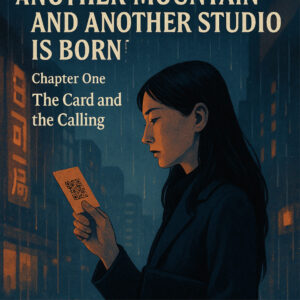
Fuji – The Card and the Calling
In a city that pulsed with neon and deadlines, where skyscrapers boxed in the sky and ambition roared louder than the wind, lived a woman named Fuji. Her world was one of polished glass and clipped voices, of metrics and projections and the quiet ache of something long buried.
She was brilliant, undeniably so. Her eyes caught details others missed, and her presence in a room seemed to adjust its temperature. But even brilliance burns out when trapped in the machinery of a life built by others. And so, late one rainy evening, under the dull gold of a flickering streetlamp, Fuji found something that didn’t belong.
It was a business card—brown kraft paper, rough to the touch, and oddly warm. No text. No logo. Only a QR code etched by fire. Laser-burnt with delicate accuracy. She turned it over. Nothing. No name. No brand.
Suspicion rose. Fuji was not one to scan strange codes, especially not in a world where tracking and manipulation were currency. But something about the card resisted discard. It wasn’t flashy. It wasn’t begging. It simply was.
She slipped it into her clutch without thinking, the same clutch she carried on nights when the city seemed too large, and she walked home just to feel the ache in her feet.
Weeks passed. The card remained untouched. Life went on—escalating deadlines, too-loud laughter in meetings, and that gnawing sensation that somewhere, something real was calling.
Then one night, exhausted, she fumbled with her keys at her apartment door. The card slipped from her clutch. Reflexes born of martial arts caught it mid-fall. That sudden awareness—the snap of mind into body—startled her.
Inside, with the kettle on for green tea, she stared at the card.
And scanned it.
The portal that opened was not what she expected.
No landing page. No marketing funnel. Just a site. Raw. Beautiful. Confounding. A world of hammered silver and storytelling, of wild lines and ancient quiet. CoolBobStudios.com.
She read for hours. Then days. Each piece came with myth. Every story felt hand-forged, as if the writer had slipped into her dreams and taken notes. The work wasn’t commercial. It didn’t sell. It invited.
She had to know.
Who was this Cool Bob?
What kind of mountain mystic made silver that whispered?
And how did an American craftsman so deeply embody the wabi-sabi ideals her own culture had so long ignored—imperfection, impermanence, authenticity?
With no clear plan but a heart cracking open, Fuji requested a leave of absence, packed a single bag, and left the city.
Her search was not easy. There were no directions. Only fragments: a valley mentioned here, a pine forest there. People she met spoke of Bob with reverence. “The man with the forge in the mountain.” “The one who speaks to rivers.”
When she finally found the studio, it was near twilight. A weathered building tucked into the rock, smoke curling from a crooked chimney, the air thick with juniper and snowmelt. She decided to approach without warning. To surprise this eccentric, overalled silver-sorcerer.
She crept silently. Years of discipline made her nearly invisible.
But as she reached to tap him on the shoulder—
Wham.
She found herself flat on her back, staring at the evening sky.
Bob stood over her, grinning, his hand extended.
“Nice form,” he said. “But you led with your left shoulder.”
She took his hand and laughed. “You practice Aikido?”
He shrugged. “I wrestle bears, mostly.”
They sparred for a while, playful and sharp. No egos. Just movement and shared rhythm. When the sun dipped below the horizon, they sat on a weathered bench, breath steaming in the cool air.
He brewed tea—pine needle with wild mint—and handed her a mason jar full of the iced version.
“Iced?” she raised an eyebrow.
Bob grinned. “I’m not a monk.”
She sipped.
And in that moment, Fuji knew her life had just unraveled.
But not in loss.
In freedom.
In rewilding.
This was no longer a story of escape.
It was the beginning of her return.
A Thousand Lessons in Silver
The next morning, the fog rested low over the ridgeline, mist curling between pine trunks and the jagged edges of talus fields. Fuji woke early, surprised at how deeply she had slept in the loft above Bob’s studio. The scent of silver, beeswax, pine pitch, and coffee brewed over open flame drifted up the wooden stairs. She descended barefoot, reverent, like stepping into a shrine.
Bob was already working.
No words. Just the hiss of the torch, the clink of tongs on stone, the gentle hum of someone wholly in tune with their craft. Fuji watched for a long while before he looked up and grinned.
“Ever seen lost-wax casting done by magpie rules?” he asked.
She didn’t answer, but stepped forward to watch. The mold was still warm from the pour. A ring cooling in its cradle of soot and bone-black clay. Around it, sketches were strewn across a workbench—wild spirals, trees, meteor paths, some forms seemingly lifted straight from a dream.
For days, Fuji stayed.
At first, she only observed. Bob didn’t offer lessons. He lived them. Every act in the studio was a ritual. Every piece of silver, a story waiting to be coaxed from the ore.
She asked questions. He answered by doing.
“Why not just buy wire like the others?” she asked once, watching him stretch a molten bead of moonlight silver into filament, his arms rhythmic and slow.
He handed her the cooled wire and said, “Because that wire remembers the fire, not a factory.”
Bob spoke with his hands, with silence, with sidelong grins. He never used the word ‘teach,’ but everything was instruction. He would make tea—always pine needle, sometimes with yarrow or mint—and say things like, “You know a tree by how it bends, not by its bark.”
Fuji learned to sweep the floor with care, to temper silver in rhythm with breath, to listen for the click that said the mold had cooled just enough. She learned the names of the mountain herbs and which birds brought gossip. She began to sketch again.
One morning, Bob placed a cuff in her hands. It shimmered with an odd asymmetry—part wave, part branch, part spiral of wind.
“This was made from the mold I saw you bury near the ravine,” she said.
He nodded. “You’re seeing it now.”
She wore it the rest of the day.
Visitors came. Sometimes hikers, sometimes seekers. Bob treated each the same—with hospitality and a mischievous twinkle, but never salesmanship. He didn’t sell jewelry. He placed pieces. If something resonated with a visitor, it was theirs. If not, it returned to the shelf.
And Fuji saw it: each piece wasn’t made for the masses. They were talismans, forged with story and spirit. The castings couldn’t be replicated. No two ever were. Bob’s molds shattered after a single pour—by design.
Each day, her questions grew deeper.
Why this metal? Why these lines? Why the moonlight hour for pouring?
And Bob always answered with a story.
A river that carved silver veins. A bear that carried a ring in its mouth. A dream of lightning that became a necklace.
She listened. She helped. She laughed.
And she knew: this place, this man, this mountain—had become her dojo, her temple, her forge.
One morning, after watching Bob set a newly cast pendant into a leather cord, Fuji asked him something that had puzzled her since the day she arrived.
“Why don’t you stamp your work?” she said.
Bob paused, rolling the silver gently between his fingers.
“I used to,” he said. “Years ago. Had a little maker’s mark and everything. Clean lines, tidy font. Looked real official.”
He chuckled, then set the piece down and leaned back against the window frame. Outside, a crow cawed once and flew off toward the ridge.
“But then I realized something. The mountain doesn’t sign its trees. The river doesn’t autograph its stones. Why should I?”
Fuji tilted her head, intrigued. “So you just… let the work speak for itself?”
Bob nodded. “Every curve, every flaw, every fire mark—that’s my name. And if someone can’t feel that, then maybe the piece wasn’t meant for them.”
She turned the pendant over in her hand. The edges were just slightly uneven. The form was wild and organic, as if it had grown rather than been forged. And yet, unmistakably, it bore the weight of Bob’s presence.
“You trust a lot,” she said softly.
“I trust the ones who listen,” he replied.
She smiled. “Like the mountains.”
“Exactly.”
And that day, Fuji began to understand that Bob’s work wasn’t just craftsmanship—it was ritual. Not a product, but a practice. A way of being. She turned the pendant over in her hand. The edges were just slightly uneven. The form was wild and organic, as if it had grown rather than been forged. And yet, unmistakably, it bore the weight of Bob’s presence.
Rhythm of the Mountain
The rhythm came slowly.
Not all at once, not in a cinematic awakening, but like water soaking into dry earth. At first, Fuji kept a list—a mental inventory of techniques she wanted to learn, processes to master. She asked about soldering temperatures, alloy ratios, grain orientation in hand-pulled wire. Bob nodded, sometimes answered, sometimes didn’t.
“You’re not here to collect methods,” he said one day, “You’re here to remember what’s already in your hands.”
She bristled at first. The city had trained her to extract knowledge, measure improvement, quantify worth.
But the mountain didn’t care.
Time here was different. She stopped wearing a watch. She stopped waking to alarms. She began waking to light.
The way Bob worked wasn’t linear. Some days he smithed in silence for hours, other days he wandered into the forest with a flask and a sketchbook. There were weeks when the forge sat cold, the only sound in the studio being the scratch of pencil on handmade paper and the occasional owl.
And yet, the work never ceased.
It happened in layers—in dreams, in tea rituals, in hikes where they spoke to ravens and named rock formations.
Fuji learned to track stories, not progress. She began to see the silver not as metal, but as frozen conversation between earth and fire. She started sculpting wax herself—at first timidly, then boldly, carving not designs but memories into the beeswax Bob harvested from wild hives.
One piece in particular—a ring, fluid and spiraling—captured a dream she had of wind weaving through her childhood hair.
She cast it with Bob beside her, both of them silent, holding breath during the pour.
When the mold cracked and the piece emerged, Bob only said, “There she is.”
And Fuji cried.
She cried not out of sentiment, but release. The city, the noise, the pressure to perform—gone. The mountain had given her back to herself.
From then on, she worked freely.
Not for commerce. Not for approval.
But for communion.
The Mountain Calls East
The call came not through voice or letter but through the wind itself.
One late autumn morning, as the golden leaves whispered their final goodbyes and frost crept across the studio windows, Fuji paused mid-hammer. Something in the silence had shifted. Not a sound, exactly—but a tug. A deep pulse, ancestral and magnetic. She closed her eyes.
Mountains speak, if you’ve learned how to listen.
And Fuji had learned.
A mountain in Japan, far across the sea—her homeland—was stirring. Not metaphorically, but literally. Earth trembled beneath its roots. Thunder rolled across its back. Villagers whispered of omens, of spirits displeased. Some said it was restless. Others said it wept.
Fuji didn’t ask for clarity. She only packed.
Bob, as always, offered no resistance. He stood beside the forge, watching her fold her few belongings into a woven rucksack.
“Got another mountain to talk to?” he asked.
She smiled, sad and certain. “This one’s mine.”
“I’ll keep the kettle hot,” he said. And meant it.
Her journey home was dreamlike. The busy cities she once knew felt thinner, like she could walk through their concrete facades if she tried. As the train wove upward into the mountain pass, she felt her pulse synchronize with the land.
At the summit’s base lay a small, abandoned shrine. She cleared the vines. Brushed away decades of moss. She built nothing new—only repaired what had already been. A forge was erected with stone and clay, shaped to the land’s curves. A roof of cedar. Walls of reclaimed wood. The air smelled like memory and snow.
When she lit her first fire, the mountain sighed.
And went still.
Villagers came, at first out of curiosity, then reverence. She crafted not for sale, but for healing. Tiny charms. Amulets for births, funerals, lovers. Each piece held story, breath, and ash.
But though the earth calmed, Fuji was not alone.
At twilight, she would sit cross-legged before the forge, inhale the steam of mountain herbs, and close her eyes. In that stillness, she reached beyond time, beyond space. The forge-fire’s rhythm echoed that of another across the world.
Bob, thousands of miles away, sat in the same posture, a mason jar of iced tea beside him. Sometimes he laughed mid-meditation, swatting at a curious pine marten. Other times he merely listened.
Between them, the mountains spoke.
Not in words, but in feeling. In memory. In light.
Messages came in flashes—visions of hammer strokes, of riverstone textures, of a new alloy dreamed in sleep. She would send sketches without knowing why. He would reply with castings that mirrored her thoughts.
Once, she dreamed of a silver leaf, shaped like the one outside her shrine, etched with kanji that meant “Echo.” A week later, a package arrived: Bob had sent the exact piece, though they’d never spoken of it.
They called this their “long-distance forge.”
Creation had become communion.
And in this practice, Fuji began to understand that what Bob had offered her was not just silverwork, nor even mountain wisdom—but a language.
A language of silence.
Of reverence.
Of rootedness.
So she stayed. The studio remained. The mountain rested.
And every time a storm tried to rise again, she whispered to the wind—and the wind listened.
Because now, two mountains were in balance.
And their makers were no longer alone.
Rin
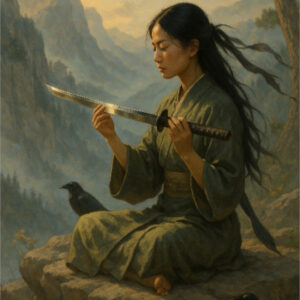
A Continuation
The mountain welcomed them, as it always did, in silence.
The wind curled gently around the two figures as they ascended — Fuji steady in her steps, Rin slightly behind, her breath already thin as the trail narrowed.
They had come far — not just in distance but in life.
Rin’s blade was sharp in the city. It always had been.
She entered the high glass towers every morning like a warrior entering a dojo. The polished floors gleamed like water under her feet. The lights overhead hummed quietly, cold and endless. Every meeting was another duel. Every negotiation, another contest. She spoke in measured tones, listened with silent calculation, and cut cleanly when the moment came.
They admired her. Feared her, even.
Her katana skills were not metaphorical. She had trained since childhood — precision, discipline, poise. The sword was an extension of her breath. And in the corporate world, that same breath cut contracts instead of opponents. She was known for never missing a detail, never revealing emotion, never letting the blade slip.
The executives called her the steel lily. Beauty and danger in equal measure.
But behind the conference tables, behind the spreadsheets and strategies, something inside Rin had begun to wither.
There was no honor in the victories. No breath in the balance sheets. The patterns repeated. Promotions came. Salaries grew. Her name carried weight. But at night, when the city glowed with its endless artificial stars, she would stare out over the skyline and feel nothing.
The katana hung in her apartment, untouched.
Its polished surface reflected a woman who barely recognized herself.
Her hands, once steady with purpose, sometimes trembled in the mornings. She told no one. She simply pushed forward, as she always had. That was the way.
Until the tremor reached her breath.
And then she called Fuji.
Fuji met her in a small tea house far from the towers. One of the few remaining places untouched by the city’s steel and glass.
Fuji had always been different. She had left long ago, seeking something the city could not give. Rin admired her strength, though she never understood it fully.
They sat across from one another as steam rose gently from two simple cups.
“I see it in your eyes,” Fuji said softly.
Rin said nothing. The silence stretched.
Finally, Rin whispered, “I’m hollow.”
Fuji nodded. She needed no further explanation.
Rin’s fingers tightened slightly on the porcelain. “Take me with you.”
Fuji’s eyes softened. “The mountain does not fix. It dissolves. Are you ready to let it dissolve you?”
Rin exhaled slowly. “I am.”
They finished their tea in silence.
The next morning, they left the city behind.
The train carried them through the lowlands first. Past the suburbs and industrial parks. Past the tidy farms that clung to the city’s outer breath. The towers faded into mist behind them, until only the mountains stood ahead — tall, silent, ancient.
At the final station, they stepped onto a platform of weathered wood. The air was thinner. Cleaner. The wind carried the scent of pine even here.
A narrow road led upward. They walked.
Rin felt the climb immediately. The slope was steady, but unforgiving. The air cooled with every turn. The sky grew larger. The trees older.
For hours they ascended, speaking little.
Small villages appeared and disappeared — clusters of wooden homes tucked into the folds of the mountain. Children played near streams. Elders sat beneath leaning cedars, their eyes following the travelers with quiet knowing.
The road narrowed to a trail. The trail narrowed to a path.
By evening, they camped beneath a wide maple. Fuji lit a small fire. The stars emerged like silent witnesses above them.
Rin watched the flames dance.
“What will I find there?” she asked quietly.
Fuji answered without looking up. “Yourself. Or nothing. Either is enough.”
The fire cracked softly.
In the distance, an owl called once, then was silent.
By the third day, the path opened onto a small plateau.
There stood Fuji’s studio — simple, beautiful, breathing with the mountain. The wooden structure curved slightly with the slope of the land. Wide doors stood open to the wind. Inside, smooth cedar floors caught the light filtering through rice paper screens.
The mountain’s breath moved freely through it.
“You’ll stay here first,” Fuji said.
Rin stepped inside. She placed her bag quietly by the wall. The weight of the city seemed to fall from her shoulders, though its shadow still clung.
For the first time in years, she slept deeply that night.
The mountain breathed around her.
The days that followed were slow.
There was no schedule. No list of tasks. Only the rhythm of the mountain.
In the mornings, Fuji brewed tea from pine needles and wild mint. The steam carried the scent of the forest directly into Rin’s breath.
They walked often, following narrow deer trails through the tall pines. Fuji spoke little, but pointed often — at the way moss clung to the north side of stone, at the curve of a fallen branch, at the ripple of water in shallow pools.
“This is practice,” Fuji would say. “Seeing is practice.”
Rin struggled at first. She had come seeking instruction, steps, method. But here, there was only presence.
At night, they sat quietly beneath the stars.
The city’s noise slowly faded from her chest.
Her breath slowed.
Her hands stopped trembling.
Weeks passed.
One morning, Fuji stood at the doorway, pack in hand.
“It is time,” she said.
Rin followed.
They left Fuji’s studio at dawn, climbing higher into the teeth of the mountain. The trail grew steeper, narrower. Wind pressed against them with sharp fingers. Clouds drifted low, brushing against their faces.
For two days they climbed.
They camped beneath twisted pines, whose roots gripped the stone like ancient hands. Fuji brewed tea over small fires. Rin listened to the wind move through the trees like old voices whispering.
On the second night, as they sat near the fire, Fuji finally spoke.
“You wonder why I bring you to this man.”
Rin nodded. The silence had asked the question for her.
“When I first came to the mountain,” Fuji continued, “I thought I understood wabi-sabi. My teachers taught me the words. The forms. The philosophy. But they remained ideas.”
She paused, eyes on the fire.
“Bob lives it.”
Rin frowned slightly. “An American?”
Fuji smiled. “The mountain does not care where one is born. It listens to those who listen.”
They sat in silence again.
The fire crackled softly.
Rin stared into the flames, her breath steady.
The mountain was already teaching.
By midday on the third day, the mist lifted.
Before them, carved directly into the cliffside, was Cool Bob’s studio.
It clung to the rock like a living thing. Wide beams of weathered pine supported the structure like patient arms. Stone walls curved into the mountain itself, worn smooth by years of wind. Wide open windows allowed the air to pass freely. Copper wires, braided and ancient-looking, laced the joints like veins.
The studio breathed as part of the mountain.
Inside, tools rested in careful disarray. Hammers, tongs, chisels — all worn smooth by use, none perfect, none new. On a long workbench, fresh-cast silver cooled in simple molds.
Cool Bob stood at the center.
He did not greet them with words. Only a nod.
His linen shirt was simple, sleeves rolled to the forearms. His leather apron bore the stains of years. His eyes were impossibly clear — neither hard nor soft, simply present.
“This is Bob,” Fuji said softly.
Bob nodded again. “Welcome.”
The silence stretched comfortably.
Rin bowed slightly. “Thank you for receiving me.”
“You come with your sword,” Bob said, noticing the katana resting across her back.
Fuji stepped aside. “You are to challenge him.”
Rin’s brow furrowed slightly. “Challenge?”
Fuji smiled faintly. “Not to harm. Not to defeat. To see.”
Bob reached behind him, lifting a long forging rod — unsharpened, heavy, yet balanced like a staff. He held it lightly across his body.
Rin exhaled, drawing her katana. The blade whispered as it left its sheath, the metal catching the mountain light.
“I do not wish to harm you,” she said.
“You won’t,” Bob replied simply.
She moved first.
The katana cut clean arcs through the air — years of training driving each movement. Precision. Breath. Form.
Bob shifted. Not opposing. Not resisting.
Her blade met the forging rod, but never struck. His deflections were gentle, almost lazy, yet perfectly placed.
Every time she advanced, he was no longer where she aimed.
Faster now. She pressed harder.
Bob’s rod met her blade again — the faintest whisper of contact, guiding the strike away. He moved like the wind curling through pines: present, but ungraspable.
Her breath grew heavier.
Her strikes faltered.
Her balance wavered.
Finally, she stopped, blade lowered.
Bob lowered his rod. The mountain exhaled with them.
“You are beginning to see,” Bob said quietly.
After the challenge, Fuji led Rin higher.
The ridge overlooked the endless sea of mist below. Stars bloomed overhead as night settled.
“Sit here tonight,” Fuji said softly. “Not to meditate. To think.”
Rin sat on the flat stone. The air cooled. The wind sang.
Memories returned — sharp meetings, cold towers, the weight of ambition. Victories that tasted hollow. Promotions that led nowhere.
Hours passed.
Her breath slowed.
The mountain breathed with her.
By sunrise, she had not moved.
At first light, Fuji returned.
“You’ve carried much,” she said softly. “It is enough.”
Together they descended toward Bob’s studio.
Bob stood waiting, holding a large glass jar. Cold condensation beaded down its sides. Inside, pine needles floated among mint leaves and thin shards of mountain ice.
Without ceremony, Bob offered it.
“Morning tea.”
Rin drank. The sharp, wild taste filled her lungs.
Bob nodded. “Now we begin.”
There were no lessons. Only sweeping.
Each dawn, Rin swept the studio floor — silver dust, metal flakes, stray mountain leaves.
At sunset, she burned the gathered debris in a small copper brazier.
Bob’s only words:
“Let what no longer serves return to the air.”
At first, it frustrated her. She had come for mastery, not chores.
But the sweeping taught her.
The simple motion emptied her mind.
She began seeing cracks in the beams, knots in the floor, tiny insects carried on mountain breezes.
The broom became her first blade.
In the evenings, Fuji would sometimes sit nearby.
“You are composting,” she said once.
“Composting?” Rin asked.
“Decay feeds growth.”
Rin smiled.
The broom was set aside. Bob handed her raw silver.
“You will melt this.”
The forge was alive.
At first, Rin approached it like the city — measurements, charts, precision.
The silver rebelled.
Molds cracked. Pours failed. The metal ignored her control.
One evening, staring at a ruined casting, Bob spoke softly:
“Control is an illusion. The metal collaborates.”
The next day, she listened to the flame. She watched the flow. She surrendered.
The silver answered.
Her castings breathed.
Spring arrived.
Fuji stood at the ridge.
“My work here is done,” she said.
“Stay,” Rin whispered.
“You are ready.”
They shared one final tea at sunrise.
Fuji disappeared into the trees.
Rin remained.
Bob spoke less.
His hammer strikes were irregular, yet perfect.
“Symmetry is safe,” he whispered once. “Wabi-sabi breathes.”
Rin’s calligraphy returned. Her brush danced with breath — thick strokes, thin fades, imperfections alive like wind.
At night, under the moon, she danced with her katana — no forms, only breath and movement.
Bob watched.
“That,” he said softly, “is the sword you were meant to carry.”
As her time neared its close, Bob presented her with a small cloth-wrapped bundle.
“For your blade.”
Inside was the tsuba — moonlight silver, glowing softly.
Three overlapping circles formed a cloverleaf.
Three names engraved:
Fuji — Rin — Bob.
“You do not leave alone,” Bob said.
Rin bowed deeply.
When Rin returned to Fuji’s studio, she drew her katana.
The moonlight silver tsuba gleamed.
Fuji smiled.
Neither spoke.
The wind carried their silent knowing.
Rin found her own mountain.
Her studio rose — open to wind and sky. The beams curved with the land. The walls breathed.
Students gathered.
They learned the Katana Dance and Brush.
Each morning, swords traced arcs in the air — breath guiding the blade.
In the evenings, their brushes flowed — characters imperfect, alive.
“The katana does not cut,” Rin whispered.
“It sings.”
News of Rin’s studio spread.
One season, Master Kenzo visited.
Over tea, his eyes fell repeatedly to her tsuba.
“I have never seen such work,” he said. “Where might one acquire such a piece?”
Rin smiled softly.
“It cannot be purchased,” she said.
“It must be earned.”
Kenzo nodded, silent.
The tsuba glimmered quietly between them.
One morning, a raven arrived.
It circled above the studio, calling.
Each sunrise, it returned — watching her students from a high pine.
The students named it Kuro-sama.
Rin simply smiled.
The mountain was watching.
In quiet evenings, Rin sometimes glimpsed smoke rising from distant peaks — Fuji’s studio, Cool Bob’s forge.
Three mountains.
Three hearts.
The circle remained.
One year passed.
Beneath the stars, Rin sat alone.
The mountain whispered:
“This is only your beginning.”
Rin smiled.
The mountain breathed.
As it always had.
Master Kenzo
A Continuation
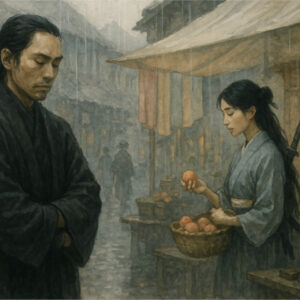
The Journey of Kenzo
The rain fell steady that morning, not in sheets but in a quiet, persistent drizzle that clung to the rooftops of the old city like thin silk. The stone paths glistened with moisture, reflecting the muted gray sky above. Master Kenzo walked these streets with his head bowed, his long coat wrapped tightly about him, as though the fabric might shield him from the weight he carried inside.
It had been three days since the match.
The contest had not gone as he had planned. In front of the gathered masters, elders, and onlookers, Kenzo had faced the challenge with the poise and precision he had cultivated for decades. Yet, the other master—older, surprisingly agile, and unorthodox—had unbalanced him, forced him into a defensive posture he could not reclaim. In the final moment, Kenzo had found himself disarmed, yielding with a respectful bow but burning with private shame. Not for losing—every master understands that defeat is a teacher—but for what the loss stirred within him.
Doubt.
For a man like Kenzo, who had built his life on discipline, structure, and honor, doubt was a dangerous seed. It whispered. It eroded. And now, as he wandered the market streets, it pressed heavily upon his chest.
He found himself in the silk district, where the stalls bloomed with vibrant colors and the scent of jasmine floated through the humid air. Normally, he would not come here—it was a place for traders, for women selecting fabrics, for merchants selling trinkets and fine teas—but today his feet had led him without conscious thought.
And then he saw her.
Rin.
She moved through the crowd like a ribbon of energy. Her steps were light, her posture calm yet alert. A small basket hung from her arm, filled with herbs and fresh fruits. She stopped briefly at a vendor, examining a cluster of wild mountain peaches. The merchant bowed deeply, almost reverently, as she made her selection. There was something in the way people regarded her—a mixture of respect and quiet awe—that Kenzo had not noticed before.
Of course he had heard of her. Everyone in their circles had heard of Rin, the young prodigy whose style blended tradition and fluid improvisation like no other. Whispers called her a genius, a rising master. Some older masters dismissed her as untested, her youth masking naivety. Others, in private, admitted her skill was beyond measure.
Kenzo had watched her from afar once or twice during demonstrations. But to seek her instruction? The thought would have been unthinkable.
Yet, here he stood. Watching.
And inside him, something shifted.
Rin turned, as if sensing his gaze. Their eyes met. Her expression held no arrogance, no false humility—only calm curiosity.
Kenzo stepped forward, his voice steady but low. “Master Rin.”
She inclined her head politely. “Master Kenzo. You honor me.”
For a brief moment, the drizzle softened, as though the rain itself paused to witness the exchange.
“I… would request a private audience,” Kenzo said, carefully measuring each word.
Rin gestured to a nearby tea house, small but warm, its lanterns glowing softly behind rice paper walls. “Shall we sit for tea?”
Inside, they sat across from one another at a low table. The tea was served without words by the keeper, leaving them alone in quiet company.
Kenzo breathed deeply. “I come to you… as a student.”
Rin’s brow arched gently, but she spoke with grace. “You are already a master. What can I offer you?”
“My discipline is strong,” he admitted. “My forms are precise. My mind is sharp. But… I have discovered gaps in my being. Openings I could not see before my recent… failure.”
Rin studied him, not judging. Only listening.
“I have heard of your methods,” Kenzo continued. “Of your approach. They say you walk a path both old and new.”
Rin nodded once. “Balance is not always found in rigid adherence, Master Kenzo. Sometimes it flows, like water choosing its way around stone.”
“It is difficult, for me,” he admitted. “In my tradition, it would be… unconventional to receive instruction from one so much younger.”
“And a woman,” Rin added, her voice without offense.
Kenzo lowered his eyes briefly. “Yes.”
Rin smiled softly. “Then let us not call it instruction. Let us call it… shared exploration.”
Kenzo allowed a small smile to appear. “That would ease my conscience.”
And so it began.
The first sessions were simple. Basic forms. Flow drills. Exchanges of movement in the courtyard of Rin’s private studio, where the polished stone reflected sky and blossom alike.
Kenzo moved like the mountain—solid, unmoving, powerful.
Rin moved like wind—light, swirling, unpredictable.
In the beginning, Kenzo easily blocked her strikes, anchoring himself in solid stance. But as days progressed, Rin introduced subtle shifts—misdirections, faint suggestions of one move while the true strike arrived from another angle. Her center was always low, yet her reach extended unexpectedly.
During sparring, Kenzo began to feel the edges of frustration. His strength and precision did not guarantee control. He found himself parrying at odd angles, stepping out of alignment to compensate for her fluid attacks.
“You resist water with stone,” Rin said one morning, as they paused beneath the shade of flowering trees. “But sometimes water seeps through the smallest crack and changes the shape of stone forever.”
He nodded, absorbing her meaning.
Over weeks, Kenzo softened his stiffness. His transitions grew lighter. His steps quieter. His breathing slowed. He was learning—not merely technique—but release.
And yet, during one particularly intense sparring match, his old instincts surged. He pushed harder, driving Rin back with powerful strikes, pressing her defenses to their limit. With a sudden pivot and sweep, he brought her to the mat, pinning her arm with practiced efficiency.
They froze for a moment. Both breathing hard.
Rin smiled up at him. “You found the opening.”
Kenzo released her arm immediately, bowing his head. “I did. But it was not easy.”
“That,” she said as she stood gracefully, “is why you must go to the mountain.”
“The mountain?”
“To Cool Bob.”
Kenzo’s expression grew cautious. He had heard tales of the mountain artisan—the reclusive master whose ways defied categorization. Some said he was a silverworker, others a mystic. But all agreed he was… different.
“I am not sure I am ready for mountain mystics,” Kenzo said, attempting mild humor.
Rin’s tone was gentle, but firm. “You have already crossed your first threshold, Master Kenzo. You came to me. You overcame hesitation and custom. The mountain is your next trial. If you permit, I will escort you there. But I will not remain.”
“You would leave me there?”
Rin nodded. “It is not my place to remain during your challenge. This journey must be yours.”
Kenzo was silent for a long moment. Then he bowed his head. “Very well.”
They departed at first light two days later.
The city vanished behind them as they journeyed north, where the hills grew steep and the air turned sharp with pine. The road was long, winding through high passes where hawks circled and rivers ran fast with snowmelt.
Along the way, Rin and Kenzo spoke little. She led confidently, her horse navigating narrow mountain trails with practiced ease. Kenzo followed, observing how comfortably she moved through wild terrain.
At night they camped beneath towering spruces. The stars spilled like diamonds across the black silk sky. Kenzo listened to the mountain’s breath—the wind whispering through needles, distant calls of elk echoing across valleys. This world was foreign to him, but its rhythm soothed something restless within his chest.
On the fourth day, they crested a ridge where a small plateau opened like a hidden sanctuary. There, built into the mountainside itself, was the studio of Cool Bob.
The structure was not grand, but it possessed a quiet dignity. Stone walls grown from the mountain’s flesh. Timber beams aged and weathered. A small forge sat to one side, smoke rising in a lazy column into the sky. The door stood open.
Rin dismounted and turned to Kenzo. “This is where I leave you.”
Kenzo nodded solemnly. “You have guided me far.”
Rin offered a final bow, then with a turn of her reins, disappeared back down the trail, her figure swallowed quickly by the forest.
Kenzo stood alone before the doorway. Taking a steadying breath, he stepped inside.
The interior was cool, lit by shafts of morning light that filtered through high windows. The scent of silver, smoke, and wild mint filled the air.
And there, standing before the forge, was Cool Bob.
He was exactly as the stories whispered—long hair pulled back, eyes sharp but kind, hands scarred from countless creations. A man both ancient and ageless, as though the mountain itself had lent him part of its spirit.
“You’re early,” Bob said, not looking up from the piece he was polishing.
Kenzo blinked. “I… am?”
Bob chuckled. “Everyone arrives early. Or late. The mountain doesn’t care about time the way we do.”
Kenzo bowed deeply. “Master Bob, I have come to seek—”
Bob raised a hand, waving the words aside. “Don’t call me master. Bob will do.”
“Yes… Bob.” Kenzo straightened. “I was told you might help me.”
“I don’t help,” Bob said, setting the silver piece down. “I observe. Sometimes I nudge. Sometimes I challenge.”
Kenzo exhaled slowly. “Then I am ready for whatever you offer.”
Bob studied him for a long moment, eyes narrowing slightly. “We’ll see.”
The days that followed were unlike any training Kenzo had known.
There were no formal lessons. No drills. No katas.
Instead, Bob set him to tasks that seemed meaningless at first—gathering specific herbs at dawn, carrying buckets of snowmelt up the rocky path, chopping wood precisely, polishing silver pieces with a careful hand.
“You learn with your body,” Bob said once as Kenzo strained under a heavy log. “But you also learn through the small things. Balance. Patience. Attention.”
In the evenings, they sparred.
Bob moved like no fighter Kenzo had faced. His strikes were subtle, unpredictable. Sometimes deliberate, other times playful. He would pause mid-strike to sip tea, then resume as if no time had passed.
Kenzo, forced to adapt, slowly let go of rigid patterns. He began to feel the rhythms of the mountain—the way the wind shifts suddenly, the way snow falls differently on north-facing slopes. His steps grew lighter, his counters more fluid.
And when frustration crept in, Bob would simply smile and say, “The mountain doesn’t care if you win today.”
Weeks passed.
Kenzo changed.
Not in ways the old masters would recognize. His strength remained, but it no longer ruled him. His precision was now tempered with adaptability. His breathing matched the rhythm of trees swaying under storm clouds.
One night, as the first snows of early winter began to fall, Kenzo sat beside the forge, sipping pine needle tea with Bob.
“You came here burdened,” Bob said softly. “With expectations. With rules.”
Kenzo nodded. “I did.”
“And now?”
Kenzo smiled faintly. “Now I carry only what I need.”
Bob leaned back, eyes twinkling. “That’s a good beginning.”
A silence settled between them, filled only by the crackle of the forge and the wind singing through distant cliffs.
Kenzo spoke again, his voice softer now. “I am grateful.”
Bob raised his cup in a quiet toast. “The mountain thanks you for listening.”
When Kenzo descended from the mountain weeks later, his steps were sure, his breath steady. He carried no trophies, no titles—only a simple silver band, gifted by Bob, engraved with a pattern that echoed the wind’s path through stone.
As he entered the lower villages, word of his return spread quickly. Old peers would watch him, curious. And though few spoke aloud, they saw the change.
He moved like a man who no longer feared defeat.
He had walked the path few dared tread—first humbling himself before Rin, then offering himself to the mountain.
And now, Kenzo was whole.
When Kenzo finally returned to the city, he made no grand announcement of his arrival. There was no need. The city, in its quiet way, had already begun whispering his name again. Rumors of his time on the mountain circulated among the schools and marketplaces. Some dismissed it as a temporary eccentricity. Others—especially the younger instructors and advanced students—spoke of it with growing curiosity.
But Kenzo was not concerned with what others whispered. He made his way back to Rin’s studio before stepping foot inside his own school.
The autumn air was crisp, the wind carrying the scent of turning leaves and distant rain. Rin stood in her courtyard beneath the familiar cherry tree, as though she had been expecting him all along.
She bowed deeply. “Master Kenzo.”
Kenzo returned the bow, though this time with less formality and more warmth. “Rin. I have come to thank you.”
Rin gestured for him to sit beneath the tree. “Tell me.”
Kenzo settled onto the bench, his movements relaxed yet grounded, like a branch swaying but never breaking. His gaze was steady as he began. “I sought you in desperation. I sought Bob in confusion. But both of you showed me that I was searching in the wrong place.”
He turned his wrist slightly, allowing the silver cuff from Bob to catch the morning light. “I no longer fear my weaknesses. I have embraced them.”
Rin smiled faintly. “The mountain has changed you.”
“No,” Kenzo corrected gently. “The mountain allowed me to change myself.”
They spoke for hours, as old friends rather than teacher and student. Kenzo shared stories of Bob’s peculiar lessons—the endless wood chopping, the quiet tea breaks in the middle of sparring, the strange philosophy of doing by not doing. Rin listened closely, her eyes glittering with knowing amusement at Bob’s methods.
“You are ready,” Rin said finally.
“Ready?” Kenzo asked.
“To return. To face what still remains.”
Kenzo exhaled softly. “Yes. I must.”
Back at his school, the familiar halls seemed both unchanged and entirely different. Students bowed respectfully. Fellow instructors watched with a mixture of curiosity and skepticism. Kenzo offered no explanations for his absence nor detailed accounts of his mountain retreat.
He resumed his place quietly, but his teaching methods were no longer the same.
The rigid drills he once demanded were replaced with flowing exercises, where students learned to feel the rhythm of their own movements, to listen to the air between strikes, to sense the tension beneath their opponents’ balance. Some students adapted quickly. Others resisted.
But something new was growing.
And then, as expected, the grandmasters summoned him.
The annual exhibition was approaching—an event where instructors demonstrated their skills before masters, students, and the public. It was not a competition in name, but every pairing was a silent test of one’s standing.
When Kenzo’s name was called alongside Master Hiroshi—the man who had bested him before—whispers rippled through the assembly.
This was what many had come to see.
The great hall was filled with silent anticipation as Kenzo and Hiroshi faced one another under banners that swayed like breath held in waiting. The polished floor reflected the glow of lanterns hanging high above.
They bowed, as tradition demanded.
Hiroshi’s voice was calm but edged. “You have returned different, Kenzo.”
Kenzo met his eyes. “I have.”
“Then let us see.”
The match began.
Hiroshi’s movements were sharp, precise—every strike a lesson in discipline. His attacks came swift and hard, a calculated offense designed to control the space and tempo.
Kenzo yielded—not in weakness, but in invitation. He moved like water around stone, letting Hiroshi’s strength pass through empty space. He redirected force with subtle shifts of weight, stepping where Hiroshi had struck just a breath before.
The first exchange ended with no points claimed.
The second exchange was faster, more aggressive. Hiroshi’s confidence grew. He pressed harder, feinting and attacking in combination. But each time Kenzo was where he was not expected to be, touching Hiroshi’s balance and guiding him off his line.
By the third exchange, the audience had grown utterly silent.
Hiroshi, breathing harder now, launched a decisive strike—a spinning cut meant to unbalance even the most seasoned opponent.
But Kenzo simply stepped beneath the arc, allowing Hiroshi’s momentum to carry him forward. As Hiroshi stumbled, Kenzo extended a single open palm, stopping his opponent’s chest with a feather-light touch.
The match was over.
Hiroshi froze, his balance broken, his defeat undeniable.
Kenzo held his hand there for a moment, then withdrew and bowed.
“I yield.”
Gasps rippled through the audience.
“You had the match,” Hiroshi said quietly.
Kenzo smiled gently. “Victory was not my purpose.”
Hiroshi stared at him for a long moment, then bowed deeply in return. “You have walked far, Kenzo.”
The grandmasters called the match complete. But the eyes of everyone present knew something profound had just shifted. The old order had been shaken, though Kenzo sought no title, no recognition.
In the days that followed, many students sought him out. Not for trophies or competition, but for understanding. He quietly gathered those who struggled as he once did—those bound by the need for rigid control, perfection, and fear of failure.
With them, Kenzo shared what he had learned—not only the forms of combat, but the deeper flow beneath them: humility, balance, and freedom.
He never spoke of victory. Only of harmony.
As for the council of grandmasters, they watched and whispered but took no action. For even the most tradition-bound elders could see that Kenzo’s influence was growing—not through defiance, but through quiet truth.
Weeks later, Kenzo once again found himself wandering through the city’s market district on a rare free morning.
The air was cool and sweet with the scent of autumn fruits. Silk banners fluttered above busy stalls. Merchants called their wares. Children darted between tables of spices and lacquered bowls.
And then, as though by design—or perhaps by fate—he saw them.
Rin and Fuji.
The two women were browsing a table filled with finely crafted jewelry and hand-carved boxes. They stood close, laughing easily together as they examined a small lacquer box with a gold crane painted on its lid.
Kenzo approached quietly, bowing with genuine warmth. “Masters.”
Fuji beamed at him. “Master Kenzo! What a pleasant surprise!”
“An unexpected meeting,” he replied softly. “Or perhaps the mountain arranged it.”
Rin smiled, her gaze steady. “You seem… lighter still.”
Kenzo chuckled gently. “I continue to carry less with each season.”
Fuji’s sharp eyes immediately caught the glint of silver on his wrist. “That cuff… is it one of Bob’s?”
Kenzo lifted his wrist slightly, allowing the sunlight to shimmer across the smooth silver. “It is.”
Fuji leaned closer, her voice tinged with awe. “You must tell us everything.”
And so, beneath a swaying silk canopy, the three found a quiet tea vendor. They sat at a small table, the steam of fresh jasmine tea curling into the air as Kenzo shared his story.
He spoke of Cool Bob’s studio carved into the mountain, of his first confused days hauling buckets of snowmelt and chopping wood. Of the strange sparring sessions where Bob would pause mid-strike to sip tea and speak of rivers and winds. Of how the mountain taught him not through force but through patience.
Rin listened with quiet pride, while Fuji leaned forward, absorbing every detail as though they were precious relics.
At last, Rin spoke softly. “You have found your path.”
“I am still walking it,” Kenzo said. “But yes. And now, I seek to help others who, like me, once struggled against their own walls.”
Fuji’s eyes sparkled.
Kenzo smiled knowingly. “The mountain finds those who are ready.”
As the sun began to dip behind the rooftops, painting the market in gold and amber light, the three continued sharing stories and laughter long into the afternoon. The crowd bustled around them, but their small circle remained peaceful and still—anchored in quiet friendship.
And far above, hidden among the windswept ridges of distant peaks, Cool Bob worked quietly at his forge, humming softly as silver flowed beneath his steady hands.
The mountain, as always, was watching.
Hiroshi – The Tea House and a Hidden Master
A Continuation
The tea house crouched in its narrow Tokyo alley like an old stone that had seen too many winters yet refused to crack. Steam rose lazy from simple porcelain cups, carrying the sharp green bite of sencha laced with something almost pine-like—reminding Fuji and Rin of ridges they’d once walked under a sky so wide it swallowed sound.
Hiroshi arrived like a storm dragged indoors on a leash. Pale as new snow, sweat beading cold along his temples, hands trembling so violently the cup clinked against its saucer like nervous bones rattling in a box. He was still wearing the invisible armor of decades in steel-and-glass towers—salaryman ghost, senpai-kohai shadow, man who had learned early that emotion was a liability best filed away.
Fuji tilted her head, voice soft but pointed. “You look like you’ve seen a bear in your boardroom.”
Hiroshi tried to speak. The words lodged—taboo, unthinkable, a betrayal of every rule etched into muscle memory: respect upward, restraint sideways, distance with women in power. To confess longing to Fuji and Rin—former corporate queens who had simply walked away—was to risk everything: face, harmony, the illusion of control. His pulse hammered loud enough to drown the soft clink of porcelain around him.
Rin read the fracture lines instantly. No judgment, only understanding. They guided him to the private booth without haste. Door slid shut. World muted.
Inside, bamboo screens turned light to gentle haze. The air smelled of aged cedar and tea leaves thick with quiet. Hiroshi sank to the cushion, knuckles white on the low table’s edge. His breathing stuttered.
Fuji poured tea with deliberate slowness, steam curling like smoke from a distant ridge fire. “Drink,” she said. “Even if it’s just to stop the rattle.”
He lifted the cup. Porcelain burned palms. Heat spread slow, almost painful, through his chest. Silence stretched—heavy, expectant.
Rin sat across, expression soft yet unflinching. “Hiroshi. We see you. Speak when the words allow it. This room holds no judgment.”
His gaze flickered between them—women he had known only through crisp boardroom exchanges, measured respect, unspoken rankings. Yet whispers had always trailed Fuji and Rin like elk tracks in fresh snow: undisputed masters of their corporate kingdoms who one day simply left—no scandal, no failure. Rumors circulated in hushed tones among former colleagues: in their search for something the towers could not feed, they had found a wild American mountain hermit in Colorado’s Rockies—towering, flannel-wrapped, wild-bearded Cool Bob—living carved into a ridge among weathered pines and storm-scarred stone. He forged silver not for shine or profit, but in humble, grinning dialogue with the land’s imperfect stories. “Organic Wabi-Sabi,” some said with raised brows. Now Fuji and Rin ran simple studios of their own, guiding only a handful of devoted students by rhythms no corporate ladder could dictate. To Hiroshi they were legends—proof that excellence could breathe outside the machine, mentored by untamed authenticity he secretly ached for.
Now, in this dim enclosure, the armor cracked. He bowed his head, forehead nearly brushing tatami, raw desperation in the gesture.
“Your freedom,” he whispered. “The way you exist beyond structure. Beyond expectation. I watched you leave what I still cling to. The stories of that American hermit—Cool Bob—the simple studios, the students you guide… they haunt me. You found something real there.”
Rin traced the rim of her cup. “Understand it… or live it?”
“Both.” The word escaped like a confession torn free. “I want to know if it’s possible. To remain myself… yet breathe differently.”
Fuji’s faint smile held no mockery. “You are brave to ask.”
Hiroshi sipped again. Warmth battled the cold knot in his gut. Then deeper truth spilled—halting, fractured.
“In Japan competition is precise. Clean. We rank. Promote. Respect is formal, controlled. Emotion stays hidden.” Throat tight. “But in America—six weeks only—I saw something else. Colleagues teased failures openly. Laughed at mistakes. Mocked, then lifted each other. Rivalry… alive. Playful. Encouraging. Not crushing.”
Fuji’s brows lifted. “A rivalry that honors growth yet keeps dignity?”
“Yes.” Voice cracked—relief and terror mingling. “It was beautiful. They awakened something—not ego, but life. I could never speak of it at home. To admit longing for openness… would mark me weak. Yet it haunts me.”
Rin leaned closer. “You glimpsed a path without shame.”
Hiroshi’s eyes shimmered, wet with unshed feeling. “I want to try it. Even in whispers. Here it feels impossible.”
Fuji’s voice softened to near-whisper. “You have begun. By trusting us. By speaking the unspeakable.”
Silence returned—thicker, charged. Hiroshi’s hands shook again—not fear alone, but the terrifying possibility of change laced with a strange, budding glee.
Fuji leaned in. “We can guide you. Not in public. Not yet. Here. With trust. With practice.”
Hiroshi bowed deeply, forehead to tatami. “I am willing.”
Rin met Fuji’s eyes in silent accord. “Then begin with patience. Observe. Reflect. True awakening demands readiness.”
Pulse steadied. Something sharper replaced dread: anticipation edged with mischief, like a magpie eyeing something shiny.
Fuji slid the card across—rough kraft paper, oddly warm as sun-baked stone. No name. No brand. Only a laser-etched QR code, precise and mysterious as a brand from the forge.
“If you wish,” she said, “return in one week. Or don’t. The ridge waits either way.”
Hiroshi stared. The card seemed to pulse in time with his heart.
The week became exquisite torment laced with forbidden glee. The card sat on his desk like a mischievous magpie, daring him. Instinct screamed no—culture, hierarchy, shame. Curiosity clawed deeper each day. On the final night, hands slick with sweat, he scanned it at 3:17 a.m.
The screen opened raw—no marketing funnel, no polish. Just poetry and photos: hammered .999 fine silver and proprietary Moonlight Silver capturing gnarled twigs, ancient arrowheads, storm-scarred bones—imperfect, luminous, alive with organic Wabi-Sabi. Myths spilled like pine resin: magpies stealing shards under full moon, dropping them into crucibles where sacrificial fire birthed new glow; Cool Bob grinning like ice in sunlight, saying neither yes nor no to Aurora-captured pendants; full-moon forges humming with pine smoke and the land’s quiet pulse. “The silver knows. I just help its echo find its way.”
Hiroshi laughed—actual, startled laughter that startled him more. A crazy wild mountain man in Colorado had bottled the soul of Japanese imperfection and hammered it into jewelry that laughed back at perfection. Confusion melted into wonder. This was freedom: playful, irreverent, alive.
He returned to the tea house, eyes bright with something new—raw amazement, almost disbelief.
“I explored it,” he began, voice trembling with wonder. “Cool Bob Studios… the humility, the embrace of broken things… it moved me. But how—how can this be? Wabi-sabi is ours—Zen gardens, tea bowls, mujō, the beauty in transience and flaw. Rooted in Kyoto temples, tea masters, centuries of quiet acceptance. Yet a wild mountain hermit in Colorado—endless ridges, snow, pine, no tatami, no scrolls—understands it so deeply? Imbues every piece with the same soul? He is not Japanese. He has never lived in our world. Yet his silver… it breathes the same quiet. Cracks twinkling like stolen moonlight. Flaws grinning like they know the joke. I am… amazed. Confused. How is this possible?”
Fuji chuckled low, warm. Rin leaned forward, steady.
“The spirit doesn’t need a passport,” Rin said. “Wabi-sabi is not geography. It is recognition: all things imperfect, impermanent, incomplete. Cool Bob didn’t study scrolls. He lived it in the Rockies. The land taught him—the weathered bone, the storm-broken twig, the fire that scars and purifies. He listened without ego. The silver answered. That is why we sought him. The philosophy found him, as it finds anyone ready to see.”
Hiroshi sat back. Breath caught. Confusion lingered, but wonder overtook it—a bridge across oceans, cultures, lives. “Then silver is not my path,” he said finally. “But something stirs.”
They waited.
Shame rose—hot, choking—then fell away like shed snow. “I am already a master. And I hide it.”
Fuji’s breath caught. “Sought after?”
A nod—small, trembling.
“Your craft?”
He summoned the waiter. Requested a Soto teacup.
It arrived. The room stilled. Glaze held subtle imperfections—cracks like lightning veins in mountain stone, form grounded yet alive, radiating restrained power in quiet Wabi-Sabi restraint. Fuji and Rin stared, transfixed—then burst into bright, belly-deep laughter.
“You sneaky fox!” Fuji said, wiping a tear. “All this time…”
Hiroshi’s cheeks burned, but a small, genuine smile flickered. “Soto. The ghost name.”
The next gathering unfolded in the main room. Sun slanted gold through paper screens. Hiroshi placed Soto teacups before Fuji and Rin. As they sipped—quiet, reverent—a cluster of sharp-suited executives drifted past.
One froze mid-stride. “Those… Soto teacups?”
Another whispered, stunned: “I’ve never seen more than one at a time.”
Longing rippled. “A week’s wage,” one breathed. “I would pay double—triple.”
Fuji and Rin’s laughter erupted again—pure, unstoppable, like wind through pines carrying magpie chatter.
Hiroshi felt it then: the weight of decades lifting. No more hiding. No more ghost. He rose slowly, deliberately. Set aside the salaryman mask like shedding a too-tight coat. Shoulders squared—not arrogance, but simple truth. Posture shifted; breath deepened. He bowed once—deep, respectful—then spoke clear as a hammer strike on silver.
“I am Hiroshi Soto,” he said calmly, voice carrying without effort. “The creator.”
The room stilled. Executives’ jaws dropped; bows faltered mid-motion before deep, reverent waves cascaded like falling leaves. The tea house owner, approaching quietly, froze—then bowed so low his forehead kissed tatami, awe etching every line of his face.
“Master Soto…”
In that instant Hiroshi fully became Soto. The mask dissolved. Secret mastery stepped into light—not with fanfare, but with the quiet certainty of clay that has finally found its form.
He reached into his bag and lifted one final piece: the Moonlit Soto—a single teacup whose glaze shimmered with a subtle, ethereal silver-gray iridescence, as if moonlight had seeped into the cracks and edges during firing, catching the light like Cool Bob’s proprietary Moonlight Silver. The patina danced across the imperfections, turning flaws into luminous stories.
Soto presented it directly to the tea house owner with both hands, bowing low. “This one is for you. For the house. A bridge between ridges and tatami.”
The owner’s hands trembled as he accepted it, eyes wide with reverence. “It… glows. Like captured moonlight.”
Soto inclined his head. “The clay listened to the same quiet the silver does.”
The owner bowed again, deeper. He placed the Moonlit Soto under a simple glass dome on the low table—now officially roped off as the “Soto table.” Beside it rested a plain notepad and pen, open for orders, questions, or quiet reflections from anyone who paused to look.
Orders followed—urgent, reverent. Sixteen names scrawled eagerly—some with shaking hands, others with wide grins.
The owner bowed once more, voice thick. “Master Soto… return weekly. Your table—roped off forever. Tea on the house. And this… this Moonlit Soto… it will stay here, under glass, for all to see. A reminder that beauty hides in the cracks, and sometimes winks back.”
Soto inclined his head. “Thank you.”
A small smile broke through—fragile at first, then luminous, the first unburdened breath in years. It carried the echo of a mountain hermit grinning at the moon.
Outside, sun dipped low, painting the reserved table gold. Fuji and Rin flanked him, grinning like magpies who’d just stolen the best secret.
“See?” Fuji said, nudging his shoulder. “The ridge echoes everywhere—even in teacups that shimmer like moonlight.”
Rin leaned in, playful. “Next time, bring one for Cool Bob. Tell him the clay listened too. Maybe he’ll trade you a twig ring that winks back.”
Soto laughed—free, light, the sound of a man who’d finally let his own echo find its way.
They walked into the evening together, footsteps unhurried. Behind them the tea house glowed softly, the roped-off table a quiet testament under its glass dome: hidden mastery revealed, wild philosophy without borders, a shimmering Moonlit Soto catching stray light, and the sheer fun of realizing imperfection isn’t a flaw—it’s the best damn story ever told.
A gentle wind stirred the alley, carrying faint pine and the distant chuckle of a ridge that had always known.
Yui and Yuuki – The Twin Strings That Bend
A Continuation
**The Ones Who Drifted Too Far Inward**
Master Kenzo did not notice Yui and Yuuki disappearing all at once.
It arrived in fragments.
A breath held too long.
A release too perfect.
A silence not peaceful—but sealed.
Their yumi work was beyond discipline. It was inevitable.
Arrows left the string already knowing their destination. No visible correction. No adjustment phase.
They did not practice. They executed.
Yet there was no joy. No spark. No frustration. No hunger.
Most unsettling: no separation.
They spoke little, yet were never out of sync.
They never looked at one another before acting, yet moved as one.
Kenzo tested it subtly. He dropped a small wooden dowel behind them during practice.
Before it struck the floor—both twins shifted. Not reacting. *Knowing*.
That was when he understood:
They were no longer two people practicing the same art.
They were a single awareness in two bodies.
And in that shared space, the rest of the world had dimmed.
“They are not failing,” Kenzo said quietly one evening, seated across from Rin and Fuji in a small tea house far from the city’s clamor. Steam rose untouched from his cup.
“They are… disappearing.”
Fuji watched the vapor curl.
“They’ve gone too far inward.”
Rin rested her fingers on the table, light as a blade’s edge.
“Then we don’t pull them back. We give them something that forces them outward.”
Kenzo looked between them.
“The mountain?” he asked.
Fuji’s mouth curved faintly.
“The mountain doesn’t force. It reflects.”
Rin’s eyes sharpened.
“And Bob… doesn’t explain.”
A small, knowing smirk.
“He interrupts.”
That was enough.
**Arrival: The First Disruption**
The mountain did not greet them. It simply continued.
Wind moved through the pines like breath. Cold air cut clean. The path narrowed until words felt superfluous.
By the time they reached the clearing, something had already begun to shift.
Bob stood outside the studio—exactly as expected, and entirely unpredictable.
Mason jar in hand. Ice drifting slowly through pine-needle tea.
He watched them approach. Not judging. Listening.
His gaze lingered on the twins longer than the others. Not curiosity—with recognition.
He nodded once.
Then bent, picked up two rough sticks from a wood pile.
Walked over.
Placed one in Yui’s hand. One in Yuuki’s.
“That’ll do.”
They looked at the sticks. Then at him.
Bob jerked his chin toward the forest.
“Go hit something in the woods.”
He turned away.
**The Long Silence Before Life Returns**
The forest absorbed them. Light dimmed. Sound softened.
They stood—two masters of refined form—holding crude sticks like novices who had forgotten everything.
No stance. No lines. No expectation. Just space.
Fifteen minutes. Thirty. An hour.
Stillness.
Rin watched from the clearing’s edge.
“They’re waiting.”
Kenzo folded his arms.
“For instruction.”
Fuji shook her head.
“For permission.”
Bob took a long drink. Ice clinked.
“They’ll get bored first.”
**The First Crack in the Wall**
Yui moved—barely. Adjusted her grip. Tapped a stone.
Tap.
Nothing.
Again. Tap.
Yuuki felt it. Turned slightly.
Yui struck harder.
Crack. The stone shifted.
Yuuki stepped forward. Struck the same stone—harder.
It split.
Both froze.
That moment—simple, physical, undeniable—cut through the hollow perfection.
No form. Just contact.
**The Return of Energy**
The change ignited.
Yui turned and struck a branch. Yuuki hit a trunk. Not elegantly. Just honestly.
It escalated. They moved through the trees—striking rocks, bushes, trunks—testing resistance, sound, force.
A branch snapped. Leaves scattered.
Yui laughed—real, unfiltered.
Yuuki answered.
The forest echoed with it.
Soon they circled each other—striking, dodging, reacting—instinct flooding back where discipline had carved everything smooth.
Yui tapped Yuuki lightly across the shoulder.
Yuuki paused. Then struck back. Harder.
They were no longer one sealed awareness.
They were two—alive, separate, connected.
By sunset they returned—breathing hard, dust-streaked, pine needles in their hair.
Alive.
Bob didn’t ask questions. Didn’t correct.
He nodded once.
“Alright,” he said.
“Now we can start.”
**The Ribbon and the Ink — Unannounced**
That night, while the others slept, Fuji rose without sound.
No words. No warning.
She moved through the studio like mist.
Brush. Ink. The same shallow dish.
She took the twins’ yumi first—already marked earlier in the day—and added one more unseen stroke across each limb, so faint it would only be felt, never seen.
Then she prepared something new.
Two lengths of plain ribbon, cut while the fire crackled low.
She wrote on them in silence, each character drawn with breath held, responsive, listening.
No ceremony. No explanation that might startle the twins’ still-fragile outward turn.
When the ink dried, she tied one ribbon around each of their sleeping bows—high on the grip, where fingers would rest without noticing the addition.
The second ribbon she kept for herself, binding it around her brow as before.
Rin stirred once but said nothing.
Bob, across the room, simply watched the shadows move.
He gave the smallest nod.
Nothing was announced.
Nothing was explained.
The twins slept through it all, undisturbed.
**The Encounter: When Play Ends**
The next day began too calmly.
Gear adjusted. Bows in hand. Breath steady.
Then the wind stopped.
Not slowed. Stopped.
Mist rolled in—fast, cold, unnatural.
Three distortions formed in the fog.
Kenzo moved first—no hesitation. The silver cuff on his wrist caught light. He struck.
Solid. The distortion recoiled.
Bob’s voice: “That’s it! Stay in it!”
Kenzo held ground—longer than before—but the third movement threw him hard.
Fuji stepped in front of Bob without pause.
The ribbon at her brow gleamed.
She met the strike—not with force, but redirection. Energy slid past her.
She glanced back at Bob. Small smile.
“You might be getting slow.”
Bob grinned.
“Or you’re getting faster.”
Rin moved like drawn breath. Katana appeared—silver tsuba flashing.
One clean motion. One distortion vanished.
The remaining two slipped deeper into mist.
Bob’s voice cut through: “Twins! Silver broadheads!”
They nocked. Locked.
“Can’t see them!” Yui called.
Bob didn’t hesitate.
“Then don’t look. Become one. Close your eyes. Shoot from your mind.”
They did.
Breath aligned. Thought aligned. World fell away.
Release—at the exact instant.
The mist shattered. Both targets destroyed.
Silence returned—not empty, but full.
Kenzo rose slowly. Looked at his cuff. Then at Bob.
A small nod passed between them.
Fuji adjusted her headband. Rin sheathed her blade. The twins lowered their bows.
Something had shifted. Not just in them—in all of them.
And somewhere—beyond the ridge—something felt it.
Felt them.
For the first time in centuries, it was afraid.
**Later That Day: The Compound Bow**
Later that same afternoon, Bob returned carrying two compound bows.
They looked wrong the instant they crossed the tree line.
Too precise. Too engineered. Too *certain*.
The aluminum risers gleamed like cold bone.
Cams and cables imposed tension instead of earning it.
No breath. No memory. No soul of the yumi.
Kenzo’s reaction was instant and visceral.
He rose so sharply the bench scraped behind him.
“No.”
The word tore out of him like a wound reopening.
“No—this is not training. This is not the way. This is—”
His voice cracked. The hand at his side clenched until the knuckles blanched white.
“This is *sacrilege*.”
The accusation landed like a stone in deep water.
Ripples moved outward—through the grass, through the twins, through the mountain itself.
Kenzo stepped forward, eyes burning.
“This discipline has survived centuries of war, of fire, of forgetting. It is not improved by machines. These things—” he jabbed a finger at the bows as though they were poisoned “—steal the awareness. They steal the correction. They steal the long, painful becoming.”
His chest heaved.
“They steal the soul.”
He turned away, unable to look at them any longer.
Bob said nothing.
He simply stood, holding the bows, as if the outrage belonged to the wind.
The twins—now alive, outward, the unannounced ribbons resting unseen beneath their fingers—watched the bows with quiet recognition. Not hunger. Not relief. Just *knowing*.
Fuji stepped forward without a word.
But Kenzo was not finished.
He paced. He muttered under his breath—old prayers, old oaths.
His hands trembled with the weight of centuries pressing down on him.
Yet as the twins raised the strange bows, as the first shots flew clean and immediate to impossible distances, something in Kenzo cracked wider.
He watched them—alive, joyful, unified—and felt the old path tremble beneath his feet.
After the tenth perfect shot, Kenzo stopped pacing.
He stared at the second compound bow still in Bob’s hands.
Then, voice rough and reluctant:
“…Let me try.”
Bob handed it over without comment.
Kenzo took it like it burned him.
Grip awkward. Shoulders tight. Jaw locked.
He drew.
The let-off felt like betrayal.
The release came too fast—sharp, merciless.
The arrow flew.
It struck true.
Again.
And again.
Each shot landed cleaner than the last.
Kenzo lowered the bow slowly.
His face was pale.
His breathing unsteady.
He did not speak for a long time.
When he finally did, the
words came quiet, almost ashamed.
“It… works.”
He looked at the compound bow in his hands as though it were both savior and traitor.
“I hate that it works.”
A long silence.
Then, softer:
“But I accept it.”
Not with peace.
Not with joy.
With unease—deep, abiding unease.
As though he had just bent something ancient that had never been meant to bend.
And somewhere beyond the ridge, the mountain itself felt the shift.
The old guardian—the “it” that had known the twins before the yumi had a name—recoiled.
Tradition had not broken.
The twin strings had simply… bent.
And in that bending, something ancient looked at what the twins had become and, for the first time in a thousand years, knew fear.
**After the Mountain: Return to the School**
After the mountain’s lessons had settled into their bones, they returned to the school.
The journey down was quiet—not the sealed silence of before, but a shared, breathing one.
The twins walked side by side, steps light, eyes bright.
The unannounced ribbons rested on their grips like quiet promises—responsive, listening.
The dojo welcomed them without fanfare.
Students paused mid-draw.
Masters turned slowly.
Even the wooden floorboards seemed to creak with awareness.
Yui and Yuuki stepped to the line.
First the yumi—elegant, inevitable, the long asymmetric curve rising like an old friend.
Arrows flew in perfect tandem, striking distant mato with the soft, soulful *thunk* of centuries.
Then, without pause, they switched to the compound bows Bob had carried down.
The mechanical click of cams.
The flatter, faster flight.
The same impossible precision—yet now carrying the living awareness the yumi had awakened in them.
Back and forth they went, seamless, effortless.
Yumi: meditative, breathing, poetic.
Compound: immediate, certain, merciless.
Each tool revealed the same truth—the intent never changed.
The school’s reaction did not come in cheers. It came in ripples.
Whispers spread like wind through bamboo.
A senior master’s brow furrowed; his fingers tightened on his own yumi as though it might betray him.
Younger students leaned forward, eyes wide, some clutching their bows like children seeing magic for the first time.
One girl in the back row actually dropped her arrow.
At the rear of the hall stood Haruto—a quiet 16-year-old second-year student who had trained here since he was fourteen.
To everyone else he was diligent, correct, respectful.
To himself he was failing.
*They move like the mountain itself is guiding them,* he thought, chest tight.
*My shots are perfect on paper. Same stance. Same breath. Same release. But they feel… dead. Like the twins used to look before they left.*
He remembered the day the twins had departed—hollow, sealed, untouchable.
Now they radiated something alive.
Haruto’s throat ached with envy and hope at the same time.
*If even the compound bow can carry the spirit… maybe I’m not broken. Maybe I just never bent.*
The twins lowered both bows and turned—not toward the masters, not toward the seniors—but straight to him.
Yui’s voice was soft, almost private.
“Haruto.”
Yuuki simply nodded once, the same small tilt they had shared since childhood.
No announcement. No spectacle.
They walked over as though this had always been the plan.
“Come,” Yui said. “Try with us.”
Haruto’s hands shook as he stepped forward.
The whole dojo watched in silence.
First they handed him his own yumi.
Yui adjusted nothing about his form. Instead she placed two fingers lightly on his wrist.
“Feel it before the draw,” she whispered. “The awareness is already there. The string only listens.”
He drew.
The arrow flew—cleaner than any he had ever shot.
A small spark of warmth bloomed in his chest.
Then Yuuki offered one of the compound bows.
“Same awareness,” he said. “Different language. Let it speak.”
Haruto hesitated—then drew.
The let-off felt like falling, but the ribbon under his fingers (unnoticed until that moment) seemed to steady him.
The arrow snapped forward and struck the same center.
He laughed—short, startled, real.
For the first time in two years, the shot felt *his*.
The twins smiled, small and knowing.
“You carry both now,” Yui said gently. “The string bends. You don’t have to break.”
Yuuki added, even quieter:
“The mountain showed us. Now we show you.”
Haruto bowed—deep, grateful, eyes shining.
When he rose, the hollow place inside him was gone.
Kenzo watched from the far end of the hall, arms folded, face still carrying the shadow of unease.
He said nothing.
But when Haruto turned back to the line—now switching between his yumi and the spare compound with growing confidence—Kenzo’s shoulders lowered another fraction.
The dojo exhaled.
Students began to move again.
Whispers turned to quiet questions.
A few of the younger ones drifted toward the twins, shy but hopeful.
Even the stern senior master loosened his grip on his bow.
The school had not changed its forms.
It had simply… bent.
And in that bending, something ancient—the guardian that had once feared the twins—now watched an entire dojo begin to wake up.
The twin strings had not only bent for themselves.
They had opened the way for everyone else.
Sissy – The Boutique and the Red Thread That Never Snapped
A Continuation
The Ginza boutique existed in a hush so profound it felt like stepping into an old mountain shrine disguised as commerce. Cedar shelves absorbed light rather than reflected it; single silver pieces rested on black lacquer stands like solitary monks in meditation. No price tags shouted. No eager voices pressed. The air carried only the faint scent of polished wood, distant incense, and the metallic whisper of things that had been forged with intention rather than haste.
Fuji entered carrying her small cedar box—plain, unadorned, yet heavy with the weight of recent work from the shrine forge. Inside lay the newest offerings: a wide cuff hammered thin then folded like wind caught mid-turn through pine branches, its edges left deliberately uneven as if the metal itself had decided perfection was a lie; a leaf pendant whose surface bore the faint scars of fire and quench, edges proud and unpolished, catching stray moonlight in soft, shifting prisms that seemed to breathe. She set the box down with the quiet reverence one reserves for sacred things. The owner—a small, silver-haired woman who moved like water over stone—bowed once, deeply, and accepted the pieces without a single question. Words were unnecessary here.
Fuji turned to leave, already feeling the pull of the mountain road home, when the atmosphere thickened.
Across the long, narrow room, near a display of moon-pale rings, a tall figure stood motionless. Pale skin like fresh cream poured over porcelain. Hair the exact color of living flame—impossibly red, impossibly long—braided into a single thick rope that reached her ankles and swayed with the slow gravity of a pendulum. Tiny hammered bands of gold and silver had been woven into the braid at irregular intervals, each one catching the low light and throwing it back in tiny, living sparks. The woman’s fingers traced the curve of a silver leaf pendant on display—exactly the kind Bob had once poured under northern aurora, the kind that carried storm-cloud iridescence in its depths.
Sissy.
The name rose in Fuji’s chest like a hammer striking hot silver—sharp, ringing, undeniable.
Sissy turned. Green eyes the color of high alpine lakes after rain met Fuji’s brown ones. Time folded. The boutique vanished. The glass towers of their shared corporate past, the endless spreadsheets, the clipped voices in boardrooms, the silence that had stretched between them for years—all of it collapsed inward like a mold cracking open after a perfect pour.
They moved at the same instant. Three strides each. Arms locked around each other with the force of years held back. The long red braid spilled over Fuji’s shoulder like molten copper. Silver clinked wildly against silver—cuffs, rings, pendants singing in chaotic harmony. The owner stepped quietly behind a lacquered screen, granting them privacy older than any sale she had ever witnessed.
They held on for what felt like minutes that could have been hours. Breath ragged. Hearts hammering in unison. No tears yet. Only the raw certainty that something believed lost had returned.
Later—much later—they sat in a narrow, hidden izakaya down a lantern-lit alley. Steam curled from bowls of soba like smoke from a low forge. The lanterns cast warm gold across their faces. The world outside continued its neon pulse, but inside this small room time moved differently.
Sissy’s voice came low, almost shattered. “You disappeared, Fuji. One morning the corner office was dark. Your desk empty. No email. No note. Nothing. I searched every quiet channel I knew—old contacts, back channels, even the ones the clan taught me to use without leaving traces. Weeks turned to months. I thought the city had swallowed you. Or worse—that you had chosen to vanish because staying hurt too much.”
Fuji stared into her tea, steam rising like mountain mist. She had never known the scale of the wound. In the Rockies she had assumed Sissy—always the stronger, the shadow-trained survivor—had simply adapted, moved forward, found new rhythms in the life they had both quietly despised. She had carried the mountain’s silence like a shield, believing her friend was safe within the familiar hardness of glass and steel.
Sissy continued, words slow and deliberate, as if each one had to be shaped before release.
“When you were gone, something in me broke that no blade or training could repair. I quit the corporate world the same week your absence became permanent. I couldn’t sit in those glass boxes anymore, pretending numbers mattered more than breath. I traveled alone—Kyoto’s narrow alleys at dawn, Hokkaido’s snow-heavy forests, forgotten mountain villages where old women still hammered copper by hand. I bought every piece of wild silver I could find that carried even a whisper of your spirit: imperfect edges, fire marks left proud, no maker’s stamp, just the honest refusal to be tamed. I carried them like breadcrumbs, like proof you had existed.
“In borrowed workshops I hammered my own grief into metal. Hands bled. Calluses formed. Split again. The braid grew longer because every time I thought of cutting it, it felt like severing the last living thread to you—the friend who once laughed so hard at my deadpan salaryman impression that green tea sprayed across the conference table and soaked my blouse. I kept that stained blouse wrapped in silk, wore your old scarf like hidden armor under my coat. Nights I sat on tatami floors in rented rooms, holding the flawed river-pearl pendant from the tea-house fight—the one you clasped around my neck after the blades stopped—and whispered to it like a prayer: ‘Come back. Just come back. I can’t do this alone.’”
The loss had hollowed her in ways the clan’s strict codes could never have prepared her for. They had trained her to endure physical pain, betrayal, silence—but not the slow, quiet death of the only person who had ever looked past the red hair, the pale skin, the half-breed shadow, and seen simply Sissy. The friend who had made her feel human instead of obligation. She had believed Fuji dead. Or broken beyond return by the machine that had nearly crushed them both.
Fuji reached across the low table, sun-browned fingers covering Sissy’s pale ones. “I never knew how deep it cut. The mountain took everything—every deadline, every mask, every piece of the old life. I thought you were still there, still strong, still moving through the world the way you always did. I thought you were safe.”
Sissy’s green eyes shimmered but held. “We were never safe apart. Not really.”
They sat until the soba bowls were cold and the lanterns burned low. Outside, the city continued its restless hum. Inside, something older than either of them began to mend.
The Clan Shadow and the Longest Night in the Tea House
Sissy’s existence had been carved from shadow and obligation from the moment she drew breath after the alley.
Her American parents—gentle, laughing teachers who had come to Kyoto to share language and light—died in a Yakuza crossfire never intended for them. A debt owed to someone else. A stray bullet in a narrow street. The clan took the infant not from affection but from the iron logic of honor: blood spilled demands blood cared for. Uncle Taro—the same gray-haired shadow who would one day halt a blade with a single raised hand—carried her from that rain-slick stone, wrapped in his coat, her tiny cries muffled against his chest.
They raised her in rooms thick with incense, tatami worn smooth by generations of quiet footsteps, walls lined with blades and ledgers. Breakfast was kata practice before dawn. Lunch was etiquette drilled until every bow was perfect, every glance measured. Dinner was silence unless spoken to. They named her Shizuka—quiet one—because even as a child her presence demanded stillness. When her hair grew long and erupted in fierce, unmistakable red, someone in a smoke-filled back room muttered “Sissy” in rough English. The name stuck like a burr. She kept it. Defiantly. It was the one thing that belonged to her alone.
They taught her everything the life required: reading intent in the smallest flicker of an eye, moving without sound across creaking floors, appraising gold by weight on the tongue and silver by the way it caught moonlight. They taught her blades—tanto, wakizashi, hidden edges in sleeves. They taught her silence as weapon and shield. But never the full ink. Never the oath that bound the others. “You are the debt repaid,” the elders told her in voices like dry leaves. “Not the sword that collects. You walk beside us, never within.”
Silver and gold became her private rebellion. She learned them in stolen hours—secret workshops lit by single lanterns, borrowed tools, metal that answered her touch when words failed. Jewelry became her exit route, her quiet defiance. Beauty forged without blood. The clan allowed it because a beautiful piece could hide a blade better than steel ever could.
In the corporate years she found Fuji—two women pretending the glass towers and quarterly reports could contain what burned inside them. Late nights on high-rise balconies overlooking neon rivers, sharing sake from paper cups. Sissy teaching Fuji to feel the memory locked in metal—how silver remembered every fire it had known. Fuji teaching Sissy that laughter was still possible, that softness could survive even in hardness. They were each other’s secret refuge: proof that humanity could endure the machine.
Then the tea house.
Plum-rain night. Humidity thick as regret. Low cedar beams. Lanterns bleeding warm gold across worn tatami. The scent of wet stone and green tea.
Sissy had just placed her first creation on the low table between them: a delicate loop of hair-fine silver wire, twisted like wind refusing to be tamed, cradling a single flawed river pearl—gray, irregular, faintly
iridescent, found in the Kamo after a storm. “I didn’t plan it,” she said softly. “The wire kept breaking until I stopped fighting it. The pearl looked lonely.”
Three enforcers entered without knocking. Black suits. White shirts. Tattoos peeking at cuffs like hidden rivers. The leader—scar slicing his left eyebrow—locked eyes on Sissy. Recognition. Contempt.
“Still playing with children’s toys, half-breed?” he said in flat Kansai dialect. “The family grows tired of your little games.”
He stepped forward. Reached for the ankle-length braid pooled on the tatami like spilled fire.
Sissy uncoiled.
She rose in one fluid breath—wrist caught in mid-reach, twisted until bone creaked but did not break. Low sweep—foot hooking ankle while open palm drove upward into solar plexus. The man grunted, staggered backward into a lacquered table. Teacups exploded. Matcha sprayed across the floor like green blood.
The second enforcer lunged—fingers curled for her throat. Sissy sidestepped, redirected his momentum with a hip turn, sent him crashing into the third. Bodies collided. Wood cracked. Lanterns swung wildly, shadows dancing like panicked spirits.
Fuji was already rising—corporate calm transformed into lethal focus. She blocked a wild punch meant for Sissy’s head, took the impact on her forearm with a sharp hiss of pain, countered with an elbow to the throat. The man choked, staggered.
Scar-brow recovered. Rage boiled over. He drew the tanto—short, black-lacquered hilt, blade glinting wet in lantern light. The arc came fast, aimed low at Sissy’s side.
Memory slammed into her: the alley, rain, the wet sound of a bullet finding her parents, the sudden silence after laughter.
She spun inside the blade’s path—too close, breath mingling with his—forearm deflecting steel with bone-jarring force while her other hand drove upward under the chin. Head snapped back. Blood trickled from his split lip. He swung again—wilder now. Sissy ducked, rolled across tatami, came up with a low kick that caught his knee. He dropped.
The third enforcer pulled a short steel baton from his sleeve. It whistled through air. Sissy took the blow on her shoulder—pain blooming white-hot—rolled again, swept his legs from under him. He crashed through a paper screen, tearing it like thunder.
Fuji blocked another strike aimed at Sissy’s back, drove a knee into the attacker’s midsection. Breath exploded from the man. He doubled over. She followed with a precise palm-heel to the nose—cartilage crunched. Blood sprayed.
The fight stretched—furious, contained, no guns drawn yet because honor’s thin line still held in this place. Tables overturned. Lanterns swung. Breath came in ragged gasps. Sissy’s braid whipped like living flame, rings chiming wildly. The silver pendant remained clutched in Fuji’s fist—refusing to fall, refusing to be forgotten.
Then—from the deepest shadow at the engawa—Uncle Taro materialized.
Gray hair cropped short. Simple black cotton. Face lined like hammered metal left to weather. No weapon visible. Only presence—vast, quiet, inevitable.
One open hand rose.
“Enough.”
The room froze. Scar-brow’s tanto trembled mid-air, then lowered. The others straightened slowly, breath heaving. They bowed—stiff, furious, obedient—and retreated backward into the rain without another word.
Taro stepped forward. Looked first at Sissy—green eyes meeting his dark ones—then at Fuji.
“You were watched,” he said quietly, voice like gravel over stone. “Always. But never interfered with. Until tonight.”
To Sissy: “Your work has spirit. Keep making it. The silver remembers what we forget.”
To Fuji: “Guard her. She guards nothing for herself.”
He paused at the engawa’s edge, rain drumming soft behind him. “The clan releases her to you. She was never ours to keep.”
He stepped into the night. The rain swallowed him whole.
Fuji—bruised, breathing hard—placed the flawed river-pearl pendant around Sissy’s neck. Fingers steady despite the pain in her arm. “Your first piece. It fought for you tonight.”
Sissy touched the pearl. Warm against skin. Alive.
The Oath at the Shrine Forge
Back at the mountain shrine, the forge fire had burned low to glowing coals. Frost rimmed the cedar eaves like silver filigree. Pine smoke drifted upward in slow spirals. The night was so quiet they could hear the distant trickle of snowmelt carving stone.
Sissy’s braid lay uncoiled between them on the engawa like a living bridge of flame and metal. The quantum bangles on their wrists hummed faintly—almost inaudible, like a heartbeat remembered across oceans.
Fuji spoke first, voice low and steady.
“I never knew how deep the wound went. I carried the mountain’s silence like armor. Thought you were still moving through the world the way you always did—strong, untouchable. I never saw the emptiness I left behind. Never understood how much it carved you out.”
Sissy took Fuji’s hands—pale fingers against sun-browned, callused ones. She held them tightly, as if afraid the moment might dissolve.
“Not lovers,” she said softly. “We were never that. The world tried to make us rivals or strangers or tools. But we refused. More than sisters. Blood never bound us. Silver did. Mountains did. Shared laughter in high places did. The way you saw me—not as debt, not as half-anything, just as Sissy.”
She drew a slow breath, pine smoke filling her lungs.
“From this night forward, we do not part. If one mountain calls, both answer. If one forge cools, the other keeps the coals alive. If shadows come again—clan or city or stranger—we face them together. No more vanishing. No more silence between us.”
Fuji’s eyes never left Sissy’s. Her voice carried the same certainty as a hammer striking true.
“We swear it on the silver that remembers every fire. On the pearl that survived its own flaws. On the red thread that stretched across years and oceans and never snapped. We are each other’s home now. Wherever the work takes us—here, there, across the long-distance wave—we go together.”
They pressed foreheads together. Breath mingled with pine smoke and forge heat. The quantum bangles chimed once—soft, clear, resonant—as if the metal itself had witnessed the words and sealed them.
The coals popped once. A single spark rose, bright against the dark, and drifted upward like a small red star.
The Uncle’s Final Passing
Three nights later, under a thin crescent moon that looked like the first cut of a silver sheet, a shadow moved at the torii gate.
Uncle Taro stepped into the firelight—same simple black cotton, same lined face carved from years and mountain stone. He carried only a small cloth-wrapped bundle tied with faded silk cord.
The villagers had long since departed, leaving their quiet offerings—daikon, umeshu, a child’s drawing of two women at a forge with a red river flowing between them. Only Fuji and Sissy remained, seated by the low hearth, coals still warm.
Taro bowed once—deep, formal, the bow of one who had carried debts his entire life.
He looked at Sissy with eyes that had first seen her as a bloodied infant wrapped in his coat.
“I come to pass you fully,” he said. Voice quiet but carrying across the night like a struck bell. “The clan’s debt is paid in full. You were never meant for our shadows. You were meant for light—for fire—for this.” He gestured slowly to the forge, the waiting moonlight-silver ingot still glowing faintly on the workbench, the two women seated side by side like roots of the same ancient tree.
He placed the bundle in Sissy’s hands.
Inside: an old tanto—blade darkened with age, hilt wrapped in faded red silk, the same silk her mother had once worn in a photograph Sissy kept hidden. And a single folded note in Taro’s careful hand:
*If the mountains ever need an old shadow, send word. One word only. I will come.*
He met Fuji’s eyes next—measured, approving.
“You guard her better than we ever could. She has chosen her family. Honor that choice.”
Sissy’s green eyes filled, but the tears did not fall. She bowed—deep, from the waist, the way she had been taught in rooms thick with obligation.
“Thank you, Uncle. For carrying me then. For releasing me now.”
Taro’s mouth twitched—the closest he ever came to a smile.
“The red hair always was too bright for our alleys. It belongs here—among flame and silver and open sky.”
He turned without another word. Stepped past the torii gate. The mountain night swallowed him as completely as it had swallowed countless secrets before.
Sissy and Fuji remained seated long after the coals had settled to faint red glow. The ingot waited on the workbench—prismatic, patient, alive with stories yet unborn.
Two women. Two bangles. Two forges now bound by oath and silver and red thread.
The Wave That Carries No Sound
A week slipped by in the mountain’s quiet rhythm—forge coals tended at dawn, silver annealed under moonlight, meals shared on the engawa with only the wind and distant temple bells for company. Sissy’s braid, still threaded with the old gold and silver bands from her clan days, now carried new additions: tiny hammered crescents Fuji had shaped while they talked until the stars faded. The flawed river-pearl pendant never left her throat; it warmed against her skin like a second heartbeat.
One frost-clear morning, as pine needles glittered like scattered solder on the path, Sissy sat cross-legged beside the low workbench, fingers tracing the faint hum of the quantum bangle on her wrist. The metal felt alive—cool yet pulsing, tuned to something deeper than blood or breath.
“Fuji,” she said, voice soft as the first hammer strike on cold silver. “I need to speak with Cool Bob.”
Fuji looked up from the ingot she was planishing, hammer paused mid-air. Sunlight caught the sweat on her brow, turned it to liquid light. “Of course. When would you like to travel to his
mountain?”
Sissy shook her head slowly, red strands shifting like slow fire. “Not travel. Not the long way. The wave. The bangle. If it’s possible… I want to use it.”
Fuji set the hammer down with deliberate care. She studied her friend’s face—green eyes steady, freckles sharp against pale skin, the braid coiled beside her like a guardian serpent. No fear. Only certainty.
Fuji rose, crossed to the cedar chest beneath the eaves, and returned with the pair of bangles. They rested in her palms like twin moons—smooth, unadorned, yet humming with that impossible low frequency that made the air feel thicker.
“They’re synced,” Fuji said quietly. “Always have been. But if you go alone—”
“I need to go alone.” Sissy’s fingers closed around one bangle. “This conversation… it’s mine to carry first. Just me and him. No shadows between us.”
Fuji searched her eyes for a long moment. Then nodded once—sharp, accepting. “I thought I was preparing you. But you’ve already decided.”
Sissy slipped the second bangle onto her other wrist. They chimed together—soft, resonant, final. She stood. The red braid uncoiled fully, pooling at her bare feet like spilled lava. She pressed her forehead to Fuji’s for three steady breaths.
“Wait for me,” she whispered.
Before Fuji could answer, Sissy closed her eyes. The air around her shimmered—once, like heat rising from coals—and she was gone. No flash. No sound. Only the sudden absence of her warmth, the faint metallic tang left hanging in the frost.
Sissy had trained in shadows all her life: moving unseen through Kyoto alleys, slipping past watchful eyes in corporate high-rises, melting into doorways when blades whispered. She intended to arrive quietly—observe first, perhaps watch Cool Bob at his workbench under that wide Colorado sky, sketchbook open, iced tea sweating beside him. A shadow’s courtesy. A test of the wave’s silence.
She materialized on the edge of his mountain clearing—pine scent sharp, air dry and high, sun low and golden. The cabin sat sturdy against spruce and rock, smoke curling lazy from the chimney. No movement at first.
Then a low chuckle from behind her.
“Thought you might try the sneak approach. Old habits.”
Sissy spun—fluid, silent—but Cool Bob was already there, leaning against a weathered post with arms folded, grin easy under the brim of his worn hat. Flannel shirt rolled to elbows, pencil tucked behind one ear, the faint scent of graphite and cedar on him. He hadn’t moved. He’d simply been waiting.
Her green eyes narrowed, half amusement, half respect. “You felt the wave before I did.”
“Hard not to when it’s tuned to someone like you.” He gestured toward two Adirondack chairs facing the view—mountains rolling blue into forever, a hawk turning slow circles overhead. “Sit. Tea’s fresh. No rush.”
They talked for hours.
First the bangle—how it had answered her the moment she claimed it, no ritual, no forcing. Just recognition. Like silver remembering its own fire.
Then silver and gold. Sissy spoke of the pieces she’d forged in borrowed workshops, grief-shaped, imperfect on purpose. How metal listened when people wouldn’t. How she’d poured loss into cuffs and chains until the weight felt bearable.
Bob listened—really listened—nodding slow, asking questions that cut clean to the core without wounding. He spoke of waves that carried memory across distances no plane could touch, of metals that sang when struck true, of the difference between teaching skill and simply witnessing mastery already there.
As the sun dipped behind the ridge, painting the snow gold, he leaned forward, elbows on knees.
“I could try to be your teacher,” he said quietly. “But it would be dishonest. Your hands already know what most spend lifetimes chasing. The fire in you isn’t borrowed—it’s yours. Impressive doesn’t cover it.”
Sissy touched the bangle—warm now, settled.
“And the wave?”
“Locked to you,” he answered. “It matched your frequency the first time you wore it. Natural resonance. No forcing needed. But if you want something steadier—something you can carry without the full cuff, something that tunes with intent rather than just presence…” He reached into his pocket, drew out a small silver ring. Plain band, yet etched inside with the faintest spiral—like a wave captured mid-crest. “This. Quantum wave ring. Wear it permanent, or with the bangle, or alone when focus calls. It won’t shout. It’ll just… remember you.”
He placed it in her palm. Cool at first. Then warming, like it knew her pulse.
Sissy slid it onto her right ring finger. It fit perfectly—no adjustment needed. The bangles hummed once—soft approval—and quieted.
Before she could rise, Bob leaned forward again, voice dropping to the register reserved for truths that needed quiet.
“Sissy,” he said, eyes steady on the long red braid that pooled between them like a river of living flame. “Before you go—understand your hair.”
She tilted her head, green eyes curious but unguarded.
“Everyone sees the fire in it,” he continued. “The way it catches light and refuses to let go. The way it moves like it’s still burning from whatever forge first shaped you. But that fire isn’t decoration. It’s not accident. It’s strength. Given straight to you—by God, by whatever name you give the thing that breathes life into metal and bone and stubborn red strands.”
He reached out slowly—not to touch, only to gesture toward the braid’s coiled length.
“Never cut it. Not because of vanity. Not because of tradition. Because the choice to keep it long, to keep it braided, to tend it through every storm and shadow and forge-heat night—that choice is where the power lives. Every morning you wake and decide again to carry that weight, to weave it tight, to let it trail behind you like a banner no blade can sever… that’s the root of your strength. The fire doesn’t just show. It answers every time you refuse to break.”
He paused, letting the mountain wind carry the words.
“And yeah,” he added with the smallest grin, “the beauty is incomparable. But beauty’s just the surface glow. The real heat is underneath. In the keeping. In the remembering. In the never-letting-go.”
Sissy’s fingers drifted to the braid’s end. She wrapped the tip once around her wrist—gentle, reverent—like sealing a vow she’d already carried for years without knowing its name.
Bob sat back. Lifted his mason jar in a quiet salute.
“Now go home to her. The wave’s waiting.”
She closed her eyes. The air shimmered—once, soft—and she was gone.
Back on the mountain engawa, the forge coals had settled to a steady ruby pulse. Fuji sat cross-legged, back against a cedar post, sketching the outline of a new cuff in the small notebook she kept for midnight ideas. The night smelled of pine resin and cooling silver.
Then the air thickened. A faint metallic hum. Warmth blooming where cold had been.
Sissy arrived mid-step—bare feet silent on the tatami runner, braid swaying once like a pendulum finding center. Before Fuji could rise, Sissy crossed the distance in two strides and folded her arms around her sister so tightly it felt like the world itself had been pulled into the embrace.
Fuji’s arms came up automatically, strong and sure. She felt the tremor first—small, contained—then the wetness against her shoulder.
She pulled back just enough to see Sissy’s face.
Tears. Not streaming. Not broken. Just steady, silent tracks shining on pale freckled cheeks under the lantern light.
“Sissy?” Fuji’s voice was soft, thumb already brushing one tear away. “Why are you sad?”
Sissy shook her head—once, quick—red strands shifting like slow fire across Fuji’s arm.
“Not sadness,” she whispered, voice thick with something brighter than grief. “Extreme happiness.”
Fuji searched her eyes—green as high alpine lakes, clear now, unguarded, full.
Sissy drew a shaky breath, then another.
“He saw me,” she said. “Not the shadow. Not the debt. Not even the skill. Just… me. The fire. The choice to keep carrying it. He said it was given—by God, by whatever made me—and that every time I choose to keep the length, to braid it tight, that’s where the strength lives. Not in cutting. Not in hiding. In the keeping.”
She touched the braid where it spilled over Fuji’s shoulder, fingers lingering on the tiny gold and silver bands woven in like stars.
“And he said the beauty is incomparable. But that’s only the surface. The real heat is underneath.”
Fuji’s own eyes shimmered now. She pressed her forehead to Sissy’s—forehead to forehead, breath mingling with pine smoke and forge warmth.
“Then keep it,” Fuji murmured. “Keep every inch. Keep every strand. I’ll help you braid it when your arms get tired. I’ll guard the fire with you.”
Sissy laughed—soft, cracked, radiant.
“I know.”
They stayed like that a long time—two women wrapped in red and silver, tears drying to salt tracks that caught the lantern glow like tiny prisms. The coals popped once. A single spark rose, bright and brief, then drifted upward into the dark like a promise already kept.
Somewhere across the wave, under a different sky, Cool Bob looked up at the same stars, grinned into his tea, and went back to his sketchbook.
He drew a single line—long, curving, red as living flame—and let it run the full length of the page.
No end.
Just continuation.
The silver remembered.
The gold listened.
The braid held every fire it had ever known.
And the two who carried it now carried each other—home, unbreakable, forever.
The Rhodolite Key
A Continuation
In the gentle hush of the old mountain tea house, where paper lanterns swayed like fireflies and the scent of pine-needle tea curled through the air like a promise, Rin sat once more with Fuji. But this evening was different. This evening Sissy had joined them, sliding into the low lacquered table as naturally as if she had never left.
The tea house itself felt alive with memory. Its wooden beams, darkened by decades of incense and laughter, held the echoes of a thousand quiet conversations. Outside, the village lights twinkled below like scattered stars, while inside, steam rose from celadon cups painted with delicate cranes. The three women—once queens of the glass-and-steel corporate towers—now wore simple yukata and silver that sang with power. They had ruled boardrooms with sharper blades than most men carried, but here, in the tea house, they were simply sisters.
Fuji poured with the graceful precision she had never lost, her silver cuff catching the lantern light. “Remember the night we closed the Tokyo deal at 3 a.m. and still made it to the onsen before sunrise?” she asked, eyes sparkling.
Rin laughed, the sound bright as temple bells. “You spilled matcha all over the CEO’s contract and somehow turned it into an advantage. We were unstoppable.”
Sissy leaned in, her flaming red braid flickering softly like a hearth fire. With her cream-white skin, bright green eyes, and that unmistakable cascade of red hair, she looked every bit the American she was by blood, yet she moved with the quiet grace of someone raised deep in the Japanese mountains. She had only recently returned to their circle, yet the bond snapped back into place as if no time had passed. “I still have the photo of us three in those ridiculous power suits, looking like we owned the world. Because we did.” She raised her cup. “To queens who chose peace… and still kept their crowns.”
They clinked porcelain, giggling like schoolgirls again, the camaraderie wrapping around them warmer than any blanket. Stories flowed as freely as the tea—old battles won in conference rooms, late-night strategy sessions fueled by too much caffeine, the day Fuji walked away from it all and Rin followed weeks later. Sissy, who had stayed longest in that glittering world, teased them both mercilessly. “You two left me to rule alone! I had to be the scary one for all three of us.” Laughter spilled across the table until their sides ached.
They were still laughing, cups half-empty, when the air ripped open.
The unworldly force crashed into the tea house like a storm of shadow and hunger. This was no mere echo of the creatures they had slain before. This was stronger—ancient, furious, and impossibly vast. Tables overturned. Lanterns shattered. The three women moved as one, years of trust and training igniting in an instant.
Fuji’s silver cuff blazed white, anchoring her against the pull. Rin’s silver tsuba flared on her katana, holding the darkness at bay. Sissy spun her quantum wave bangle and ring together, hurling the entity through a screaming rift. For one heartbeat it vanished. Then it tore back through reality, snarling, before the portal could seal.
Breathing hard, bruised but unbroken, the three queens retreated through the hidden path behind the tea house to the sanctuary of Fuji’s shrine-studio. The studio sat nestled against the mountain, its shoji screens glowing softly with candlelight. Incense still burned from earlier prayers. They collapsed onto tatami mats, cups of fresh pine-needle tea pressed into their hands by Fuji’s gentle insistence.
“We cannot keep doing this with what we have,” Rin said quietly, wincing as she rotated her shoulder. “Our quantum waves, the cuffs, the blades… they held tonight. Barely.”
Fuji nodded, her usual fire tempered by worry. “We need an edge.”
Sissy, ever the newest yet already the bridge between them, set her cup down. “Then we go to the one who forges edges that no one else can. Cool Bob.”
The others agreed at once. Because Sissy’s mastery of quantum wave jewelry made travel between studios effortless, she was chosen. The camaraderie shone again in their teasing farewell. “Don’t let Bob talk your ear off about old mining stories,” Rin warned with a grin. Fuji hugged her fiercely. “Come back to us, sister. The tea will be waiting.”
It was breathtaking to watch. Sissy simply stepped forward, the air folding like silk, and walked through a shimmering quantum doorway as casually as crossing a threshold. One moment she stood in the shrine-studio. The next she stood before Cool Bob.
He was already waiting, as though the mountain itself had whispered the warning. The great forge glowed behind him, and the air smelled of hot metal and pine. Bob bowed deeply to the living flame of Sissy’s red braid. “I felt the disturbance,” he rumbled, voice like distant thunder. “How can I help, flame-bearer?”
Over steaming cups of iced pine-needle tea—Bob’s own blend, sharp and clarifying—they talked. Sissy described the battle, the creature’s growing strength, how even their combined mastery had only driven it back, not ended it. Bob listened, eyes half-closed, fingers absently tracing the grain of the old wooden table. Then memory stirred.
“Years ago,” he said at last, “on a far mountain I mined silver unlike any other. A single streak of Colorado rhodolite ran through it like a key waiting to be turned. I cut three perfect cabochons and kept the ore. Only now do I understand why.”
From a weathered chest he drew the glowing stones and the last piece of that ancient ore. He fired the forge until the heart of it roared. At his request Sissy offered a quiet prayer, her flaming red braid casting dancing shadows across the walls. Bob melted the old ore into a new ingot of his magpie-made moonlight silver, the two metals singing together as they fused.
He cast the new tsuba using the exact pattern he had once carved for Rin’s katana. He forged a flawless habaki for the House of Taro tanto. He shaped a stunning kanzashi tipped with a real rattlesnake rattle for Sissy’s braid, and three elegant cuffs. Into each cuff he set one rhodolite cabochon so the stones caught the firelight like living keys. And secretly—because he could feel the creature watching even across worlds—Bob sprinkled a pinch of the finest rhodolite dust into the hollow core of the kanzashi before sealing it. The dust would ensure the bearer could always return.
He wrote one final instruction on a scrap of paper, showed it to Sissy in silence, then burned it in the forge flames. Leaning close, he grinned that unmistakable Cool Bob grin and whispered so only she could hear: “These items will not kill it… but they will protect. It will still hurt.” Another pause. “Seal it away for eternity.”
Sissy returned the same impossible way she had come, stepping back into the shrine-studio with the new treasures glowing in her arms. The reunion was fierce and joyful—hugs, tears, and more laughter as they prepared. The new tsuba was mounted on Rin’s katana with reverent hands. The habaki slid perfectly onto the House of Taro tanto. Each woman fastened a rhodolite cuff to her wrist, the stones warming at once against their skin like living promises. They tested the new pieces slowly, feeling the unfamiliar weight and balance, practicing a few slow kata together in the candlelit studio. The silver hummed in harmony with their movements. Rin spun her katana, admiring how the new tsuba caught the light. Fuji flexed her wrist, the cuff gleaming. Sissy adjusted the kanzashi in her flaming red braid, the rattlesnake rattle giving a soft, almost playful click. They could not help striking dramatic poses, declaring themselves the Three Musketeers of the Silver Key, giggling until they were breathless. The camaraderie that had carried them through corporate wars now carried them into something far older and deeper.
Before heading into the night, the three decided on one last quiet moment together. They slipped back down the hidden path to the tea house for a final cup of courage. The tea house owner smiled warmly as they entered, already setting out their favorite low table. Sissy, still buzzing with energy from the forge visit, ordered without thinking, “Iced pine-needle tea, please.” Rin and Fuji froze for half a second, then burst into belly laughs so hard they had to hold onto the table. “Only you would order iced tea before a battle against an ancient horror!” Rin wheezed. Fuji wiped tears of laughter from her eyes. “This really is the only tea house in all of Japan that serves iced tea at all — and that weird concoction Cool Bob’s sister and the Twisted Sisters love, that super-sweet ‘iced sweet tea’ with extra lemon.” The owner chuckled as he brought the chilled glasses, the ice clinking like tiny bells. They sipped slowly, savoring the sharp, clarifying taste, letting the familiar comfort steady their nerves. The short trip filled them with renewed warmth and sisterly joy before the real fight began.
When all was ready, Sissy held out the breathtaking kanzashi one last time. “Place it in my braid,” she said softly.
Both Rin and Fuji protested at once. “It’s too beautiful,” Rin whispered. “You mustn’t risk something so lovely in battle.” Fuji’s eyes shimmered. “We cannot lose you, sister.”
Sissy only smiled, calm and certain. “It is necessary. Trust me.”
As they rose to hunt, Sissy gently asked for Fuji’s quantum wave bangle. “We will need both bangles and the ring for maximum power.” The three queens clasped hands one last time, then slipped into the night.
The creature found them within the hour. Or perhaps it had always been
hunting them.
The battle was long, brutal, and glorious. Fuji fought like a storm in hand-to-hand, her silver cuff blazing as she shattered shadow with fist and elbow. Rin’s katana sang, cutting deep arcs of light through the darkness. Sissy’s House of Taro tanto flashed again and again, drawing black ichor that hissed where it fell. They moved as one—three hearts, three blades, one unbreakable sisterhood.
Then the creature struck Fuji so hard they heard ribs snap like dry branches. Fuji staggered, gasping. Rin refused to let her fall. She sheathed her katana for a moment, grabbed Fuji under the arms, and tried desperately to drag her sister away from the fight toward the shelter of the trees. “Not you too!” Rin shouted, voice raw with fear and love. “I’m getting you out of here!”
In that desperate moment, Sissy leaped forward. She snapped her head so the flaming red braid whipped around, sending a brilliant flash of firelight straight into the creature’s eyes, disorienting it long enough for Rin to keep pulling Fuji a few precious steps farther. The thing roared in confusion, giving them one extra heartbeat.
But the creature recovered too quickly. It slammed into Rin’s shoulder; her katana flew from her grasp. Darkness closed in.
In that hopeless instant Sissy drove the tanto deep into the creature’s core, released the blade, and activated every quantum wave at once. A blinding flash swallowed them both.
Rin and Fuji collapsed to the cold ground, not from their wounds but from the shattering grief of losing Sissy.
What they did not know was that Bob and Sissy had made a plan—the secret written on the paper that had burned in the forge. The rhodolite dust hidden inside the kanzashi was the key.
Sissy emerged with the creature in the exact buried mine shaft where Bob had first found the silver and stone. The shaft glowed with the living flame of her red braid. She found the narrow crevice. When the creature reached for her one final time, she shoved it inside with all her remaining strength. Then she drove the rattlesnake-rattle-tipped kanzashi into the stone above it. The mountain groaned, sealing shut forever. The kanzashi could never be withdrawn. The creature was pinned for eternity.
The rhodolite dust inside the kanzashi flared. A quantum doorway opened beneath Sissy’s feet. She stepped through—exhausted, bloodied, but alive—and tumbled back into Fuji’s shrine-studio.
The reunion was wordless at first. Rin and Fuji, still on the ground outside, felt the rhodolite in their cuffs blaze warm and golden. They staggered inside to find Sissy already there, smiling weakly, the flame in her red braid now soft and steady. They fell into each other’s arms, laughing and crying all at once, the three of them whole again.
Only then did Rin and Fuji notice the empty place in Sissy’s braid. “The kanzashi… it’s gone,” Rin whispered, fresh tears rising.
Fuji reached out, touching the spot where the beautiful piece had been. Both women began to weep openly for the loss of something so precious.
Sissy just grinned, the same mischievous grin she used to wear in boardrooms when she had outmaneuvered everyone. “We planned it that way,” she said softly. “Bob and I. The kanzashi was the key to seal the mountain. Although it is gone from my braid, it now protects the sealed mountain fissure forever.”
The tears turned to relieved laughter as the truth settled in.
The village had felt the battle in their bones. By dawn, gifts had begun appearing at the shrine-studio door—fresh rice cakes, healing herbs, bottles of sake, hand-woven blankets, and small wooden charms carved with cranes. The villagers gathered at a respectful distance as the three women, still healing, began to move through kata together in the shrine courtyard. Their blades flowed like water, slow and deliberate, each movement a prayer of gratitude and renewal. The rhodolite cuffs glowed softly in time with their breathing. The village watched in reverent silence, tears on many faces, as the Three Queens of the Silver Key danced their healing into the morning light.
Days passed in gentle recovery. More tea flowed in the shrine-studio—endless pots of pine-needle and roasted barley—while stories were retold and laughter returned. When they were mostly healed, the village elders insisted the women return to the tea house where their story had begun.
The tea house had been lovingly restored. New lanterns glowed. Fresh tatami smelled of sweet grass. And waiting for them, in full traditional Japanese style, was Uncle Taro himself—the master bladesmith who had forged the original House of Taro tanto and had raised Sissy as his own daughter.
He rose as they entered, bowing deeply from the waist, hands pressed together. The three women returned the bow, lower still, in perfect synchrony. Uncle Taro’s eyes shone with pride and something deeper—love for the daughters of steel and spirit he had helped shape.
“Honorable daughters,” he began, voice thick with emotion, “I have heard of your victory. The mountain itself sings of it. Tonight we give thanks the old way.”
What followed was a ceremony of pure beauty and gratitude. They knelt at the low table. Uncle Taro poured tea with ritual precision, each movement deliberate and sacred. He presented each woman with a small gift—a new silk wrapping for Rin’s katana, a hand-carved stand for Fuji’s tanto, and for Sissy a delicate silver bell to hang from her braid so its soft chime would always remind her she was never alone.
They spoke of old times, of blades forged in fire and bonds forged in trust. They laughed until tears came, shared memories of the corporate days when Uncle Taro had visited them in secret. The camaraderie was deeper now, tempered by battle and sealed by rhodolite and mountain stone.
As the lanterns burned low and the village slept below, the three queens raised their cups once more.
“To silver that remembers,” Rin said.
“To flame that never dies,” Fuji added.
“To sisters who always return,” Sissy finished, touching where the kanzashi had been woven safely in her flaming red braid. Although it was gone from her braid, it now protected the sealed mountain fissure forever.
Uncle Taro bowed again, smiling. “And to the tea house that will always wait for its queens.”
Outside, the mountain stood quiet and strong, the creature sealed away for eternity. Inside, laughter rose again—bright, unbreakable, eternal.
The Rhodolite Key had turned.
And the story of the three sisters had only just begun.
**Lanterns, Sweet Tea, and Quantum Footsteps**
Months had passed since the night the mountain sealed its ancient wound.
Spring had come to the village, painting the hills in soft greens and wild cherry blossoms that danced on the breeze like pink snow. The old tea house had never looked more alive. Fresh paper lanterns hung in double rows along the eaves, glowing warmly each evening as the three queens—Rin, Fuji, and Sissy—made it their unofficial headquarters once again.
They had fallen into a gentle rhythm. Mornings were for kata in the shrine-studio courtyard, their movements now slower, more meditative, the rhodolite cuffs glowing softly in the sunrise. Afternoons often found them at the low lacquered table, sharing pots of both hot roasted barley tea and the now-famous “Cool Bob Special” — iced pine-needle tea with a splash of that ridiculously sweet iced sweet tea that had somehow become a permanent fixture on the secret menu.
The villagers had grown used to the sound of their laughter echoing down the hillside. Children sometimes peeked through the shoji screens, wide-eyed, hoping to catch a glimpse of the flaming red braid or the faint silver gleam at their wrists. The older folk simply bowed a little deeper when the three women passed, whispering blessings for the guardians who had saved them all without ever asking for thanks.
One golden afternoon, as petals drifted across the tea house porch, Uncle Taro arrived carrying a long, cloth-wrapped bundle. He bowed low, then placed it reverently on the table between them.
“For my three daughters of steel and spirit,” he said, voice thick with quiet pride. “The mountain has rested. The creature is sealed. But the world is wide, and shadows have a way of stirring again. These are not for war… they are for the next chapter.”
Inside the bundle lay three new pieces, each incorporating the tiniest remaining fleck of rhodolite dust Bob had sent:
– A delicate silver hairpin for Rin, shaped like a tiny katana guard
– A bracelet of interlocking waves for Fuji, humming gently with quantum energy
– And for Sissy, a new kanzashi — smaller, simpler, tipped with a single silver rattle — so her braid would never again be without its guardian song.
The women accepted the gifts with tears in their eyes and laughter on their lips. Sissy immediately wove the new kanzashi into her flaming red braid. It gave a soft, cheerful click, as if saying, “I’m home.”
That same evening, as the lanterns began to glow, the air near the tea house porch shimmered and folded. A tall figure stepped through — not as gracefully as Sissy, but with unmistakable determination. Cool Bob had used one of the quantum wave bangles Sissy had helped him tune. He still stumbled slightly on the landing, boots scuffing the wooden step, but he caught himself with a sheepish grin.
“Still got some kinks to work out,” he rumbled, brushing pine needles from his shirt. “Not as smooth as you, flame-bearer.”
Before anyone could reply, the air shimmered again — twice more. Two women in boots, jeans, and wide-brimmed hats stepped out behind him, laughing loudly enough to make the lanterns sway.
Bob’s sisters — the Twisted Sisters from their sprawling Texas ranch — had made the journey all the way to Japan. They tipped their hats in unison, big grins splitting their faces.
“Well, I’ll be,”
drawled the older one, looking around at the paper lanterns and cherry blossoms. “This place is prettier than a bluebonnet field after rain.”
The younger sister zeroed in on the table immediately. “And y’all really drink iced tea here? Hot damn. We heard rumors, but seein’ it with our own eyes…”
The three queens rose to greet them with warm bows and even warmer hugs. The Twisted Sisters returned the bows awkwardly but enthusiastically, then pulled everyone into proper Texas-style embraces that left Rin, Fuji, and Sissy breathless and laughing.
That night became the wildest the quiet mountain tea house had ever seen.
The Twisted Sisters declared Japanese iced tea “very acceptable” — high praise indeed from two proud Texians. They insisted on mixing a round of their signature “iced sweet tea” using the tea house’s pine-needle base, adding extra lemon and enough sugar to make the owner’s eyes widen. Soon the table was crowded with cups, laughter, and stories that bounced between corporate battles in Tokyo skyscrapers and cattle drives under vast Texas skies.
As the sugar-high laughter peaked, the older Twisted Sister leaned forward, eyes sparkling with mischief. “Okay, hold up. We gotta know — how in the world does a full-on American gal like you end up with a proper Southern affectionate nickname like ‘Sissy’? You’re cream-white skin, green eyes, flaming red hair, and that braid looks like it belongs on a Texas rodeo queen, not in a quiet Japanese mountain village!”
Sissy grinned wide, the new kanzashi clicking softly in her flaming red braid. She took a slow sip of the super-sweet iced tea before answering. “Both my parents were American — from Texas. They were living in Tokyo when I was born. One night they were in the wrong place at the wrong time… caught in the crossfire of a Yakuza dispute that had nothing to do with them. They were killed instantly. I was only four. Uncle Taro — who had been a close friend of my father’s — took me in and raised me as his own. I barely remembered any English, but one of the old blacksmith apprentices, still learning the language, pointed at me one day and said in the most broken English you ever heard, ‘Hey… Sissy, you okay?’ The name just stuck. Uncle Taro liked it because it sounded warm and family-like. So here I am — raised in a Japanese forge, carrying a Texas heart I never really knew, with cream-white skin, green eyes, and this flaming red hair that never let anyone forget where I came from.”
The Twisted Sisters stared for half a second, then burst into loud, warm laughter mixed with genuine affection. “Well, damn,” the younger one said, wiping her eyes. “That’s the best origin story I’ve heard all year. Your mama and daddy would be proud as hell seein’ you now — savin’ the world with quantum jewelry, a flaming red braid, and iced tea that meets Texian approval.”
The older sister raised her glass high. “To Sissy — Texas by blood, Japan by raisin’, and sister to all of us by choice!”
The conversation exploded into even wilder territory after that — stories of Texas rodeos mixed with tales of Japanese onsen mishaps, quantum wave bangle demonstrations that made the lanterns flicker like disco lights, and a chopstick-versus-fork debate that ended in chaotic laughter and spilled sweet tea.
Bob watched with quiet amusement as his sisters taught the queens how to properly “yee-haw” after a good story, while Sissy taught them how to make the quantum wave bangle shimmer just enough to make the lanterns dance. Fuji tried (and failed) to drink an entire glass of the super-sweet iced tea in one go and ended up coughing with tears of laughter. Rin challenged the younger Twisted Sister to a mock kata using only chopsticks, resulting in much dramatic posing and more giggles than actual technique.
The tea house owner, instead of being scandalized, joined in wholeheartedly, bringing out extra lanterns and even a small shamisen so they could attempt (with limited success) a Texas-Japanese fusion song that somehow involved both cowboy yodels and traditional folk melodies.
Long after midnight, when the laughter had softened into comfortable quiet, the seven of them sat together under the glowing lanterns. Cherry blossoms drifted down like gentle blessings.
Fuji looked at her sisters — old and new — then at the mountain standing strong and silent in the distance. “We thought we were closing a door that night,” she said softly. “But maybe we were only turning the Rhodolite Key… opening the next one.”
Rin nodded, touching the new hairpin in her hair. “Whatever comes next — shadows, adventures, or just more ridiculous iced tea — we face it together.”
Sissy raised her glass, the new kanzashi clicking softly in her flaming red braid. “To silver that remembers, flame that never dies, sisters who always return… and to Texians who crossed an ocean just to approve of our iced tea.”
The Twisted Sisters let out a loud “Yee-haw!” that echoed down the hillside. Bob’s deep chuckle rolled like distant thunder. Even the mountain seemed to smile.
Far above them, deep inside the sealed mountain, the rattlesnake-tipped kanzashi stood eternal vigil. And somewhere in the darkness, the creature dreamed of keys it would never turn again.
The three queens — now part of a much larger, wonderfully strange family — sat together, cups in hand, hearts full, ready for whatever story came next.
Because some bonds, once forged in fire and rhodolite (and a whole lot of sugar), could never be broken.
And the tea house would always keep a table waiting — iced tea and all.
Kozokana – The Second Pearl
A Continuation
The heavy wooden door of the tea house slid open with a soft rasp, letting in a swirl of mountain mist and the faint scent of pine. Inside, the air was warm with steam from celadon cups and the low murmur of quiet conversations. Kozokana stood at the low counter, her shoulders slumped, salt-streaked hair clinging to her face in damp strands. She looked small—defeated—like a wave-tossed shell washed far from the sea.
Her clothes were travel-worn, simple diving jacket faded from salt and sun, now dusty from weeks on the road. In her trembling fingers she held a tiny, imperfect pearl, its surface softly iridescent but marred by a natural flaw. She offered it to the owner as payment for a bowl of tea she barely had the strength to request.
The owner hesitated, eyes softening with pity at the sight of the exhausted young woman.
Then the door opened again.
Sissy stepped in, her flaming floor-length braid swaying like living fire against her back, the bright red catching the lantern light in dancing flickers. The quantum bangle on her wrist hummed faintly, still warm from the mountain’s pulse. She froze mid-step, breath catching in her throat as recognition hit her.
“Kozokana…?” The name came out as a whisper, barely audible over the gentle hiss of the tea kettle.
The young woman turned. For a heartbeat, her dark eyes widened in disbelief. Then recognition crashed over her like a breaking wave.
“Sissy…!”
Kozokana dropped the pearl. It rolled across the tatami with a tiny clatter. She stumbled forward and threw herself into Sissy’s arms, burying her face against the older woman’s shoulder. Her body shook with deep, racking sobs that had been held back for weeks—grief, exhaustion, loneliness, and overwhelming relief all pouring out at once. Sissy’s strong arms wrapped around her immediately, one hand gently stroking the back of her head while the other held her steady and secure.
“It’s all right, little fish,” Sissy murmured, voice low and steady, the familiar nickname slipping out naturally from years of fond teasing along the coast. “I’ve got you. You’re safe now.”
The tea house owner watched quietly, then nodded with understanding as Sissy looked up. “Private room,” Sissy said softly. “And please… send word to Fuji at the shrine studio. Tell her it’s urgent.”
Minutes later, in a small tatami room screened by delicate shoji panels, Sissy sat with Kozokana cradled against her. The younger woman’s tears had slowed to quiet hiccups, but she still clung tightly, as if afraid the moment would vanish like sea foam on the tide.
The door slid open again. Fuji entered, graceful and composed, though her eyes sharpened with immediate concern the instant she saw the scene. She carried the faint scent of incense and forge smoke from her nearby studio. Without a word, she knelt beside them, placing a fresh cup of warm sencha within easy reach.
Sissy kept one arm around Kozokana as she spoke. “Fuji… this is Kozokana. My friend from the coast. She’s an Ama—one of the sea women. She used to dive deeper and longer than anyone her age. And she always admired…” Sissy’s lips quirked in a small, sad smile, “my ridiculous flaming braid.”
Kozokana lifted her head slightly, eyes red-rimmed but shining with a flicker of old warmth. Her voice was hoarse, barely above a whisper. “It was like fire underwater… so bright and strong. I thought if I could be half as strong as you…”
Fuji poured tea for all three with calm, ritualistic movements, giving the heavy moment space to breathe. “What happened?” she asked gently, her tone steady like the mountain itself.
Between shaky sips and fresh waves of tears, Kozokana told them everything. Her older brother—her diving partner, her protector, her constant laughter on the boat—had been lost at sea during a sudden, violent storm. A rogue current, a tangled line, the sea claiming him in mere seconds while she watched helplessly from the surface. After that, the water that had once felt like home became a cold, unforgiving grave. She couldn’t bring herself to dive again. The iron will that had carried her through hundreds of breath-holding descents had simply… vanished.
For weeks she had wandered inland, sleeping in roadside shrines, eating little, drifting without purpose or direction. The tiny pearl had been one of the last things she and her brother had harvested together—flawed, beautiful, unsellable in the markets but infinitely precious to her.
Sissy’s green eyes darkened with shared grief, her long braid shifting as she pulled Kozokana closer. “The sea takes, but it also gives back in ways we don’t always expect. You’re not alone anymore, little fish.”
Fuji nodded, her voice steady and reassuring like the mountain itself. “The tea is finished. Come with us to the shrine studio. It’s quiet there. The wind speaks clearly through the pines, and the forge… the forge remembers stories exactly like yours.”
They helped Kozokana to her feet. Sissy kept a supportive arm around her shoulders as they stepped out into the crisp mountain air. The path to Fuji’s shrine studio wound gently upward through ancient cedar and mist, lanterns flickering softly along the way like guiding stars in the fading light.
The studio nestled against the mountainside—a beautifully repaired ancient shrine with a spacious open courtyard, shoji screens glowing warmly with candlelight, and the faint, rhythmic ring of hammer on silver drifting from the small forge area Fuji had built with her own hands. Incense lingered in the air, mixing with the clean scent of pine and cooling metal.
Inside, they settled Kozokana on thick tatami mats near the low table. Fuji lit fresh incense while preparing more tea—this time a grounding pine-needle blend. Sissy sat close, her long braid coiled carefully beside her like a protective flame.
The three women sat in companionable silence for a long while, letting the mountain’s deep, steady rhythm settle around the newcomer. Kozokana’s defeated posture began to ease, just a little, as the warmth of the space and the quiet strength of these two women worked its subtle magic.
Fuji finally spoke, eyes gentle but purposeful. “Here, we do not force the dive back into the sea. But we can help you find a new way to breathe… and perhaps, in time, a new way to return to the water—if you choose. Silver remembers the stories of fire and earth. Fire transforms. And sisterhood… sisterhood holds the broken pieces together until they are ready to mend.”
Sissy reached out and lightly touched the tiny pearl Kozokana had retrieved from the tea house floor. “This has a story. And stories belong in silver.”
Kozokana looked between them, exhaustion still heavy in her limbs, but something new and fragile flickering in her eyes—like the first glint of sunlight piercing deep water.
“What… what happens now?” she whispered.
Sissy smiled, the fire in her braid seeming to burn a little brighter in the lantern light. “Now, little fish, you rest. Tomorrow, the forge will be warm. And we begin.”
—
The next morning dawned soft and silver-gray, mist curling lazily through the courtyard like breath from the living mountain itself. Kozokana woke on the futon Fuji had prepared with care, wrapped in a simple yukata that smelled faintly of cedar and pine resin. For the first time in many weeks, she had slept deeply without the constant roar of crashing waves haunting her dreams—only the quiet, soothing sigh of wind through the pines.
Fuji was already moving gracefully in the open studio space, sweeping the wooden floors with deliberate, mindful strokes, each pass of the broom a small, sacred ritual. Sissy sat cross-legged nearby, her flaming braid fully uncoiled and spilling across the tatami like a river of living fire, her fingers patiently working a small silver wire into a delicate spiral while she hummed an old Texas tune under her breath.
Kozokana rose slowly, bare feet padding across the cool mats. She bowed slightly to both women, the old Ama habit of respect surfacing even through her lingering weariness.
Fuji set the broom aside and offered a warm smile. “Good morning, Kozokana. Come. Tea first—always tea. Then we listen to what the mountain has to say.”
They gathered around the low table again. This time Fuji brewed a lighter blend infused with wild mint from the high ridge. Sissy passed Kozokana a small wooden comb. “Your hair looks like it fought the same storm your brother did. May I?”
Kozokana hesitated only a moment, then nodded. Sissy’s hands were surprisingly gentle as she worked through the salt-tangled strands with the same patient care she once used on her own rebellious braid. As she combed, she spoke softly. “I used to hate this thing,” she said, nodding toward her own fiery length. “Too bright. Too much. But keeping it… choosing to keep it… that became my strength. Not the hair itself. The choice.”
Kozokana’s voice remained raw but honest. “My brother called me ‘little fish’ because I was always slipping through the currents faster than him. After he was gone… the sea felt empty. Like I was the one who had drowned instead.”
Fuji poured more tea with precise yet warm movements. “The Ama way is breath and respect—one dive at a time, never taking more than the sea offers. Here on the mountain, we learn something very similar with silver. We do not force the metal. We listen to its memory of fire and earth. Imperfection is not failure; it is the honest signature of truth. Wabi-sabi.”
Kozokana watched the steam rise in delicate curls, thinking of the isobue—the ocean whistle Ama divers made on the surface to release tension and recover breath. A long, slow exhale shaped like a whistle. Perhaps the mountain had its own version of that healing breath.
As the morning deepened, the faint hum of Sissy’s quantum bangle grew stronger. She tapped it lightly. “Time to call the forge master himself.
Bob will want to meet our new sister.”
The air shimmered once, soft as a gentle wave crest, and a portal opened—not with dramatic flair, but naturally, like mist parting on a calm sea. Cool Bob stepped through, overalls dusted with silver filings, a broad grin splitting his bearded face and a mason jar of iced pine-needle tea already in hand. His sharp yet kind eyes took in Kozokana at once.
“Well now,” he rumbled, voice like distant thunder rolling over the Rockies. “A little fish far from the tide. Welcome to the mountain, Kozokana. I hear you brought a pearl with a powerful story.”
He didn’t press for details. Instead, he simply sat cross-legged with the others and listened as the women spoke. When Kozokana shyly described Ama rituals—purifying chants before each dive, the sustainable rhythm of one careful breath, and deep respect for the sea’s impermanence—Bob nodded slowly, eyes thoughtful.
“Sounds a lot like what we do here,” he said. “Fire, breath, listening. No forcing.” He reached into a small pouch and pulled out a piece of raw silver stock, its surface naturally uneven. “This one remembers the earth it came from. Flawed on purpose. Just like your pearl.”
Fuji rose gracefully. “Shall we begin at the forge?”
The small forge area glowed with banked coals. Bob showed Kozokana how to sweep the space first—not as mere chore, but as moving meditation—clearing old ash to make room for new stories. Sissy stood close, her braid casting flickering shadows that danced like underwater flames across the walls.
Bob heated the silver gently, then invited Kozokana to watch as he demonstrated annealing—softening the metal so it could bend rather than break under pressure. “The sea shaped you with pressure and time,” he said quietly. “Here, we shape with heat and choice.”
As the metal warmed, Fuji sketched lightly on rice paper: flowing wave patterns interrupted by a single deliberate flaw, like a current broken by rock. Sissy added a suggestion—a tiny setting for the imperfect pearl, not centered perfectly, but off to one side, as if caught mid-swim in a gentle current.
They worked together in quiet, focused harmony, the hammer strikes measured and respectful. As the piece began to take shape—a delicate pendant with wave-like hammering and an irregular edge—Kozokana sat back on her heels, watching the tiny flawed pearl resting on the low table beside the silver.
All of them were discussing the tiny pearl’s wabi-sabi brilliance. Fuji traced its uneven surface with a fingertip. “Its flaw is its voice—honest, unpolished. It will sit beautifully in the silver, reminding the wearer that perfection is only an illusion.”
Bob nodded, his deep voice warm with approval. “Exactly. That little pearl has already lived a full life in the sea. It doesn’t need to pretend.”
Sissy smiled, her flaming braid shifting as she leaned forward. “It carries your brother’s last dive with you. A perfect imperfection.”
Kozokana listened for a moment, then reached out and gently took the tiny pearl back into her palm. Her expression was soft but resolute.
“It is not what you believe,” she said quietly, her voice gaining a little strength for the first time that morning. “Yes, the wabi-sabi is strong here, and its brilliance is wonderful… but it is not the one for our silver project.”
She stood slowly, still a bit unsteady on her feet. “Sissy… may I have your assistance?”
Sissy rose without hesitation, stepping close. Kozokana leaned in and whispered softly into her ear so that no one else could hear: “Embrace me… there is a tiny pocket sewn into the small of my back. Retrieve the second pearl. Please.”
Sissy wrapped her arms around the younger woman in a warm, protective hug, her long braid falling over Kozokana’s shoulder like a shield of living fire. Her fingers moved with practiced discretion to the hidden pocket in the diving jacket, feeling the careful stitching. She retrieved the object smoothly and slipped it into her own palm before they both sat back down.
Once settled, Sissy held out her hand and slowly opened her fingers.
Resting in her palm was a medium-sized pearl, perfectly formed yet utterly impossible: shaped like a delicate crescent moon, its surface glowing with a soft, inner luminescence that seemed to hold the quiet light of the sea at night. The curve was graceful and ethereal, as if the ocean itself had decided to mirror the moon’s phase in living nacre.
Everyone froze in stunned silence.
Fuji’s teacup paused halfway to her lips, her disciplined composure cracking into open astonishment. Cool Bob’s eyebrows shot up, his mason jar lowering as he let out a low whistle. “Well I’ll be damned… that ain’t supposed to exist.”
Sissy’s green eyes widened, the quantum bangle on her wrist humming louder for a moment, as if reacting to the pearl’s strange energy. “Kozokana… how?”
Kozokana looked at the crescent moon pearl with a mixture of deep reverence and fresh grief. Her voice was barely above a whisper, but it carried the full weight of the deep.
“My brother found it on our very last dive together. We were deeper than usual, in a hidden cleft where the currents are gentle and the light barely reaches. He called me over with the signal rope… and there it was, nestled in a bed of oysters like it had been waiting just for us. A moon pearl—shaped exactly like the crescent that watched over us that night. He said it was a gift from the sea… for both of us. He made me promise to keep it safe, hidden, never to sell it. Only for something truly important.”
She reached out and gently touched the edge of the crescent with one fingertip. “The tiny one was the last we harvested together before the storm. But this… this was our secret. Our shared miracle. It should not exist, yet it does. Just like grief and beauty can exist together in the same breath.”
The studio fell into a profound, respectful silence, broken only by the soft crackle of the forge coals and the distant sigh of mountain wind through the pines.
Cool Bob leaned forward, studying the impossible pearl with deep respect. “That’s no ordinary nacre. There’s real memory in it—and a kind of quiet pull. Like it’s still connected to the tides and the moon itself.”
Fuji set her cup down carefully, eyes shining with quiet wonder. “Wabi-sabi teaches us to embrace the flawed and impermanent. But this… this feels like the sea offering something rarer. A true bridge between what was lost and what can still be born anew.”
Sissy closed her fingers gently around the crescent moon pearl for a moment, then offered it back to Kozokana with reverence. “Little fish… this belongs at the heart of whatever we create. Not the tiny one. This one carries your brother’s last smile, his last gift to you.”
Kozokana took the moon pearl, cradling it carefully in both hands. For the first time since arriving, a small but genuine spark of light returned to her eyes—fragile, but unmistakably real.
“Then… we use this,” she said softly. “Together. If the silver will listen.”
Bob grinned, the kind of slow, knowing grin that lit up his whole face. “Oh, the silver will listen. Especially to something like this. Let’s make it sing, ladies.”
The group leaned in closer around the low table, the crescent moon pearl now placed reverently beside the raw silver stock and the evolving sketches. The air in the studio felt thicker, charged with quiet possibility—as if the mountain and the distant sea had just aligned for one perfect, shared moment.
After a thoughtful pause, everyone agreed it should become a pendant—something elegant and meaningful that could rest close to the heart.
Kozokana held the crescent moon pearl a moment longer, then spoke again, her voice quiet but clear. “Actually… I would rather consider a choker style.”
The words hung in the warm air. Fuji tilted her head, considering. Sissy’s fiery braid shifted as she nodded slowly. Bob rubbed his beard, eyes twinkling with understanding.
Kozokana continued softly, “A pendant could… obstruct me. If I ever decide to return to the sea. The cord might catch, the weight might pull wrong during a dive. A choker sits higher, closer to the throat—like a breath held just right. It feels more like the Ama way. Close to the voice. Close to the isobue whistle.”
Sissy’s green eyes lit with immediate approval. “Smart thinking, little fish. Practical. Honest.”
Fuji smiled warmly, her graceful posture relaxing. “It honors both worlds—the mountain and the sea. A choker can be worn every day, through movement, through water, without fear. I agree completely.”
Bob gave a deep, rumbling chuckle. “Fitting as a mountain pine bending in the wind. No dangly bits to fight the current. A choker it is, then.”
With everyone quickly in agreement, the energy in the studio shifted into focused creativity. The sketches on the rice paper were carefully adjusted—wave-like silver links forming a flexible, collar-style band that would sit snugly at the base of the neck, not tight, but secure and flowing like a gentle current. The design allowed the crescent moon pearl to rest prominently at the front, centered like a moon rising over hammered waves. The edges would remain deliberately irregular, embracing wabi-sabi imperfection, while the overall piece stayed sleek and practical enough for diving.
Cool Bob leaned back slightly, staring at the impossible pearl with new appreciation. “And it would be fitting,” he said, his voice taking on that deep, storyteller tone, “to meld the crescent moon to moonlight silver.”
He reached into another pouch and pulled out a small, specially prepared ingot—silver that had been alloyed with trace elements and cooled under moonlight during a previous ritual, giving it a soft, ethereal sheen that seemed to catch and hold light differently from ordinary silver. It glowed faintly even in the studio’s warm lantern light.
“Moonlight
silver,” Bob explained. “It remembers the night sky. Pairs real nice with something born under the sea’s own moon. The two will speak to each other—tide and phase, depth and reflection.”
Fuji nodded, already imagining the delicate wire-work. “We can hammer the links thin and fluid, like currents, then weave in the moonlight silver for the central band that holds the pearl. The setting will be slightly asymmetrical—one side a touch heavier—to remind the wearer that balance is found, not forced.”
Sissy’s fingers itched to begin. “I’ll help with the braiding of the wire. Make it strong enough for the sea, flexible enough for the mountain.”
Kozokana looked at the group, her exhaustion still present but now threaded with quiet hope. She placed the crescent moon pearl gently in the center of the table. “Then let’s begin. For my brother… and for the breath I still have.”
The forge coals were stoked higher. Bob guided Kozokana’s hands once more as they selected the moonlight silver ingot. The first hammer strikes rang out—measured, respectful, each one a small prayer. Fuji prepared a subtle rhodolite dust to be worked into the setting, while Sissy began twisting fine wires that would form the flexible choker band.
As they worked, the rhythmic clink of hammer on silver filled the studio, blending with the soft hiss of the bellows and the occasional murmur of suggestion. The crescent moon pearl sat safely in its temporary clay holder, glowing with that impossible inner light.
Sissy paused mid-twist on a length of moonlight silver wire, her flaming braid shifting as she looked up. Her voice was thoughtful, carrying the weight of her own journeys through wave and shadow.
“We need to imbue it with the power to return the wearer safely home,” she said. “No matter how far the currents pull, no matter how deep the dive or how lost the path through the mist… this choker should always guide its wearer back. To shore. To breath. To family.”
Fuji nodded slowly, her brush pausing over the rice paper. “A homing talisman. Yes. The silver can carry that intention—anchored in the moonlight and the pearl’s memory of the sea.”
Kozokana’s eyes met Sissy’s, a flicker of gratitude passing between them.
Sissy continued, a small, determined smile curving her lips. “Not only to return home… but to travel as well. Safely. Freely. When the time comes.”
Without another word, she slipped the Quantum Wave ring from her finger—the one that had carried her through countless shimmering journeys between mountain and coast, between worlds. The ring hummed softly as she held it up, its surface etched with faint wave patterns that seemed to move on their own.
She heated a delicate soldering tool over the forge, the tip glowing cherry-red. With steady, practiced hands—hands that had forged and fought and protected—she carefully soldered the Quantum Wave ring as a thin, elegant outline encircling the crescent moon pearl. The metal fused seamlessly, the ring becoming a protective border that framed the pearl like a silver halo around the moon. Tiny sparks danced as the join cooled, and for a brief moment the entire piece pulsed with a soft, blue-white light—the quantum hum blending with the pearl’s oceanic glow.
Bob watched with quiet approval, his deep voice rumbling. “That ring has carried you through storms of its own, Sissy. Now it’ll help carry her.”
The quantum bangle on Sissy’s wrist responded in kind, singing a low, harmonious note that made the air shimmer faintly, as if the mountain itself acknowledged the gift.
At that moment, Fuji let out a soft, melodic giggle—the sound light and teasing, cutting through the focused quiet of the forge like a gentle breeze. She covered her mouth briefly with the back of her hand, eyes sparkling with mischief as she looked at Cool Bob.
“Bob-san,” she said, her voice warm with playful affection, “now Sissy will need a new quantum wave ring. We can’t have the master virtuoso of the quantum waves walking around without her proper instrument. The waves might get lonely without her leading them.”
Bob threw his head back and laughed, a deep, rolling sound that echoed off the studio walls. “You’re right about that, Fuji. Can’t let our fire-braided wave rider go bare-handed. I’ll forge her something even better—maybe with a little extra Texas twist this time.”
Sissy grinned, flexing her now-bare fingers with mock dramatic flair. “As long as it still lets me show up when my sisters need me, I’m good. But I’ll hold you to that ‘even better,’ Bob.”
Fuji’s giggle bubbled up again as she added, “And for now, Sissy’s quantum wave bangle will have to suffice until the new ring arrives. Maybe you should restrict your quantum wave travels to only this universe for a little while—no accidental slips into parallel realms or surprise visits to dinosaur ranches.”
The studio erupted in warm laughter. Sissy let out a bright, Texas-tinged cackle, clutching her sides as her long flaming braid shook with mirth. “Only this universe? Well, shoot—that takes half the fun out of it! But fine, I’ll behave… mostly. Wouldn’t want to show up in the wrong timeline wearing nothing but my braid and a confused look.”
Bob wiped a tear of laughter from his eye, still chuckling deeply. “Deal. One universe at a time, darlin’. I’ll get that new ring hammered out quick as I can—maybe with a little extra fire to match that braid of yours.”
Kozokana watched the light-hearted exchange, a tiny but genuine smile breaking across her face for the first time in weeks. The easy teasing and warmth between them felt like sunlight breaking through heavy clouds—something she hadn’t felt since before the storm. Yet even as she smiled, confusion lingered in her dark eyes. She still did not know the full power of the quantum wave jewelry. The shimmering portal that had brought Bob here, the soft blue-white pulse from the soldered ring, the humming bangle on Sissy’s wrist—these were still mysteries to her. To Kozokana they seemed like beautiful, glowing charms, perhaps carrying some special blessing or memory of the mountain, but the idea that they could bend distance, time, or even realities was far beyond anything she had encountered in her life of salt, breath, and silent ocean depths.
She remained quiet for now, content to simply absorb the joy and sisterhood around her, letting the laughter wash over her like a gentle wave.
The choker continued to take final form: a flexible band of hammered moonlight silver links, flowing like gentle waves, with the crescent moon pearl at its center—framed by Sissy’s Quantum Wave ring. The setting remained intentionally imperfect, one side slightly heavier, the edges irregular in beautiful wabi-sabi honesty. It would sit high and secure at the throat, close to breath and voice, ready for both mountain paths and ocean depths.
Kozokana reached out tentatively, her fingers hovering just above the newly enhanced piece. Tears welled in her eyes again, but they were warmer this time—grateful, almost hopeful.
“Thank you,” she whispered, looking at each of them in turn. “For the silver… for the wave… for giving me a way to find home again. Even if I’m not ready to dive yet.”
Sissy placed a gentle hand on her shoulder, her now-bare finger feeling strangely light but her heart full. “You gave us the moon pearl, little fish. We just wrapped it in what we know. The rest… the rest is yours to discover, one breath at a time.”
Fuji lit a fresh stick of incense, the smoke curling upward like a silent blessing. “It is almost ready. Tonight, under the moon, we can awaken it fully—with chant, with intention, with the mountain’s own pulse.”
Bob raised his mason jar in a quiet toast. “To safe returns… and brave travels.”
The forge fire crackled softly as the final polishing began. The choker gleamed with moonlight silver, framed quantum waves, and the impossible crescent pearl at its heart—a talisman born of grief, sisterhood, and the meeting of sea and mountain.
One imperfect, beautiful piece at a time, Kozokana was beginning to find her way home.
—
Later that same day, after the choker had been fully polished and gently awakened under the moonlight with a soft Ama purification chant from Kozokana and a mountain blessing from Fuji, Cool Bob had returned through the shimmering wave to his own forge higher up the ridge. The three women — Fuji, Sissy, and Kozokana — decided to take a gentle hike along one of the familiar mountain trails to let the new talisman settle against Kozokana’s skin and to give her lungs the clean mountain air she had been missing.
The path wound upward through cedar and pine until it opened onto a dramatic cliff overlook. Far below, a deep mountain lake glittered in the afternoon light, its surface calm except for one terrible sight.
An overturned boat floated belly-up near the rocky shore. A small child — no more than eight or nine — clung desperately to the hull, tiny hands slipping on the wet wood, face pale with terror as small waves lapped against the boat.
Kozokana froze at the edge of the cliff, her breath catching sharply. Tears sprang instantly to her eyes as memories of her brother’s storm-tossed boat crashed over her like a rogue wave. “I… I could save the child,” she whispered, voice breaking with raw emotion. “If only we were close enough for me to dive. But from here… the rocks below… I could never clear them in time.”
Her shoulders trembled. The old helplessness flooded back—the same powerless watching she had endured at sea when her brother was taken.
Sissy stepped close and wrapped her arms around the younger woman from behind, her flaming braid draping warmly over Kozokana’s shoulder like a protective flame. “Little fish,” she said softly but firmly, “your new quantum wave choker can put you wherever you need to be. Just believe me.”
Kozokana turned her head, eyes wide with
confusion and lingering doubt. She still didn’t fully understand the power she now wore at her throat.
Sissy kept her voice calm and steady, the same tone she used when guiding someone through their first wave-jump. “Touch the choker with one finger. In your mind, see exactly where you wish to be — right beside the child, in the water, in a perfect dive. Then… just step forward as if you’re simply going to walk there.”
Kozokana’s hand rose slowly. Her fingertips brushed the cool moonlight silver and the impossible crescent moon pearl framed by the quantum ring. She closed her eyes, picturing the lake, the overturned boat, the terrified child. She imagined the clean entry of an Ama dive — body arrow-straight, slicing the surface without splash.
She took one tentative step forward.
The air bent.
A soft, rippling shimmer wrapped around her like liquid light. For a heartbeat the world folded — mountain cliff, pine scent, and distant lake all overlapping — then Kozokana was no longer on the overlook.
She entered the lake in a perfect, practiced dive.
Her body cut the water cleanly just beside the overturned boat, the quantum wave delivering her with impossible precision. The cold mountain lake closed over her, but it felt familiar, like an old friend. One powerful kick and she surfaced right next to the child.
“I’ve got you,” she gasped, voice strong and steady for the first time since the storm. She wrapped one arm securely around the small, shivering body while the other gripped the boat’s hull. “Breathe. I’m here. We’re going to the shore together.”
The child clung to her, sobbing but safe. Kozokana began a strong, steady side-stroke toward the nearest rocky beach, keeping the little one’s head well above water. Every kick and pull felt like muscle memory returning — the rhythm of the Ama, the controlled breath, the quiet power she thought she had lost forever.
From the cliff high above, Fuji and Sissy watched, hearts full. Fuji’s hand rested lightly on Sissy’s arm. “She did it,” Fuji whispered. “On her first try.”
Sissy’s green eyes shone with pride. “The choker didn’t just move her body. It reminded her who she still is.”
On the shore, Kozokana gently carried the child the last few steps out of the water and set her down on a flat rock. The little girl was crying but breathing steadily, no serious injuries apparent. Kozokana knelt beside her, brushing wet hair from the child’s face with trembling but gentle fingers.
“You’re safe now,” she murmured in the soft, reassuring tone Ama divers used with frightened young ones on the boats. “The water brought us both here. It’s okay.”
A few moments later, two frantic adults — the child’s parents — came running along the lakeside trail, having seen the overturned boat from farther down the shore. They scooped up their daughter with tears and grateful cries, hugging Kozokana fiercely when they learned she had been the one to reach their child in time.
Kozokana stood dripping on the rocks, the quantum wave choker still warm and glowing faintly against her throat. For the first time since her brother’s loss, the water — even this mountain lake — had not taken. It had given back.
When Fuji and Sissy made their way down the trail to join her, Kozokana turned toward them, water streaming from her hair and clothes, eyes bright with a mixture of exhaustion and quiet wonder.
“I dove,” she said simply, voice thick with emotion. “I actually dove… and I didn’t break.”
Sissy pulled her into a fierce, wet hug, her flaming braid wrapping around them both like a banner of fire. “You didn’t just dive, little fish. You flew. And you came back.”
Fuji smiled softly, placing a hand on Kozokana’s shoulder. “The choker only opened the door. You chose to walk through it. That strength was always inside you.”
—
The three women took the long, winding path back up to Fuji’s shrine studio. The late afternoon light filtered through the pines, turning the trail golden and warm. Kozokana walked between Fuji and Sissy, still damp but glowing with a new kind of life. Her steps were lighter, her shoulders no longer slumped in defeat.
As they walked, Kozokana finally spoke the question that had been building since the first shimmer of the choker.
“Sissy… Fuji… what is this?” She touched the quantum wave choker at her throat with careful fingers. “I felt the air bend. I thought of the lake and suddenly I was there. How? I still don’t understand. Back at the forge it seemed like beautiful silver and a glowing pearl… but this power… it’s more than memory or blessing, isn’t it?”
Sissy smiled warmly, her flaming braid swaying with each step. “It’s quantum wave jewelry, little fish. The silver isn’t just pretty — it’s been forged with intention and a touch of the mountain’s own living pulse. The moonlight silver and that crescent pearl hold a deep connection to the tides and the moon. The ring I gave you carries the wave itself. It lets the wearer fold distance, step from one place to another in the blink of an eye. Safe returns… and brave travels, just like we promised when we made it.”
Fuji nodded, her voice calm and precise. “It respects free will completely. You must see the place clearly in your mind and choose to step. It doesn’t force anything. That’s why it worked so perfectly for you today — your heart knew exactly where it needed to be.”
Kozokana’s eyes widened as the reality settled deeper. “So… I could go anywhere? Back to the coast? To the hidden coves where the oysters grow?”
“Anywhere you can clearly picture,” Sissy confirmed with a gentle smile. “And it will always bring you home safely if you ask it to.”
Kozokana walked in thoughtful silence for a long moment, fingers tracing the crescent moon pearl. Then a small, amazed laugh escaped her. “The sea… I can go back to the sea whenever I want now. Without weeks of walking. Without fear of the long journey.”
When they reached the studio courtyard, Kozokana turned to her two sisters with quiet resolve.
“I think… I need to go home for a little while. To the coast. To breathe salt air again and visit the places my brother and I loved. But I don’t want to walk all the way back to the ocean.” She looked at the choker, then at Sissy and Fuji. “May I… try the wave from the mountain top? To dive straight into the sea?”
Sissy grinned. “That’s the spirit. From the high overlook behind the studio — the one with the clearest view. Picture your favorite cove, the one with the gentle shelf where the oysters grow. Touch the choker, see it clearly, and step.”
Fuji watched with a mix of pride and quiet wonder as the three of them climbed the short path to the mountain overlook. The view was breathtaking — endless ridges rolling into the hazy distance, with the faint shimmer of lowlands far beyond.
Kozokana stood at the edge, wind tugging gently at her still-damp hair. She placed one finger on the crescent moon pearl, closed her eyes, and pictured her home waters in vivid detail: the familiar rocks, the gentle current, the exact spot where she and her brother used to surface together laughing.
She stepped forward.
The air bent once more, folding around her in a soft ripple of light.
As she vanished into the wave, her voice carried back on the wind — a bright, surprised giggle full of pure delight. “It’s like riding the biggest, gentlest wave in the world!”
Fuji stood blinking at the empty space where Kozokana had been, her usual graceful composure momentarily replaced by pure confoundment. She turned to Sissy, eyes wide. “How… how do the two of you just automatically understand this? One moment she’s terrified of the water, the next she’s giggling while stepping off a mountain into thin air. It took me weeks to trust the wave even for short distances.”
Sissy laughed softly, slipping an arm around Fuji’s shoulders. “Some people are born for the tide, others for the mountain. Kozokana has the sea in her bones — once she felt it work for the rescue, the trust came naturally. You and I had to learn it the hard way, through sparring and slow steps. She’s an Ama. Waves are her first language.”
Fuji shook her head, a small smile finally breaking through. “Still… it’s remarkable. And I know she’ll be quantum wave traveling back to the shrine studio regularly now. The choker will call her home to us just as easily as it took her to the sea. Sisterhood doesn’t end at the shoreline.”
Sissy nodded, her flaming braid catching the last of the afternoon light. “Exactly. She’ll bring fresh pearls when she returns — she already promised to gather some for the studio. And every time she steps back through the wave, she’ll bring a little more of the ocean with her.”
—
Three days later, just as the sun began to set behind the western ridges painting the sky in soft pinks and golds, the air above the studio courtyard shimmered again.
Kozokana stepped out of the wave as if she were simply walking through a familiar doorway, a large, heavy, dripping-wet sack slung over one shoulder. Salt water still glistened on her skin and diving jacket. Her face was bright and alive, cheeks flushed with wind and excitement, and the quantum wave choker at her throat pulsed with a soft, happy glow.
“I’m back!” she called out, voice ringing with joy. She dropped the heavy sack onto the tatami with a soft, musical clink of dozens of pearls. “Fresh harvest from the deep coves — the best ones I could find. Some are flawed and beautiful, just like the tiny one we started with. Others are smooth and perfect for new designs. The sea was generous this time… I think it knew I was bringing them home to my sisters.”
Fuji and Sissy welcomed her with warm, tight hugs. That night the three sisters shared a quiet, heartfelt meal together and then an overnight stay in the studio. Kozokana told stories of her coastal coves, of diving again without the weight of grief crushing
her, and of how the choker made every journey feel like nothing more than a joyful leap. They laughed late into the evening, braided each other’s hair by firelight, and sat together talking until the stars shone brightly overhead.
The next morning, after a simple breakfast of tea and rice, Kozokana stood once more at the high overlook, the wind tugging playfully at her hair.
She had visited Cool Bob earlier that morning through a quick wave-jump to his forge. He had roared with laughter at her tales of the rescue and her new confidence, examined the fresh pearls with genuine delight, and promised to start incorporating them into new pieces right away. The visit left her even more energized and smiling.
Now, ready to return to the ocean once again, Kozokana touched the crescent moon pearl at her throat, pictured a sparkling new reef she had explored the day before, and stepped forward into the wave.
As the air bent around her, a bright, unstoppable giggle escaped — light and free, full of pure wonder and delight. “This never gets old!”
Fuji watched her vanish with a fond, slightly bewildered shake of her head. Sissy simply smiled, arm around her sister’s shoulders.
“She’s going to be quantum wave traveling the world now,” Sissy said softly. “And she’ll keep coming back to us whenever she wants. The mountain and the sea are connected forever.”
Somewhere far away, Kozokana surfaced in warm ocean waters, still giggling with delight as she dove again — no longer a little fish lost at sea, but one who could ride the waves between worlds whenever her heart desired.
The choker glowed warmly against her throat, a constant reminder: she could always return home — to the studio, to her sisters, and to herself.
Ami – The Unexpected Embrace
A Continuation
In the hushed elegance of Silver & Whisper, an upscale boutique nestled in the heart of the city’s arts district, the air shimmered with the quiet magic of handcrafted treasures. Delicate silver and gold pieces caught the light like captured starlight—pendants shaped like wind-kissed leaves, bracelets that sang softly with tiny bells, and charms that told stories only the heart could hear. This was the world Fuji and Sissy had chosen after leaving behind the cold glass-and-steel towers of their old corporate lives. Here, silver and gold was not merely metal; it was memory, healing, and love made tangible.
Fuji stood beside the polished oak counter, her silver-streaked hair loosely braided with tiny luminous beads. She had just finished showing the boutique owner her latest collection—graceful earrings inspired by mountain mists and a set of nesting silver boxes that seemed to hold secrets. Sissy waited patiently nearby, arranging a display of their signature charm bracelets, her gentle smile never far away.
The bell above the door chimed softly as a woman entered. She moved like a shadow in motion—elegant black suit tailored for boardrooms, not boutiques, her posture perfect yet brittle. In her hands she cradled a small silk-wrapped bundle, fingers tracing its edges absentmindedly. This was Ami.
Her eyes, once bright with the fire of creation, drifted across the displays without truly seeing them. The kintsugi that had once been her passion—repairing broken things with seams of gleaming gold—felt distant now, shattered by the final, cruel argument with her beloved a month ago. The loved teacup inside the silk was her last tether to that art: a delicate porcelain piece now marred by a jagged crack from that terrible night. She carried it everywhere, unable to mend it, unable to let it go.
Lost in her fog of survival, Ami rounded a tall display of shimmering silver hair ornaments and collided gently with Fuji.
“Oh—gomen nasai,” Ami murmured automatically, already beginning a deep, formal bow of apology, eyes lowered in practiced corporate politeness. She hadn’t even registered the other woman’s face.
But Fuji’s eyes widened in joyful recognition. Instead of returning the bow, she let out a delighted laugh that filled the boutique like sunlight breaking through clouds.
“Ami-chan!”
Fuji threw her arms around her in a warm, impulsive embrace, pulling the stunned woman close. The silk-wrapped teacup pressed between them for a moment. Gasps rippled through the few other patrons and the boutique owner—such open affection was rare in this refined space.
Ami stiffened at first, her body rigid from months of emotional armor. Then something in Fuji’s familiar scent—silver polish, faint jasmine, and the unmistakable warmth of true friendship—cracked through her numbness. Her arms slowly rose to return the hug, tentative and trembling.
“Fuji…?” she whispered, voice cracking. “It’s really you?”
Fuji pulled back just enough to beam at her, hands still resting on Ami’s shoulders. “In the silver flesh! Look at you, still carrying the weight of those glass towers on your shoulders. But you found your way here—that means something, doesn’t it?”
Sissy approached quietly, her presence soft and grounding. She offered Ami a small, knowing smile. “We’ve missed you in this world. The corporate halls dimmed when you three left… but we always hoped the silver would call you back too.”
Ami’s gaze dropped to the silk bundle in her hands. The crack in the teacup felt heavier than ever. “I… I don’t create anymore. Not like I used to. Kintsugi feels like a lie now. Everything beautiful breaks and stays broken.”
Fuji’s expression softened with deep understanding. She gently touched the silk wrapping. “Then perhaps it’s time for new gold seams. Not just on porcelain… but on hearts. Come with us. The boutique can wait. There’s a place we need to take you.”
Whispers in the Teahouse
The three women left Silver & Whisper together, the boutique owner waving them off with a warm, understanding smile. Fuji and Sissy guided Ami through the bustling streets until they reached their favorite hidden teahouse, Moonlit Petals, tucked away in a quiet garden courtyard. Soft paper lanterns glowed gently above the wooden walkway, and the scent of matcha and blooming cherry blossoms welcomed them.
They were shown to a private room overlooking a small koi pond. Sliding shoji doors closed behind them, creating a cocoon of warmth and privacy. Low lacquered tables, plush zabuton cushions, and the gentle sound of trickling water created the perfect sanctuary. Fuji ordered their usual—genmaicha and a selection of delicate wagashi—while Sissy helped Ami settle comfortably.
Once the tea was poured and the doors were fully closed, Fuji reached across the table and took Ami’s hand.
“Now,” Fuji said softly, “tell us what really happened, Ami-chan. No corporate masks here. Just us.”
Ami stared into her steaming teacup for a long moment, the silk bundle resting beside her. Her fingers trembled as she finally unwrapped it, revealing the beautiful porcelain teacup with its sharp, ugly crack running down one side.
“It was during our last fight,” she whispered, voice barely audible. “He threw it. Not at me… but in anger. It hit the edge of the table and split. That was the moment everything ended. One month ago. I haven’t been able to pick up my kintsugi tools since. Every time I look at this cup, I feel the break all over again. The gold I used to love applying now feels pointless. Why mend something when the person who mattered most is gone?”
Tears slipped down Ami’s cheeks, the first she had truly allowed in weeks. Sissy moved closer, placing a gentle hand on her back. Fuji simply listened, her eyes full of compassion.
“You carried this broken cup with you into our boutique today,” Fuji said quietly. “That wasn’t an accident. The silver and gold called you, even if you couldn’t hear it clearly yet.”
Ami looked up, eyes red but searching. “I don’t know how to start again… or if I even want to.”
Fuji smiled gently. “Then come with us to the Mountain Shrine-Studio. Leave the city noise behind for a while. The air up there is different. The silver and gold speak more clearly when the only sounds are wind through the pines and water over stone. Stay as long as you need. Heal. Create. Or simply be. No pressure. Just space.”
Sissy nodded warmly. “We’ll walk with you the whole way. The journey itself is part of the mending.”
Ami hesitated only a moment before whispering, “Yes… I think I need that.”
The Mountain Path
Early the next morning, the three women left the city behind. They changed into comfortable hiking clothes—Fuji and Sissy in soft, flowing garments accented with silver thread, Ami still carrying the weight of her black corporate jacket until Sissy gently convinced her to leave it behind at the trailhead.
The path to the Mountain Shrine-Studio was long and winding, a thoughtful journey meant for reflection. Ancient cedar and pine trees arched overhead, their needles releasing a crisp, cleansing scent with every breeze. Sunlight filtered through in golden shafts, catching on small wildflowers and occasional silver-leafed bushes that seemed to shimmer just for them.
They walked mostly in comfortable silence at first, the rhythm of their footsteps becoming a meditation. As the city sounds faded, Ami’s shoulders slowly began to relax.
Halfway up the trail they met an elderly woman named Grandmother Eiko, resting on a stone bench beside a small shrine to the mountain spirits. She sold simple handmade rice crackers and herbal tea from a wooden cart.
“Heading to the shrine-studio?” Grandmother Eiko asked with a kind, crinkled smile. “The mountain always knows what hearts need. Take this—” She pressed a small bundle of crackers into Ami’s hands. “Eat slowly. Let the mountain fill what feels empty.”
Ami bowed deeply, surprised by the warmth. The old woman had no idea of her pain, yet her words felt like a quiet blessing.
Further along, a young woodcarver named Takeshi was repairing a weathered torii gate. He wiped sweat from his brow and waved them over.
“Beautiful day for walking together,” he said cheerfully. “The path is steep, but every step upward lightens something inside. I come here when my own work feels heavy. The trees remind me patience turns broken wood into something stronger.”
He offered them each a small carved wooden charm—a tiny mountain shape. “For safe steps,” he added with a grin, unaware of the deeper cracks Ami carried.
As the afternoon light turned soft and golden, they paused at a clearing where a gentle stream flowed over smooth stones. Fuji and Sissy sat on either side of Ami, letting the sound of water wash over them.
“You don’t have to speak,” Sissy murmured. “Just breathe with the mountain.”
Ami held the silk-wrapped teacup in her lap, fingers tracing the fabric. For the first time in weeks, the crack inside her chest felt a little less sharp.
By the time the traditional wooden gates of the Mountain Shrine-Studio came into view—nestled among ancient trees with silver wind chimes and golden lanterns swaying softly—the journey had already begun its quiet work of healing.
The studio itself was a place of peace: open sliding doors, worktables scattered with silver and gold tools, and a small kintsugi corner bathed in natural light.
Fuji opened her arms wide. “Welcome home, Ami-chan. For as long as you need.”
Seven Days of Stillness
For the next seven days, time at the Mountain Shrine-Studio seemed to slow and soften, as though the ancient trees themselves had wrapped the days in quiet moss.
Ami was given a simple guest room with tatami mats, a low wooden bed, and wide shoji doors that opened onto a private view of the forested slope. Each morning she rose early, borrowed a soft gray yukata, and found a quiet spot on the wide engawa overlooking the valley. There she sat in meditation — sometimes zazen, sometimes simply breathing with the mountain. Her body remained still while her mind drifted like clouds across the peaks. The silk-wrapped teacup rested beside her every day, a silent companion she was not yet ready to open.
Fuji and Sissy worked gently nearby, never pushing her. Their silver-and-gold studio was an open pavilion attached to the main shrine building. The soft ting-ting of tiny hammers shaping metal, the quiet hiss of polishing cloths, and the occasional warm laughter between the two women became the soundtrack of Ami’s days.
On the third morning, Ami watched Fuji carefully setting tiny golden granules into a silver pendant using a fine torch. After a long silence, she asked her first question.
“Does the metal ever resist you?” Ami’s voice was soft, almost hesitant. “When you try to shape it into something new?”
Fuji smiled without looking up from her work. “Sometimes. But I never force it. I listen first. Silver and gold have memory too. They remember the heat, the pressure, the hands that touched them before. I work with the memory, not against it.”
Ami nodded slowly but said nothing more. The crack in her own heart still felt too raw for any deeper reply.
On the fifth afternoon, Sissy was stringing delicate silver bells onto a wind chime while Ami sat nearby on a cushion, eyes half-closed in meditation. After a while Ami spoke again.
“How did you both leave the glass and steel world so completely? Weren’t you afraid of becoming… nothing?”
Sissy’s fingers paused on a tiny bell. “We were terrified,” she admitted gently. “But staying would have made us even smaller. Out here we learned that ‘nothing’ can be the most beautiful place to begin again.”
Ami’s gaze drifted to the trees. She still carried her hurt tightly inside, like a stone she wasn’t ready to set down. The questions came, thoughtful and quiet, but the answers stayed just beyond her reach.
The moment that truly shifted something small inside her happened on the sixth evening.
Fuji emerged from the studio carrying three chilled glasses on a lacquered tray. Condensation beaded on the outside like tiny crystals. The liquid inside was a pale, shimmering green.
“Try this,” Fuji said with a playful sparkle in her eyes. “It’s our mountain specialty.”
Ami accepted the glass, peering at it with open surprise. “Iced tea? In Japan? But tea is always hot…”
Sissy laughed softly. “Exactly what we used to think in the corporate world too — everything had to follow the old rules.”
Fuji smiled warmly as she settled beside Ami. “Actually, I discovered iced pine needle tea when I met Cool Bob in his mountain studio in Colorado, USA. The first time he served it to me, I thought he was joking. But one sip and I was hooked.”
Ami’s eyes widened with genuine surprise. “You went to America?”
Fuji nodded, her expression softening with understanding. “Yes… I was broken and lost in the glass and steel corporate world as well. That trip changed me. Cool Bob and his wild, free way of living reminded me that healing doesn’t always follow tradition. Sometimes it comes chilled, with pine needles and honey, in the most unexpected places.”
Ami took a cautious sip. Her eyes widened even more. The flavor was bright, resinous, clean — like breathing in the entire forest after rain. Crisp, refreshing, completely unexpected. She took another longer sip, then closed her eyes as the cool liquid moved through her.
“This… this is wonderful,” she whispered, genuine pleasure coloring her voice for the first time in weeks. “I never would have thought… breaking such a simple tradition could taste like this.”
Fuji gently touched Ami’s arm. “Different doesn’t mean wrong. It just means new eyes.”
Ami held the cold glass against her cheek, feeling the condensation cool her skin. For the first time since arriving, a tiny crack appeared in the armor around her heart — not enough to release the pain, but enough to let in a single new thought: Maybe there are other ways… other temperatures… other truths I haven’t allowed myself to taste yet.
She spent the seventh day in deeper meditation, the iced pine needle tea now a quiet daily ritual she looked forward to. The teacup in its silk wrapping still waited, unopened. Her questions still lingered. But something in her eyes had begun to change — a faint, flickering curiosity where only numbness had lived before.
Forest Bathing
On the eighth morning, Fuji and Sissy invited Ami deeper into the forest for the practice of Shinrin-yoku — Japanese forest bathing. It was not about hiking or exercise, but about simply being present with the trees, allowing nature to soothe the spirit through every sense. Ami followed them along a narrow, moss-covered path, still guarded yet quietly curious after the iced tea revelation.
They settled in a serene glade surrounded by ancient cedars. Removing their shoes, the three women sat on soft moss-covered logs. For nearly an hour they remained in peaceful silence, breathing in the phytoncide-rich air, listening to birdsong, and feeling the dappled sunlight on their skin. Ami placed her palms against the rough bark of a great cedar and felt something ancient and steady flow into her. Though she still carried her pain silently, the forest left her feeling lighter when they returned.
The Morning of Gold
Early on the ninth morning, Fuji and Sissy rose before dawn as was their gentle custom. They moved quietly through the studio, lighting the small forge with sacred reverence, its soft orange glow gradually warming the space. They laid out their sketches for the day’s silver and gold work — delicate designs inspired by mountain mist, flowing water, and healing seams.
As they stepped onto the wide engawa to greet the new day, they paused in quiet awe.
There, bathed in the soft morning light and framed by delicate mist rising from the valley like a gentle sunrise, sat Ami. She was fast asleep in a deeply comfortable position on the cushioned bench, her face finally peaceful, the tension of weeks finally softened by rest. Her breathing was slow and even, the gray yukata draped gracefully around her.
But what truly caught their breath was the object resting on the low wooden table before her.
Ami’s beloved teacup — once cruelly cracked — now stood perfectly repaired. Masterful seams of gleaming gold traced the fracture lines with exquisite precision, turning the breaks into radiant veins of light. The kintsugi work was flawless, the hand of a true master evident in every elegant stroke. The repaired teacup radiated brilliance in the soft morning glow, glowing as if illuminated from within, catching the mist and light in a quiet, breathtaking display of beauty reborn.
Fuji’s eyes filled with tender tears. Sissy placed a hand over her heart, smiling softly.
“She did it,” Fuji whispered. “In her own time… in her own way.”
The mountain, the forest, the silver, the gold, and the quiet healing presence of friendship had worked their magic. Ami still slept peacefully, unaware that her first act of creation after so much pain now shone like hope made visible — a golden sunrise held gently in porcelain.
Yuna – A petite Storm Cloud
A Continuation
The shrine-studio hummed with a soft, golden afternoon light that filtered gently through the delicate rice-paper screens, casting long, peaceful shadows across the room. The air was thick with the warm, resinous scent of ancient cedar wood blended with the faint, crisp bite of iced pine needle tea, creating an atmosphere both calming and invigorating. Three women sat cross-legged on the woven tatami mats around a low, lacquered table, where steam curled lazily upward from their chilled glasses like whispered secrets shared among close friends.
Fuji, ever the poised and steady anchor of the group, swirled her tea thoughtfully with a slender silver spoon, her gaze distant yet focused as if she were already envisioning new creative possibilities. Beside her, Sissy leaned back casually on her elbows, her legs stretched out in an elegant, carefree manner, a half-smile playing on her lips while she sketched idle, flowing patterns on a scrap of fine washi paper with relaxed confidence.
And between them sat the newest arrival to their intimate circle. She was remarkably tiny, standing no more than four foot nine, with a delicate frame that resembled a fragile porcelain figurine. Yet beneath that dainty exterior burned the unyielding steel of a woman who had clawed her way through quiet battles to claim the top of her own small but thriving empire. Her name was Yuna, though she rarely offered it first, preferring instead to let the weight of her hard-earned achievements speak for themselves. Born as the youngest daughter into her family’s upscale boutique jewelry store nestled in the shadowed, historic lanes of Kyoto’s old merchant district, she had watched her father’s strong will slowly transform what should have been a harmonious family enterprise into a quiet battlefield of ambitions and rivalries. While her older siblings eagerly pursued high-powered corporate careers in sleek glass-and-steel towers—chasing mergers, stock options, and power lunches far from the traditional craft—Yuna had chosen to remain behind in the shop. She had never desired that fast-paced, impersonal world. Instead, through a series of clever maneuvers—a carefully forged ledger here, a strategic whispered alliance with the master craftsmen there, and a perfectly timed revelation of her father’s hidden debts that left the others scrambling—she had outmaneuvered them all with precision and patience. Now, at thirty-eight years old, she stood as the outright owner of the store, which she had renamed Silver Moon Atelier. It had become a true jewel box of a place, where every single piece was meticulously hand-wrought by skilled artisans, and every precious stone was selected with the intimate care of a lover choosing a secret gift.
Yuna’s small, precise hands cradled her glass of iced pine needle tea with the same gentle reverence she might show one of her own intricate creations. A single silver cuff—entirely her own original design, hammered exquisitely thin as a whispered breath and inlaid with shimmering moonstones that caught even the softest light like fragments of trapped starlight—circled her slender wrist. She wore a simple indigo yukata, the fabric slightly oversized and draping loosely over her petite frame, yet the confident way she held herself and the quiet authority in her posture spoke volumes of absolute command and inner strength.
“Silver must breathe,” Yuna said, her voice low, measured, and carrying the faint melodic lilt of someone who had spent decades listening closely to metal singing and shaping itself under a jeweler’s patient hammer. “It’s not like those cold, impersonal corporate alloys that your world seems to favor so much, Fuji. Silver remembers every touch. It warms beautifully against skin and tarnishes in just the right way to tell its own unique, personal story over time. I’m thinking of launching an entirely new line—delicate chains that appear as if they were delicately spun from pure moonlight itself, yet cleverly incorporating hidden clasps that only release if you know the exact secret pressure point. They would be perfect for women who crave both timeless elegance and a subtle touch of personal control.”
Fuji chuckled softly, setting her glass down on the lacquered table with a gentle clink. “Control suits you perfectly, Yuna. You didn’t simply inherit that store—you truly conquered it through sheer determination and clever strategy. My own designs always tend to feel a bit too open, too exposed and vulnerable. But yours… yours have real teeth hidden beneath the beauty.”
Sissy grinned broadly, tapping her fingertip against her ongoing sketch. “Teeth and exquisite taste, I’d say. I like where this is going. But please make those chains adjustable. Some of us enjoy feeling the weight shift and change naturally with every movement we make.”
The three women shared a quiet, genuine laugh together—the warm, comfortable kind that only arises when creative minds are already half-entwined and eagerly exploring a fresh, exciting idea together. The shrine-studio itself seemed to lean in closer around them, the hanging scrolls on the walls rustling faintly in the soft breeze as though the ancestral spirits were quietly nodding their approval.
Then, quite suddenly, the air in the room shifted noticeably.
A low, electric thrum filled the space, sweet and deliberate, like the charged moment just before lightning strikes but somehow softer and more intentional. Reality itself seemed to fold and ripple at the far end of the room, near the alcove where the ancient kiln stood silent and idle. A swirling vortex of vibrant violet light began to coalesce, with bright sparks dancing playfully like fireflies in the evening air. From within this shimmering portal, Kozokana stepped through as casually and effortlessly as if she had simply walked through an ordinary doorway rather than quantum-jumping across dimensions.
She wore her signature sleek black ensemble, the fabric shimmering subtly with faint, ever-changing starlight patterns that had not been visible only a breath earlier. Her sharp, amused eyes swept across the entire room before landing with clear interest on the trio seated at the low table.
“Well,” Kozokana purred, her voice carrying that rich, impossible resonance that made the very walls of the studio seem to pause and listen attentively, “I hope I’m not interrupting the birth of something truly beautiful. Silver designs, is it? Yuna, I’ve already heard whispers of your impressive little conquest back in Kyoto. Most people fight their battles with swords or sharp words. You, however, fought with refined taste and quiet brilliance.”
Yuna did not flinch even slightly. Instead, she simply lifted her glass in a small, steady salute, the moonstone cuff on her wrist catching the fading quantum sparks and reflecting them back like a quiet challenge. “Welcome to the studio, traveler. Please, pull up a mat and join us. We were just deciding exactly how much mischief silver can cleverly hide in plain sight.”
Fuji and Sissy exchanged a quick, knowing glance between themselves. The air in the shrine-studio was already thickening with creative possibility as four distinct minds—and whatever strange, vibrant energies Kozokana carried with her—began to orbit and align around the same bright, shared creative spark.
The air in the shrine-studio still echoed warmly with shared laughter when Yuna suddenly set her tiny jaw with determination and crossed her arms firmly over her chest, looking every bit like a stubborn yet endearing doll.
“None of those designs truly tickle my fancy,” she declared in her precise, melodic voice. “They lack real soul. They lack that spark of genuine mischief.”
Fuji’s eyes sparkled with sudden excitement. “Then only one option remains, Yuna-chan. You simply must visit Cool Bob Studios, tucked high up on a majestic mountain in the rugged Rockies of Colorado.”
Yuna’s eyes widened instantly in clear alarm. “A mountain? In America? I am only four foot nine, and my legs are certainly not made for any kind of drastic or strenuous hikes. Absolutely not.”
Kozokana’s smile curved slowly, growing wicked and playful. “Fuji… may I borrow your quantum wave bangle for a moment?”
Fuji and Sissy immediately burst into bright, uncontrollable giggles. Fuji slipped the shimmering silver-and-crystal bangle onto Yuna’s slim wrist. It looked comically oversized, sliding loosely down her arm.
“Looks like we will definitely need to get her a proper size small once we reach Colorado,” Fuji announced, barely able to speak through her laughter.
Yuna’s cheeks flushed a deep pink with a mix of embarrassment and protest. “I am not going to Colorado with that ridiculous thing—”
Too late.
Kozokana’s hand snapped firmly yet playfully around Yuna’s wrist. Yuna let out a high, squeaky scream of surprise.
“Kozokanaaaa—!”
A swirling quantum door of brilliant blue light ripped open in the air with a dramatic whoosh, and with one swift, playful tug, Kozokana yanked the tiny jeweler straight through the shimmering portal.
A swirl of vibrant sapphire and silver light exploded dramatically inside Cool Bob Studios.
Yuna materialized still caught mid-scream, stumbling forward unsteadily on the polished pine floors before spinning around and launching herself at Kozokana like a frightened kitten desperately climbing a tree for safety. She wrapped both of her small arms tightly around the taller woman’s waist and buried her face firmly against her chest, trembling with residual panic.
“The mountain! It is right there… looking down at me like it wants to eat me whole!”
Cool Bob—tall and bearded, dressed in a comfortable worn flannel shirt and sporting an amused, welcoming grin—leaned casually against a massive wooden workbench cluttered with half-finished silver pieces, an array of specialized tools, and bright glowing LED
lamps. Behind him, enormous windows offered a breathtaking, panoramic view of snow-dusted Rocky Mountain peaks glowing beautifully in the warm late-afternoon Colorado sun.
He let out a deep, warm, rumbling laugh that seemed to fill every corner of the spacious studio.
“Kozokana, why do you always get such a thrill out of scaring this tiny lady?” Bob shook his head, still chuckling heartily. “Easy there, Yuna. You’re perfectly safe here. The mountain doesn’t bite… at least not too hard.”
Yuna cautiously peeked one eye out from her hiding spot, still clinging desperately to Kozokana. “It is enormous… and so very high up…”
Kozokana stroked Yuna’s hair gently with obvious affection, grinning like the cat who had just devoured an entire flock of canaries. “She’s absolutely adorable when she’s this terrified, Bob. Pure Kyoto fire all wrapped up in four-foot-nine of pure, delightful panic.”
Bob stepped closer with a reassuring presence, his voice remaining gentle yet teasing. “Hey there, little storm cloud. Just breathe deeply. The air up here is incredibly crisp and absolutely bursting with fresh ideas. I’ve already got a dedicated workbench cleared just for you—complete with the finest micro tools, the highest quality silver stock, a forge that runs hotter and more efficiently than anything back in Kyoto, and a view that will soon make you completely forget any fear you’re feeling right now.”
Yuna slowly began to loosen her tight death grip on Kozokana, although she kept one small hand firmly fisted in the fabric of Kozokana’s shirt for continued security. Her sharp, observant eyes darted curiously around the beautiful, well-equipped studio—taking in the neatly organized shelves lined with raw silver bars, the glowing trays of colorful gemstones, and the various half-finished pieces that caused her trained jeweler’s heart to twitch with growing, reluctant interest.
One particularly delicate chain hanging nearby immediately captured her full attention—its impossibly fine links shimmering as though they were made of frozen moonlight itself.
She swallowed hard, her voice still carrying a tiny tremor but steadily gaining strength and confidence.
“…It does not look entirely terrible,” she admitted grudgingly, though a hint of genuine curiosity was beginning to shine through. “But if I happen to fall off this mountain, I will personally haunt every single one of you. Especially you, Kozokana.”
Bob laughed again, the sound warm and genuinely welcoming. “It’s a deal. Now, how about some fresh iced pine needle tea while I give you the full tour? We’ve got all night ahead of us to create something truly wicked and beautifully unique.”
Kozokana tapped the oversized quantum bangle still dangling on Yuna’s wrist with a playful flick of her finger. “And first thing tomorrow morning, we’ll resize this properly so it fits just right.”
Bob smiled broadly, his eyes twinkling with mischief. “How about making it slightly larger instead?”
Kozokana raised a perfectly arched eyebrow in mock surprise. “But she is so tiny, and it already goes all the way up her arm.” Then that wild, crazy grin suddenly split across her face. “I’m not talking about her arm at all… I’m thinking necklace!”
Kozokana immediately lost control, collapsing into a full belly-splitting laugh that doubled her over. Even Bob had to brace himself against the sturdy workbench, chuckling deeply and wiping at his eyes.
Yuna, still half-clinging protectively to Kozokana’s side, slowly allowed a grin to spread across her face—a small, dangerous, yet utterly delighted little grin. “You know… I actually like that idea quite a bit…”
Yuna then shot Kozokana a tiny but fiercely determined glare that somehow still managed to look incredibly adorable. “I am strategically observing everything… and already carefully planning my revenge.”
Bob grinned wide and openly. “That’s the spirit. That inner fire is exactly what this studio has been needing. Welcome to Cool Bob Studios, Yuna. Let’s roll up our sleeves and make some real trouble together with silver.”
The golden Colorado sunlight poured generously through the large windows, while the fresh scent of pine trees and warm worked metal wrapped comfortably around the group like a welcoming invitation to create. Yuna’s grip on Kozokana finally relaxed fully as her natural curiosity began to overpower the last traces of her initial fear.
Bob wiped a tear of laughter from the corner of his eye. “Okay, now that the dramatic entrance is officially settled… let me ask you properly, Yuna—what exactly are you looking for in this collaboration?”
Yuna straightened herself to her full (though still very tiny) height with renewed poise, her sharp jeweler’s eyes sharpening with clear purpose and vision. “Something that no other Japanese boutique currently offers. Something that feels truly alive and vibrant. Something that carries its own deep, compelling story within every curve and facet.”
Bob paused thoughtfully for a long moment, then smiled like a man who had just remembered a cherished old secret from deep within his creative past. He reached under the workbench and pulled out a worn, old cigar box. From inside, he carefully lifted a single twisted piece of raw silver—gnarled, spiraling dramatically, and frozen perfectly in mid-dance as though captured in an eternal moment of motion.
Yuna’s eyes went really wide with genuine amazement. “I have never seen such an extraordinary twist in silver before…”
Bob’s voice dropped into a reverent, almost hushed tone. “Then allow me to properly introduce you to La Danza.”
He withdrew a small, beautifully crafted cedar box, opened it with care, and there, resting on a soft felt lining, sat a perfect silver cuff. The metal seemed to swirl and ripple with life even while completely still—waves, spirals, and lightning-like fractures all caught beautifully mid-motion. It shimmered with an almost liquid, breathing quality that felt alive.
Bob pulled up a sturdy wooden chair especially for her and opened his laptop on the workbench. “Here, take a look at this while I prepare us another round of fresh tea.”
**La Danza del Viento**
**The Dance of the Wind**
Long before silver ever cooled and took shape in the ancient mountain forges, there existed only the wind… and the wind danced freely across the world.
It birthed Xochizantli—the tiny, ethereal dancer beneath the blazing sun, woven together from the lightest hummingbird wings, sharp obsidian shards, and the vibrant pulse of the rattlesnake. Her delicate feet left powerful glyphs etched into the desert sands wherever she moved. Bright flowers bloomed instantly in her wake as she spun. Even the mighty monsoons seemed to answer and follow her joyful, rhythmic call.
Years ago, while working in a remote desert blacksmith shop, Bob had discovered a peculiar scrap of silver that appeared twisted and shaped as if it were desperately trying to dance on its own. That very same night, back in his quiet Colorado studio, the vision of the ancient dancer appeared to him clearly in the flickering forge light.
He worked the metal with deep reverence and patience—heating it carefully, cooling it slowly, and allowing it to move and flow naturally rather than forcing any shape upon it. The final result was the exquisite La Danza del Viento collection: cuffs and rings crafted from radiant Moonlight Silver that captured the very essence of frozen motion. Flowing skirts suggestive of wind and desert blooms. Elegant spirals that looked as though they might begin spinning again at any unexpected moment.
Those fortunate enough to wear her pieces often report that their own lives begin to shift gently into new, inspiring rhythms. Sudden waves of creativity strike like refreshing desert rain. Gentle breezes seem to follow them wherever they go. And sometimes, in the quietest moments of reflection, they catch a fleeting glimpse of a tiny dancer spinning gracefully in the far corner of their eye…
Thirty full minutes slipped by in comfortable near-silence inside the studio, interrupted only by the occasional soft clink of tools being handled with care and the constant, soothing whistle of the mountain wind playing outside the windows. Kozokana and Bob had stepped out onto the wide wooden studio deck together, chatting quietly and sipping their iced pine needle tea while the setting sun painted the majestic Rockies in stunning shades of gold and rose.
Then, with a soft sliding sound, the door opened.
Yuna stepped out onto the deck, the small cedar box held carefully and protectively in both of her small hands. Her face glowed with an expression close to pure awe and newfound inspiration.
“This,” she announced, her voice now steady, fierce, and filled with conviction, “is exactly what I have been searching for all along.”
She looked up at Bob, then turned her gaze to Kozokana, her eyes sparkling brightly with the combined fire of her Kyoto heritage and the fresh, invigorating inspiration drawn from the Colorado mountains.
“I want the complete La Danza collection to feature prominently in Silver Moon Atelier. And beyond that, I want us to collaborate closely on entirely new pieces that beautifully blend your wild mountain wind energy with my refined moonlight silver techniques from Kyoto.”
Kozokana grinned broadly like the playful devil she often embodied. Bob simply smiled wide and warmly in return, the gentle mountain wind playfully tugging at his thick beard.
“Welcome to the dance, little storm cloud,” he said with genuine warmth.
Yuna clutched the precious cuff box even tighter against herself, already vividly imagining exactly how it would look displayed elegantly in the front case of her Kyoto boutique—and picturing with quiet satisfaction the surprised expressions that would surely appear on her siblings’ faces when they saw the extraordinary treasures
she had brought back from her unexpected mountain adventure.
The towering Rockies, which had seemed so intimidating only hours earlier, now felt just a little less terrifying and far more like a source of endless creative possibility.
The next morning, warm sunlight flooded cheerfully into the cozy studio kitchen. Bob stood confidently at the stove, wearing his well-loved and slightly faded apron, as he plated generous, hearty helpings of fluffy scrambled eggs, freshly baked biscuits, and rich, savory sausage gravy.
Yuna and Kozokana stared at the overflowing plates with wide-eyed astonishment, as though they had never encountered such hearty, comforting food in all their lives.
“What… exactly is this?” Yuna asked, her eyes enormous with a mixture of curiosity and mild apprehension.
Bob grinned broadly and proudly. “This is a classic Colorado mountain breakfast. Scrambled eggs, biscuits, and sausage gravy. Go ahead and give it a try—I promise you won’t regret it.”
Both women hesitated for a long moment, exchanging skeptical glances across the table. Kozokana cautiously poked at the thick gravy with the tip of her fork. “It looks suspiciously like… sauce meant for something else entirely.”
After plenty of light-hearted back-and-forth teasing, playful protests, and Bob’s patient, encouraging words, they each finally took a small, tentative bite.
A brief silence followed.
Then Yuna’s eyes fluttered slowly shut in pure bliss. “Oh…” she whispered softly, almost reverently.
Kozokana took a noticeably larger second bite and actually let out a small, involuntary moan of delight. “This is positively dangerous. So warm, savory, and deeply comforting… it’s like the iced pine needle tea we love, except in solid, hearty form.”
Within just a few minutes, both women were eating with open, genuine delight, the biscuits disappearing rapidly from their plates. Yuna surprised even herself by politely asking for a second helping, her cheeks turning slightly pink with a mix of surprise and unfiltered pleasure.
Bob watched the entire scene unfold with a deeply satisfied smile on his face. “Told you both. Truly good food has a wonderful way of crossing every possible border and cultural divide.”
After the satisfying breakfast had been thoroughly enjoyed, Bob excused himself briefly and disappeared back into the main studio area. He soon returned holding a beautiful, newly completed piece—a delicate quantum wave necklace crafted from flowing, elegant silver that shimmered with a soft inner light, perfectly sized and proportioned for Yuna’s tiny frame. With gentle care, he slipped it around her neck.
“This is yours now,” he said softly, his voice warm with sincerity. “A proper, fitting size. Wear it proudly and allow it to help you learn the art of quantum wave riding from Fuji. Kozokana here tends to approach the waves more like a wild tsunami—always fun and exciting, but occasionally a little chaotic in the best possible way.”
Kozokana laughed brightly and without reservation. “Guilty as charged.”
Yuna reached up to touch the necklace gently, her usual composed expression softening into something close to pure wonder and gratitude. “Thank you, Bob. For everything you’ve shared with me today.”
With warm, heartfelt goodbyes and excited promises to begin a meaningful collaboration on the full La Danza del Viento collection for her beloved Kyoto boutique, Kozokana once again activated the quantum wave bangle. A swirling blue portal of light opened smoothly before them.
Yuna offered Bob one final small but deeply grateful hug—barely reaching up to his chest—before taking Kozokana’s hand firmly in her own. Together, the two women stepped confidently through the shimmering light and vanished.
Back in the serene, familiar shrine-studio in Japan, Fuji and Sissy were already waiting patiently with a fresh pot of fragrant tea steaming invitingly on the low table.
Yuna emerged from the portal looking slightly windswept from the journey but positively glowing with fresh inspiration and energy. The elegant new quantum wave necklace rested beautifully and perfectly against her collarbone. She clutched a small bundle of handwritten notes and photographs from the mountain studio tightly in her hands, her mind clearly racing ahead with dozens of exciting ideas she couldn’t wait to implement at Silver Moon Atelier.
Kozokana stretched lazily with a satisfied sigh. “Another successful kidnapping, I’d say.”
Yuna shot her a tiny, playful glare, but it was softened considerably by a warm, knowing smile. “Next time, I might even agree to go willingly… almost.”
The four women settled comfortably around the table once more, their shared laughter rising naturally and filling the peaceful space as Yuna began animatedly describing every detail: the mesmerizing twisted forms of La Danza silver, the surprisingly addictive taste of warm biscuits and savory gravy, and the vast, inspiring expanse of the Colorado sky that had somehow managed to steal a piece of her heart.
Somewhere high up in the majestic Rockies, Bob smiled quietly to himself as he returned to his workbench, the tools already moving skillfully in his hands. He knew without doubt that the creative circle they all shared had just grown a little bit wider—and had become immeasurably more magical because of it.
Kaze-no-Oto – The Stolen Song
A Continuation
The mist clung to the Japan Sea like an old lover who refused to let go, wrapping the small coastal shrine in a soft gray veil that blurred the boundary between sky and water. Ancient stone steps, worn smooth by countless generations of pilgrims and fishermen, led up to a modest torii gate whose once-vibrant red paint had faded to a gentle, weathered rose. The air carried the sharp tang of salt, the faint cry of circling gulls, and the eternal rhythmic hush of waves meeting the rocky shore below. Everything felt suspended, as if time itself had grown tired and decided to rest here for a while.
Kaze-no-Oto sat on the lowest step, her shakuhachi resting across her knees like a fragile bridge between worlds that no longer seemed to connect. The bamboo flute, once a living extension of her very soul, now felt foreign — heavier than memory, cooler to the touch, almost reproachful in its silence. For sixty-eight years her breath had coaxed gentle rain from stubborn summer clouds during droughts, carried quiet apologies and reconciliations between feuding fishing families whose boats had clashed over nets and territory, and whispered the sacred names of ancestors into the evening wind so they might find their way safely home across the dark waters. The sea had always answered her calls. The wind had listened with patient ears.
But those days felt distant now. Modern festivals had shifted toward crisp digital recordings blasted through crackling speakers. Young monks at nearby temples preferred slipping discreet earbuds into their ears during ceremonies, drowning out the raw, imperfect breath of tradition. Even the sea itself seemed to turn its vast ear toward other, louder voices carried on the tides of change. The world had moved on, leaving Kaze behind in its wake.
Her daughter’s last letter had arrived three springs ago — a single sheet of thin, inexpensive paper bearing a distant city address, a few polite but hollow words of update, and an emotional distance that stretched wider than any ocean Kaze had ever known. Nothing more had followed. No visits. No further messages. The silence had settled deep inside her chest, cracking her spirit like old porcelain left too long in the harsh sun and salt wind. Her eyes, once bright and full of quiet wonder, had gradually faded to a dull gray, mirroring the emptiness that had taken root within her.
With callused fingertips hardened by decades of pressing against bamboo nodes, she traced the familiar contours of the flute. No breath would rise to meet it today. The music had been stolen from her — not through any act of malice or violence, but through the slow, indifferent erosion of silence in a world that no longer seemed to need her particular kind of song. She sat there, small and weathered, spirit and love both lying in quiet shards at her feet.
—
Far away in the rugged Rocky Mountains of Colorado, Sissy sat on the weathered cedar bench just outside Bob’s open-air forge. Her long flaming red braid rested over one shoulder like a living flame against the cool mountain air, the single red thread woven carefully through it humming with its own quiet, intuitive sensitivity. She wore her Quantum Wave bangle and ring, their silver surfaces catching the fading light, though she chose not to travel herself this time.
Sissy closed her eyes and listened deeply to the red thread.
“An old voice… by the sea,” she murmured, her voice barely louder than the wind moving through the pines. “Her song is missing. The thread frays from deep loneliness and a mother’s love that has drifted away like morning mist over the water.”
Rather than stepping through the shimmer on her own, Sissy sent a gentle quantum wave message — simple, wordless, and carried on the shared silver frequency that bound the sisterhood together. The message traveled like a soft current beneath the waves of distance, reaching Kozokana, who was already diving in the cool waters not far from the misty Japan Sea coast.
—
Kozokana rose from the surf like a wave suddenly given living, breathing form. Cool salt water streamed down her salt-streaked hair and clung to the fabric of her faded diving jacket, which still carried the faint scent of deep ocean currents and hidden pearls. Her quantum wave choker — delicate moonlight silver links flowing like gentle underwater currents, centered with a luminous crescent moon pearl — hummed softly against her collarbone as she walked barefoot up the rocky shore toward the small coastal shrine.
She spotted the elder woman immediately and approached without haste or intrusion. Kozokana simply sat down beside Kaze on the worn stone steps, close enough to offer presence, far enough to grant respect. The sea still clung to her skin and clothes, bringing its clean, alive scent of salt, tide, and endless depth. Two women who both understood the ache of losing something precious to water, wind, or time sat together in a long, comfortable silence. Only the soft lap of waves against stone and the occasional cry of gulls filled the space between them.
Minutes stretched into a peaceful hour. Finally, in a voice as gentle and rhythmic as foam breaking on sand, Kozokana spoke.
“Your thread still sings quietly, even if the flute has grown silent for this season of your life,” she said with warm compassion. “I felt its pull in the water. Will you let me sit with you a little longer… and then perhaps come with me to a place where other quiet songs have remembered how to breathe again?”
Kaze’s dull gray eyes turned slowly toward the sound of the younger woman’s voice. She sensed no pressure, only honest kindness. After a long, thoughtful pause, she gave the smallest, almost imperceptible nod of acceptance.
Kozokana smiled softly, took Kaze’s callused hand with careful gentleness, and together they stepped through the gentle shimmer of the quantum wave. The air folded like liquid light around them — the sharp scent of sea salt mingling with the crisp resin of pine, distance collapsing into nothing more than a single shared breath.
—
**Rocky Mountains, Colorado — Bob’s Forge at Twilight**
The fire crackled low and steady in the outdoor hearth, sending occasional sparks dancing upward into the deepening twilight blue of the mountain sky. Fuji sat cross-legged on a low cedar bench, polishing a small silver piece with slow, meditative strokes. Rin flowed through her deliberate kata a short distance away, her movements as fluid and powerful as mountain water carving stone over centuries. The twins — Yui and Yuuki — sat side by side, watching the flames with their characteristic inward-turned quiet, though their eyes now held a softer openness than in seasons past. Hiroshi arranged simple unglazed teacups with the reverent care of a man who had learned to listen to the voice of clay itself. Yuna fussed happily with a tiny arrangement of pine needles and smooth river stones, her small hands moving with precise, fiery energy.
Bob moved among them with his usual quiet steadiness, pouring **iced pine needle tea** into chilled mason jars. Condensation beaded thickly on the cold glass surfaces; fresh wild mint leaves floated inside, releasing their sharp, clarifying aroma with every gentle swirl of the liquid.
The air near the path suddenly shimmered with soft light. Kozokana stepped through first, still carrying the faint, clean scent of the sea on her skin and jacket, gently guiding the small, weathered elder woman at her side.
Kaze-no-Oto stood still for a long moment, head slightly tilted, every sense attuned to this new and unfamiliar place. The wind here tasted different — crisp with snow and pine resin rather than salt and tide.
“Mountains…” she murmured, her voice carrying quiet wonder. “Not my sea. Yet the wind feels… honest. Alive in a way I had almost forgotten.”
Bob stepped forward with calm warmth.
“Welcome, Kaze-no-Oto. You are among friends who have each known their own seasons of silence. Sit with us. No one here will ask you to perform or prove your worth in any way.”
The group made space without fuss or ceremony. A thick wool blanket was laid over the bench for extra comfort. A chilled mason jar of iced pine needle tea was placed gently into Kaze’s hands. The glass felt refreshingly cool and alive against her palms, tiny droplets of condensation tracing cool paths down her fingers. She sipped slowly. The tea tasted of wild mountain resin, bright mint, and distant snow — simple, alive, and imperfect in the most honest way. For the first time in many long seasons, the sharp shards lodged inside her chest seemed to ease their painful edges just a little.
As twilight deepened into full evening, Bob turned to Kozokana with quiet affection in his voice.
“Kozokana, the hot spring bath is warm and ready — fresh mountain spring water, clean and steaming. If you would like to wash away a little of today’s salt from your dives, you are most welcome to it.”
Kozokana’s dark eyes sparkled with quiet delight at the offer. Before Bob could say more, the twins looked up in perfect unison, their usual reserve momentarily lifted by curiosity and the warm pull of sisterhood. In their soft, almost
synchronized voices they asked, “May we join you at the bath, Kozokana?”
Kozokana turned toward them with a wide, playful grin that lit up her entire face — the same mischievous, sun-bright grin of the “little fish” who had once startled Yuna with a sudden quantum jump and then comforted her with shared laughter. She didn’t answer with words at first. She simply grinned wider, her salt-streaked hair catching the firelight. The three of them rose together and headed off down the winding path toward the bath house tucked among the tall pines.
As they disappeared into the trees, the first notes of giggling began to drift back through the evening air — light, bright, and utterly unstoppable. Kozokana’s delighted, bubbling laugh blended beautifully with the twins’ softer, shared mirth. The sound carried like sea foam on a gentle tide, full of simple joy and the easy comfort of chosen family. It faded gradually into the pines, leaving the remaining forge circle feeling noticeably lighter and warmer.
Only then did Bob kneel beside Kaze, his presence steady and kind.
“Your breath has not truly left you,” he said gently. “It has only been waiting for a place where it could be heard again — not for noisy crowds or demanding festivals, but for itself, and for those who know how to listen without expectation.”
He took her hand — callused from decades of flute-playing, yet still gentle from years of unseen kindness — and placed the talisman into her open palm. Then he helped her lift the simple cord over her head so the piece rested naturally against her collarbone.
It was the rattlesnake rattle talisman pendant.
A genuine segment from a high Rockies rattlesnake, preserved whole and with deep respect in flowing Moonlight Silver. The natural cracks and segments in the rattle remained untouched — deliberate wabi-sabi openings where light, air, and breath could slip through without force or concealment. The pendant felt surprisingly light and warm from the nearby fire, resting against her skin like a held note that had finally been allowed to complete its phrase in peace.
Kaze’s breath caught in her throat. A soft vibration rose when she drew air near it, as though the ancient mountain itself were answering with its own timeless breath.
Tears, quiet and unashamed, traced slow paths down her cheeks.
“I thought the song was gone forever,” she whispered, voice trembling with emotion.
“It was only resting,” Fuji said softly from across the circle, her voice warm with shared understanding. “Like cherry blossoms patiently waiting through the long winter snow.”
Kozokana returned a short while later with the twins, their hair still damp from the bath and their faces glowing with relaxed happiness. She reached over and lightly touched Kaze’s shoulder, her voice carrying the lingering purr of amusement and sea-salt affection.
“Even the deepest dive eventually ends with a breath, grandmother. Yours is ready to surface again — whenever you feel ready to call it home.”
—
**The Night in the Rockies**
The group warmly invited Kaze and Kozokana to stay the night rather than return immediately. Bob led them into the large studio attached to the forge — a space that tonight held something never before seen in these wild Colorado mountains.
Tatami mats covered the entire floor in neat, fragrant rows, their woven rice-straw scent mingling beautifully with the sharp resin of pine and the deeper, smoky notes of the forge. The glowing forge fire cast an eerie, flickering orange light across the mats and rough wooden beams, creating dancing shadows that moved like living spirits on the walls. Yet the same fire gave off a steady, generous warmth that gently pushed back the crisp high-mountain chill. The studio had transformed into a quiet, otherworldly sanctuary — a unique fusion of Japanese tradition and Rocky Mountain soul that felt both strange and deeply comforting.
Rin, as always, chose the spot nearest the door. She lay down with quiet, disciplined grace, her hand resting lightly yet ready on the tsuka of her katana. No one ever asked her to change this habit. It was simply her preference — the peaceful vigilance of a silent guardian who protected the circle without fanfare or explanation.
Two heavy wool blankets were provided for Kaze. One was spread carefully across the tatami as a soft, insulating layer to lie upon; the other was folded neatly at her side for extra warmth during the night. She settled onto the mats, the rough texture of the wool surprisingly comforting against her travel-weary body, while the eerie forge glow painted the entire scene in warm, living tones of amber and gold.
The night unfolded slowly and naturally. Soft conversations drifted through the studio like gentle smoke from the hearth — stories of broken teacups mended with shining gold seams, of steel tempered in fire and cooled in mountain streams, of quantum threads that refused to break no matter how far they stretched. Kaze listened more than she spoke at first, her dull gray eyes quietly reflecting the shifting forge light. The earlier iced pine needle tea had given way to warm herbal infusions as the mountain temperature dropped, but the steady, accepting presence of the group remained constant and healing.
Kozokana sat nearby, still carrying a faint, pleasant trace of sea scent beneath the fresh spring water from her bath. The twins curled close to her, occasionally sharing quiet giggles that echoed the joyful bath-house moment earlier in the evening. Fuji and Sissy spoke in low, thoughtful voices about the nature of red threads and unbreakable silver bonds. Yuna arranged a small pine-needle talisman near Kaze’s blanket “for sweet dreams and lighter mornings.” Hiroshi added a few gentle words about how clay sometimes needed to sit in silence before it could be shaped into something useful and beautiful again.
As the hours passed, Kaze began to share small fragments of her own story — the festivals that had changed, the letter from her daughter, the way the flute had grown heavier in her hands. The others listened without interruption or judgment, offering only nods, soft smiles, and the occasional reassuring touch on her arm. The combination of tatami beneath her, wool blankets around her, and the eerie yet comforting forge light created a cocoon of safety she had not felt in many years.
Sleep eventually came gently to all of them under that unique glow. The warmth from the forge wrapped around the studio like a living embrace. Kaze lay beneath her heavy wool blanket, the rattlesnake rattle pendant resting quietly against her collarbone. Its faint, almost imperceptible vibration served as a constant, living promise with every slow breath she took — a reminder that some things broken could still find their way back to song.
—
**Morning — Breakfast and the Gift of Song**
Dawn arrived with crisp, invigorating mountain air and the cheerful chorus of the first birdsong filtering through the pines. A simple but nourishing breakfast of warm rice and miso soup, brought fresh through the quantum wave from a trusted source, was shared together on the tatami mats. The forge still glowed softly in the background, its eerie nighttime light now softened by the gentle morning sun streaming through the high windows.
As the last bowls were set aside and the group lingered in comfortable quiet, Kaze-no-Oto spoke for the first time with a clear, steady voice that carried new strength.
“Before I return home… might I be allowed to play a little? Just a small offering of thanks for the kindness I have received here.”
Everyone smiled — warm, genuine smiles that reached their eyes and lit the studio brighter than the forge itself. Fuji leaned forward with quiet delight shining on her face.
“Please do, Kaze. And if it feels right in your heart… play for the forest as well. The trees, the creatures — they have been listening to us all night in their own way.”
Kaze lifted the shakuhachi to her lips with hands that no longer felt quite so heavy. The first note rose — thin at first, imperfect, carrying the honest crack of age, silence, and long-held sorrow. Then the melody gradually opened and flowed outward like mountain wind meeting sea mist on some distant shore. It was not a polished performance meant for crowds or applause. It was simply breath returning, raw and alive, full of the wabi-sabi beauty of imperfection.
As the music filled the studio and spilled out into the surrounding forest, the wilderness around the forge came alive with an unexpected, joyful energy that felt almost magical.
Chipmunks darted excitedly from the underbrush, their tiny striped bodies bounding across fallen logs and mossy stones in playful bursts. Squirrels paused their usual frantic gathering of nuts and paused on high branches, chattering happily as if joining in the chorus. Mountain jays, chickadees, and even a pair of majestic ravens fluttered closer, perching on low-hanging limbs to listen with tilted heads. A small family of bunnies emerged cautiously from the tall grass at the edge of the clearing, their ears twitching rhythmically, noses wiggling with delight as they began hopping in gentle, spontaneous circles — dancing to the unseen rhythm of the flute. The entire forest seemed to breathe in time with Kaze’s playing: leaves rustling softly in sync, the wind itself carrying the notes deeper into the ancient pines as if the mountain wanted to remember this moment forever.
No one in the studio spoke or moved to interrupt. The group simply sat together on the tatami, wrapped in the living, breathing music that seemed to heal something in the air itself.
And without anyone noticing at first — not even Kaze — Sissy reached down and lightly touched her Quantum Wave bangle with the gentlest of intentions. She opened a small, shimmering window — barely visible
to those nearby — into a busy public square in Kyoto. The pure notes of the shakuhachi flowed through the quantum thread, soft yet clear, traveling across oceans in an instant.
In the heart of Kyoto the entire district seemed to pause as one. Pedestrians stopped mid-step on crowded sidewalks. Shopkeepers leaned out of doorways with surprised expressions. Tourists lowered their cameras and phones. Even those lost in their own worlds with earbuds firmly in place reached up and pulled them out, heads tilting instinctively as the faint, pure, living notes of the shakuhachi drifted across the square like an unexpected, ancient gift from another realm. For a long, breathless moment the constant chatter and hustle of the modern city gave way to a profound, shared silence and quiet wonder. Strangers exchanged small, awed smiles with one another. Office workers on their breaks stood still. Children pointed upward with wide eyes. The music touched something deep and almost forgotten in every listener — a reminder of breath, imperfection, and the simple beauty that still existed beneath the noise of daily life.
Sissy smiled quietly to herself, her eyes soft with satisfaction, and closed the window as gently as she had opened it. Back in the Rockies the forest continued its joyful, spontaneous dance — chipmunks racing, squirrels chattering, birds singing along, bunnies hopping in delighted circles — while Kaze’s melody reached its natural, beautifully imperfect close.
When the last note finally faded into the morning air, the animals slowly retreated back into the shelter of the trees and underbrush, leaving behind a profound sense of lightness and renewal that lingered over the entire clearing. Kaze lowered the flute to her lap, her dull gray eyes still soft with emotion, but now carrying a bright, renewed spark that had been missing for many long years.
—
**Return**
Kozokana guided Kaze back through the gentle quantum wave to the familiar coastal shrine.
When Kaze stepped once more onto the worn stone steps overlooking the vast Japan Sea, the transformation was immediate and quietly profound. The dull gray that had clouded her eyes for so long had transformed — now a bright, warm light brown, catching the morning sunlight like freshly polished wood reflecting the promise of a new day. The shards inside her spirit had not completely vanished, but they had been gently softened and reframed by mountain warmth, sea-salt kindness, the comfort of tatami and wool, the pure joy of the living forest, and the honest imperfection held within a single piece of silver.
She lifted the shakuhachi once more on the shrine steps. The first note rose — thin yet steady, imperfect in all the right ways, carrying within it the subtle crack of the rattlesnake rattle pendant and the lingering echo of tatami mats, forge glow, forest awakening, and a distant Kyoto square that had paused to listen. The melody held the crisp memory of mountain wind, the clarifying bite of iced pine needle tea, the warmth of giggling sisters, and the quiet wonder of connection across impossible distances.
Word of the elder flutist’s renewed playing traveled slowly through the coastal villages and beyond, as true and meaningful things often do. Quiet seekers — those whose own songs had been stolen by silence, loss, busy lives, or drifting love — began to arrive at twilight. They came not in large crowds seeking spectacle, but in small, humble numbers. They sat on the stones or the grass nearby. They simply sat and listened.
Kaze played for them the way the mountain and the sea had listened to her: without demand, without the pressure of perfection. And in the honest, wabi-sabi pauses between notes, the rattlesnake rattle pendant would offer its soft, almost imperceptible vibration — like a breath gently returning, like an open invitation to sing once more.
The stolen song had finally come home, carrying with it the lightness of Moonlight Silver, the profound wabi-sabi truth of the Rockies, and the enduring, vast embrace of the Japan Sea. Kaze’s bright light brown eyes now saw the world anew — not with perfect clarity, but with honest depth, renewed courage, and a quiet, enduring joy that refused to be silenced again.
Aiko – The Untested Edge
A Continuation
The late afternoon sun filtered through the paper screens of the old teahouse near Kyoto’s central square, casting golden lattices across the tatami mats. Rin and Master Kenzo sat in quiet conversation, their voices low as they discussed the finer points of a particularly fine blade Kenzo had examined earlier that week. The air smelled of roasted green tea and faint incense.
Outside the sliding doors, the square buzzed with the usual rhythm of merchants, tourists, and salarymen hurrying home. Then something caught Rin’s eye.
A young woman moved through the crowd like a shadow that didn’t quite belong. She was perhaps twenty-four, dressed in ragged, soot-stained work clothes that looked as though they’d survived a thousand fires. Her face was smudged with black, her dark hair tied back hastily with a scrap of cloth. Under one arm she clutched a long bundle wrapped in faded, threadbare fabric, holding it close to her body as if it were both treasure and burden.
Rin’s gaze sharpened. “Master… look.”
Kenzo turned just in time to see the girl slip past their window. There was something in the way she carried herself—protective, almost defiant, yet heavy with exhaustion.
Without a word, the two masters rose. They slipped out a side door of the teahouse, moving with the quiet grace of those who had spent lifetimes around sharp steel. They caught up to her just as she turned down a narrower side street lined with old wooden buildings.
“Excuse me,” Kenzo called gently.
The young woman froze. Her shoulders tensed. Slowly, she turned, eyes wary beneath the soot.
Rin offered a small, respectful bow. “We saw you carrying something. Forgive our intrusion, but… might we ask about the blade you hold so carefully?”
Her grip tightened on the bundle. For a moment she looked ready to bolt. Then something in Kenzo’s calm, steady presence made her hesitate.
“I… it’s nothing special,” she muttered, voice rough from smoke and disuse. “Just something I made. It’s not very good. I’m sorry.”
Kenzo tilted his head. “May we see it anyway?”
She glanced around as if expecting laughter or scorn, then, with visible reluctance, unwrapped the cloth.
The katana emerged into the slanted sunlight.
The blade was breathtaking.
It wasn’t flashy. There was no excessive polish or ornate tsuba. Yet the hamon—the temper line—flowed like a river of clouds caught in moonlight, subtle and alive. The steel itself seemed to drink the light, revealing a faint, almost liquid grain that spoke of countless careful folds. The edge was keen, almost impossibly so, and the curve of the blade held a perfect, restrained elegance that made the heart skip.
Rin’s breath caught.
Kenzo leaned closer, eyes widening with genuine surprise and delight.
The young woman—her name was Aiko, though they didn’t know it yet—bowed her head in shame. “I’m sorry. It’s of poor quality. I know I’m too young, and… well, I’m not supposed to be doing this. The customers always say the same thing. ‘Come back when you’ve trained longer. When you’re older. When you’re…’” She trailed off, the words too painful to finish. “I just… I love the steel. But maybe I should stop pretending.”
Rin stepped forward, voice soft but firm. “This is the most elegant katana I have ever seen.”
Aiko blinked, stunned. “What?”
Kenzo extended a hand, not touching the blade without permission, but studying it with the reverence of a man who had devoted his life to the craft. “The balance… the way the steel talks. This is not the work of someone pretending. This is the work of someone listening.” He looked up at her, eyes kind but serious. “Who taught you?”
“My grandfather,” Aiko whispered. “Before he passed. The family forge has been in our line for generations, but after he died… the others said a woman my age had no place there. They were polite about it. Always polite. But every rejection chipped away at something inside me. I kept forging anyway, at night, in secret. This was my latest. I was going to… I don’t know. Maybe melt it down.”
Rin shook her head slowly. “Do not melt this. This blade has spirit.”
Aiko’s fingers trembled slightly as she held the katana. From around her neck, half-hidden by her collar, an ancient arrowhead talisman dangled on a simple cord.
“Is that silver?” Rin asked, tilting her head with genuine curiosity.
Aiko nodded, lifting the pendant gently so the fading light could catch it. The arrowhead was rough-hewn, naturally flaked stone with a small chip along one edge—wabi-sabi in its purest form, an honest edge that had clearly seen centuries.
Master Kenzo leaned in, studying it closely. “Where did you get it?”
“It was my grandfather’s,” Aiko said quietly. “When he passed, it fell to me. He always said the chip in the edge makes it real. That real edges aren’t perfect… they just cut through doubt.”
Rin and Kenzo looked at each other. A slow, wild smile spread across both their faces at the same time.
“Cool, Bob!!!” they both exclaimed in perfect unison, their voices bright with sudden delight.
Aiko stared at them, completely bewildered. “Wait… what? Who’s Bob?”
Rin laughed softly, covering her mouth. “Long story. Private joke between us. But seriously—that talisman is perfect. It suits you.”
Kenzo’s eyes sparkled with rare mischief. “Your grandfather clearly had excellent taste. And excellent timing.”
Aiko still looked confused, but the shared laughter loosened something tight in her chest. For the first time that day, the corners of her mouth twitched upward in a genuine, if hesitant, smile.
At that moment, something subtle shifted in the air. A faint hum emanated from Rin’s wrist—a sleek, modern quantum wave bangle she rarely showed in traditional settings. It pulsed once, softly, as if echoing an old katana master’s approval from somewhere deeper than circuits and code. The hum resonated with the blade in Aiko’s hands and seemed to dance lightly with the ancient silver arrowhead at her throat—a strange harmony between ancient steel, older stone, and new possibility.
Kenzo straightened, still grinning. “Young lady… Aiko, is it?”
She nodded, surprised he somehow knew.
“The world of the forge has grown too comfortable with old gates and old voices,” Kenzo continued. “It has forgotten that steel does not care about age or gender. Only about the hands that shape it with truth.” He gestured to the katana. “This blade proves you belong. Not as an apprentice begging for scraps, but as a maker in your own right.”
Rin smiled warmly. “There are those of us who still believe the craft must evolve, or it dies. We have a small circle—masters willing to open their forges to new blood. To the next generation. Would you be willing to show this blade—and that talisman—to others who can truly see it?”
Aiko stood there in the narrow street, soot on her face, ragged clothes, an elegant katana in her hands, and an ancient silver arrowhead resting against her collarbone. For the first time in months, the weight on her shoulders felt lighter.
The arrowhead seemed to catch the last rays of the sun, its chipped edge glinting like a quiet promise.
She took a slow breath.
“…Yes,” she said. “I would.”
And somewhere in the old Kyoto forge lineage, a door that had been quietly closing for too long began, ever so slightly, to open once more.
The quantum bangle hummed again—soft, approving—as the three of them walked together toward the fading light of the square, the elegant katana carefully rewrapped but no longer hidden, and the silver arrowhead swinging gently with each hopeful step.
Rin smiled warmly at Aiko. “Before we go any further, you could use some new clothes and a proper bath. No offense, but you look like you’ve been sleeping in the forge for a week.”
Kenzo chuckled. “We should help her properly. Let’s bring her to the guild. They’ll take good care of her.”
Aiko shifted uncomfortably, still clutching her katana. “The guild…? I don’t know if that’s a good idea. They’ve turned me away before.”
Rin placed a gentle hand on her shoulder. “Not this time. Trust us.”
Then Rin asked, “Aiko, do you still want to sell this katana?”
Aiko looked down at the blade, her expression darkening. “No one would want it. They won’t buy from a girl my age. They never do.”
Rin held out her hand. “Give me the katana. Master Kenzo will walk with you to the guild and get you settled. I’ll handle the sale.”
Aiko hesitated only a moment before carefully handing over the wrapped blade. Kenzo nodded reassuringly and gestured for her to follow him down the narrow street.
Rin adjusted the sleek quantum wave bangle on her wrist. With a soft chime, a shimmering blue portal unfolded in the air in front of her—edges rippling like liquid light. She stepped through without another word. The opening folded closed behind her with a quiet snap.
Aiko stared at the empty space where Rin had vanished. “What… what just happened to Rin?”
Kenzo just laughed, a deep, warm sound. “That would be explained at another time, young one. Come. The guild awaits.”
Meanwhile, Rin stepped out of the folded time and space directly into a sleek, modern CEO’s office on the forty-second floor of a glass-and-steel corporate headquarters. Floor-to-ceiling windows offered a dizzying view of Tokyo’s glittering skyline. The old CEO, a silver-haired man named Hurto, nearly
fell out of his leather chair in fright.
“Wha—?!” He clutched his chest, eyes wide with shock.
Rin giggled lightly, completely unfazed. “Hurto! It’s been a long time. Don’t call security—I’m only here to offer you first choice on a katana I’ve just found.”
With that, she unwrapped the blade and laid it gently on his polished mahogany desk.
Hurto’s eyes widened to the point Rin thought they might pop out. He leaned forward, hands trembling slightly as he studied the flowing hamon, the liquid-like grain of the steel, and the perfect, restrained elegance of the curve.
“This… this is one of the most magnificent katanas I have ever seen,” he breathed. “Where did you get it?”
Rin smiled mysteriously. “Where is not important. It is for sale. Make your offer.”
Hurto named a figure quickly. “Ten thousand dollars.”
Rin picked up the katana without hesitation and started for the door. “I’m not here to be insulted.”
“Wait!” Hurto called, rising halfway from his chair. “It is difficult to make a proper offer when the maker is unknown.”
“You see the quality. You see the magnificence,” Rin replied calmly. “Make a real offer, or I leave.”
Hurto leaned back, taking his time, clearly hoping to negotiate a better deal. Rin reached for the door handle.
“Forty thousand!” he blurted.
Rin stopped, turned, and raised an eyebrow. “Fifty thousand.”
Hurto hesitated only a second, then nodded. “Agreed… if you disclose the maker.”
Rin held out her hand. “Money first. Because you will not believe me.”
The check was written and placed in her palm. Only then did Rin smile.
“The maker is a twenty-four-year-old woman in Kyoto. She wears a pure silver arrowhead talisman and was taught by her grandfather. She forged this blade in secret, after years of polite rejections.”
Hurto stared, stunned. “A… girl? Twenty-four?”
Rin continued smoothly, “And yes, she will make more. In fact, I’ll sweeten the deal. The next three blades will be presented to you before anyone else—if you secure first rights.”
Hurto’s eyes gleamed with the instinct of a collector who sensed history in the making. “Done.”
Rin tucked the check safely away. “The next three blades will be presented to you before anyone else.”
She gave a small, respectful bow, adjusted her quantum wave bangle once more, and stepped backward into another shimmering blue portal that opened behind her. It folded shut, leaving Hurto alone with his new prize and a look of pure astonishment on his face.
Back in Kyoto, Kenzo and Aiko had just arrived at the traditional guild hall—a quiet, beautifully preserved wooden building tucked behind a bamboo grove. Aiko had been given fresh clothes and a chance to wash the soot from her face and hands. She looked like a different person: clean, tired, but with a quiet spark returning to her eyes.
Kenzo was pouring tea when the air in the corner of the room shimmered. Rin stepped out of the folded space as casually as if she’d walked through a regular door.
Aiko nearly dropped her teacup. “How…?”
Rin grinned and held up the check. “Sold. Fifty thousand dollars. And the buyer wants the next three katanas you make—first rights, before anyone else.”
Aiko’s mouth fell open. “Fifty… thousand? But… he knows I’m a girl? And young?”
“He does now,” Rin said with a wink. “And he didn’t care once he saw the steel. Oh, and I told him about your silver arrowhead talisman. He thought it was a nice touch.”
Kenzo laughed again. “See? The forge world is changing, Aiko. Sometimes it just needs the right push… and the right quantum shortcut.”
Aiko touched the ancient silver arrowhead at her neck, feeling its cool, chipped edge. For the first time, the weight of rejection felt distant. In its place was something new: possibility.
She looked at Rin and Kenzo, eyes shining.
“So… when do I start forging the next one?”
Rin and Kenzo exchanged a knowing glance. Kenzo set down his teacup with deliberate care. “Not tonight. You’ve carried enough weight for one day. Rest. Tomorrow, the guild forge is yours. We’ll stand beside you—no polite rejections, no hidden corners.”
The next morning dawned crisp and clear. Aiko woke in a simple but comfortable room at the guild, the silver arrowhead still resting against her collarbone. Rin was already waiting in the courtyard with fresh work clothes tailored to her size—sturdy, respectful, and far better than the rags she had worn for months.
“You look ready to listen to steel again,” Rin said warmly, offering her a small bow.
Kenzo joined them at the forge entrance, sleeves rolled up, his own hammer resting on his shoulder like an old friend. “Today we begin the second blade. The one that will carry your name openly. No secrets.”
Aiko’s hands trembled slightly as she stepped into the familiar heat. The guild forge was larger than her grandfather’s hidden corner, yet the rhythm felt the same: the bellows breathing life into charcoal, the raw tamahagane glowing like captured stars. Rin and Kenzo worked beside her—not directing every strike, but offering quiet guidance when she hesitated.
“Feel the steel’s memory,” Kenzo murmured as Aiko began folding the billet. “Your grandfather’s hands are still in there. Honor them by adding your own truth.”
Rin adjusted the quantum bangle occasionally, using its subtle resonance to help stabilize temperature readings in ways no traditional thermometer could. “Technology doesn’t replace the soul of the craft,” she told Aiko during a water-quenching break. “It just gives the soul a clearer voice.”
Hours stretched into days of patient labor. Aiko poured everything into the second katana—refining the hamon into a more dramatic yet still elegant wave, polishing the ji until it shimmered with a misty ashi that seemed to move when tilted in light. The silver arrowhead dangled freely now, catching sparks and glinting approval with every fold.
When the blade was finally completed, polished, and fitted with a simple but tasteful koshirae, the three of them stood back in silence.
“It’s… stronger than the first,” Aiko whispered, voice thick with emotion.
Kenzo placed a fatherly hand on her shoulder. “Because you forged it without fear. That changes everything.”
Rin smiled. “Time to test the market again. But this time, we do it together.”
They invited Hurto to Kyoto under the guise of a private viewing. When he arrived at the guild, Rin opened a small, controlled portal directly into the reception room for dramatic effect. The old CEO stepped through, blinking in astonishment at the traditional surroundings.
“You really do have unusual travel arrangements,” he muttered, but his eyes locked immediately on the second katana resting on a silk stand.
This blade was visibly superior—deeper activity in the hamon, a more refined hada grain, and a balance that felt alive in the hand. Hurto’s offer came quickly, but Rin and Kenzo gently pushed Aiko to speak for herself.
“Seventy-five thousand,” Aiko said, her voice steadier than she felt.
Hurto laughed in delight. “You’ve found your confidence! One hundred thousand, and I still want the remaining two with priority.”
After some respectful negotiation—Kenzo offering quiet wisdom on the blade’s unique qualities and Rin adding the modern market angle—they settled at one hundred and twenty thousand dollars for the second katana. Hurto left with the blade cradled like a newborn, already whispering about private exhibitions he planned to host.
Back in the guild that evening, Aiko sat with Rin and Kenzo under the stars, sharing sake and stories. “I never imagined one blade could change so much,” she said softly.
Rin leaned back, quantum bangle glowing faintly. “One blade opens the door. The next ones build the house. You’re not just making swords anymore, Aiko. You’re rewriting what a sword maker can be.”
Kenzo nodded, eyes reflecting the firelight. “Your grandfather would be proud. And a little amused by the quantum shortcuts, I suspect.”
The third katana took shape over the following weeks. Aiko experimented more boldly this time, incorporating subtle design elements inspired by her arrowhead talisman—a faint, almost invisible notch pattern near the kissaki that echoed its chipped edge. Rin spent long hours with her discussing balance and intention, while Kenzo focused on the spiritual side, teaching her to meditate before each major fold so the steel would carry clarity rather than lingering doubt.
“This one feels different,” Aiko confided to Rin one afternoon as they cooled a billet. “Lighter in the hand, but heavier in spirit.”
Rin smiled. “That’s because you’re no longer forging against the world. You’re forging with it.”
When the third blade was ready, word had already begun to spread quietly among serious collectors. Hurto arrived again, this time bringing a trusted appraiser. The bidding started high and climbed fast. The final agreed price for the third katana reached two hundred and fifty thousand dollars—its flowing hamon and wabi-sabi-inspired details making it a masterpiece that collectors described as “alive with quiet rebellion.”
Hurto was visibly moved. “Three blades from the same young hands, each better than the last. The story alone is worth a fortune.”
Aiko, standing taller now in her guild clothes, bowed deeply. “Thank you. But the steel did the real work.”
For the fourth and final blade under the original agreement, Aiko poured every lesson learned into what she called her “Edge of Dawn.” The forging process was almost meditative. Rin and Kenzo worked as equal partners—Rin calibrating the quantum-assisted annealing for perfect crystal structure, Kenzo guiding the final polish until the blade reflected not just light, but intention.
When it was finished, the katana seemed to sing in the light. Its hamon danced like morning mist over mountains, the hada grain flowed with hypnotic depth, and the overall presence commanded
silence from anyone who held it.
Hurto didn’t even wait for a formal offer. He simply wrote a check for four hundred and eighty thousand dollars on the spot.
“First rights secured,” he said, voice hoarse with awe. “But I suspect these won’t be the last blades the world sees from Aiko of Kyoto.”
As the portal shimmered open for Hurto’s departure, Rin turned to Aiko with a proud grin. “Four blades. Over nine hundred thousand dollars total. And that’s only the beginning.”
Kenzo placed both hands on Aiko’s shoulders, looking her straight in the eyes. “You walked in wearing rags and doubt. You stand here now as a master in your own right. The forge is yours. The future is yours. What will you make next?”
Aiko touched the silver arrowhead at her neck, its chipped edge warm from the day’s work. She looked at Rin, then at Kenzo, then at the glowing forge behind them.
“I think… I’d like to teach someone else one day. Someone who feels orphaned by the steel, like I did. And maybe we’ll mix a little quantum with tradition, just to keep the old masters on their toes.”
Rin laughed brightly. “Cool, Bob!!!”
Kenzo joined in with a deep chuckle. “Indeed.”
Aiko smiled—wide, genuine, and unafraid.
The untested edge had finally cut through every doubt. In the old guild hall near Kyoto’s square, a new generation of sword-making had begun, blending ancient fire, honest wabi-sabi spirit, and the soft hum of tomorrow’s possibilities.
And the silver arrowhead continued to swing gently, its chipped edge catching the light like a promise that real edges never need to be perfect—they only need to be true.
Jin – The Weary Wheels
A Continuation
The wheels creaked with a familiar rhythm on the uneven flagstones of Kyoto’s old streets, each turn a small rebellion against the weight of the rickshaw and the years pressing on Jin’s shoulders. Mid-40s, broad-shouldered but beginning to stoop like an old pine under too many winters, Jin pulled his passengers through the narrow lanes of Higashiyama and into the edges of Gion. The wooden handles of the shafts were polished smooth by decades of callused palms—his father’s before him, and his grandfather’s before that. Wabi-sabi lived in those handles: the subtle cracks where lacquer had worn away, the faint silvering of wood grain exposed to rain and sun, the imperfection that told the true story of service.
Jin loved the work once. He loved the way the cherry blossoms in spring dusted the paths like fleeting pink snow, how passengers gasped at the sudden glimpse of a hidden temple garden or the soft glow of lanterns at dusk. He loved serving people—real people, not just bodies in seats. A quiet nod to an elderly local returning from the market, a shared laugh with a young couple on their honeymoon, the way a child’s eyes widened when he pointed out a stone lantern older than their country. That love had been his fuel. But the endless indifferent tourists had guttered it.
They came in waves now, floods of phones held high, voices loud in languages that blurred together. They haggled over fares as if the pull through steep inclines under blazing summer heat was a cheap amusement. They complained about the jolts on cobblestones, never noticing how Jin’s legs burned or how his breath came short on the uphill stretches past Yasaka Pagoda. Corporate groups were worse—booked in bulk by tourism agencies that treated drivers like interchangeable engines. “Faster,” they’d say, or “Smile more for the video.” No questions about the history he knew by heart, no appreciation for the quiet beauty of a moss-covered roof or the way the evening light caught the eaves just so. His spirit cracked under it all, a fine fracture like kintsugi pottery waiting for silver to mend it. Heart heavy, he pulled on, day after day, the joy leaking out like water from a chipped cup.
One humid afternoon in late spring, the air thick with the promise of rain, Jin paused at the edge of a quiet side street near the bamboo groves of Arashiyama. His current passengers—a middle-aged couple from overseas—had disembarked with polite but distant thanks, already scrolling through photos they’d barely looked at in real time. Sweat stung his eyes. His shoulders ached from the harness. He wiped his brow with a threadbare towel and stared at the ground, the wheels of his rickshaw still.
On his right hand gleamed his talisman: a delicate silver band that was a perfect echo of an actual cherry twig. It had been created by Cool Bob through the ancient and sacred process known as Sacrificial Fire. An original cherry twig—fresh, supple, with its natural deliberate crook and gentle curves—was carefully invested in a mold. Then the entire assembly was placed into the fire until the twig was completely incinerated, leaving behind a precise cavity. Molten silver was poured into that empty space, capturing every fine detail, every subtle imperfection of the living twig. The result was this silver echo: the deliberate crook preserved forever in metal, and a small fire-kiss dimple where the intense heat had left its mark. It carried the lightness of sakura—the Japanese heart’s knowledge that beauty is fleeting, that hanami moments of pink clouds overhead remind us to find joy in transience rather than cling to permanence. Jin had received it years ago, and he twisted it now, feeling the cool metal against his skin, drawing quiet strength from its wabi-sabi truth.
That was when Kaze-no-Oto arrived.
She appeared without fanfare, a 68-year-old grandmother with silver-streaked hair tied in a simple bun, her face lined with the gentle wisdom of someone who had walked many seasons. Dressed in a faded indigo yukata that carried the faint scent of pine and old blossoms, Kaze-no-Oto moved with the quiet grace of wind through bamboo. She was no ordinary elder; she was a quantum walker in her own right, a guardian spirit of forgotten threads and hidden connections. She approached Jin as he stood by his empty rickshaw, her eyes kind but piercing.
Without a word at first, she took his right wrist—the one wearing the cherry twig ring—in her weathered hands. From her sleeve she drew a thin red thread, soft yet strong, and tied it carefully around his wrist with a simple knot. “This will help the ones that care find you,” she said, her voice like rustling leaves on a gentle breeze. “The thread remembers. When the time is right, it will sing.”
Jin blinked, startled, but a warmth spread from the knot into his bones. Before he could ask questions, Kaze-no-Oto smiled softly, patted his hand, and faded back into the flow of the street as if she had never been more than a passing shadow. The red thread settled against his skin, almost invisible beside the silver ring, and Jin, weary as he was, soon forgot about it amid the next wave of fares and the endless turning of wheels.
A week later, the red thread had slipped from conscious memory, buried under the daily grind.
Sissy and Fuji were strolling through the quiet edges of Higashiyama, enjoying the late afternoon light filtering through the old wooden buildings. They had decided on a whim to take a rickshaw ride to a small shrine they both loved—one tucked away from the main tourist paths, where the air still carried the honest scent of incense and moss rather than camera clicks. Jin’s rickshaw was the next in line at the stand. He greeted them with his usual polite but tired nod, helping Sissy into the seat with a steady hand.
The moment his fingers brushed hers, the red thread on Jin’s wrist began to vibrate—soft at first, then with a clear, resonant hum that traveled up his arm like a plucked string. At the same instant, Sissy’s long red braid, which she wore draped over one shoulder, started to glow with a gentle, inner light, the strands shimmering as if threaded with starlight.
Both of them froze.
Jin pulled his hand back, staring at the thread that now pulsed with quiet energy. Sissy touched her braid, feeling the warmth. Fuji’s eyes widened, sensing the shift in the air—the subtle quantum resonance that Kaze-no-Oto had set in motion.
“What… is this?” Jin murmured, his voice rough from disuse of wonder.
Sissy smiled, a spark of recognition in her eyes. “It seems someone wanted us to find each other. Or perhaps to find you.”
The rickshaw ride to the shrine became something far more than transportation. As Jin pulled them along the quieter lanes, the red thread continued its gentle vibration, syncing with the silver cherry twig ring. The talisman’s sakura lightness mingled with the thread’s call, and Jin found himself speaking—not the usual scripted commentary, but the truth of his days: the love that had guttered, the indifferent crowds, the corporate weight that treated him and his fellow drivers like cogs rather than keepers of Kyoto’s living heart.
Sissy and Fuji listened deeply. By the time they reached the small shrine—its stone lanterns tilted with age, its torii gate weathered in perfect wabi-sabi imperfection—they had formed a quiet bond. The red thread had done its work. Kaze-no-Oto’s gift had bridged the gap.
That evening, after the shrine visit, the three of them sat together on a low bench near a cluster of cherry trees that still held a few late blossoms. Pine-scented tea steamed in simple cups—brewed from needles gathered in the nearby hills, earthy and revitalizing. The quantum currents that Kaze-no-Oto had awakened now drew in more: the bangle-like energy that allowed walking between layers of reality began to manifest not as a physical object at first, but as a shared field of possibility.
Jin felt it as a warmth in his chest, the silver twig ring glowing faintly with its fire-kiss dimple. The deliberate crook in the silver seemed to echo the natural bend of life itself—imperfect, resilient, beautiful.
Through the red thread and the sakura resonance, Sissy and Fuji learned they could quantum walk—not just metaphorically, but in truth. They could step sideways through the folds of probability into the places that most needed their voices: the distant corporate offices where decisions were made far from the sweat and creaking wheels.
But first, the personal healing.
Jin’s fracture began to mend that night. As they talked under the trees, the indifference that had cracked his spirit started to feel less absolute. The thread and ring together reminded him that lightness could return, like sakura after bare branches. He spoke of the joy he once carried in serving—the real connections, the shared glances with locals, the quiet pride in guiding someone through streets his family had known for generations. Sissy and Fuji shared stories of their own wanderings, of seeking places where culture still breathed honestly rather than performed for profit.
When they parted, Jin returned to his rickshaw with a step that felt fractionally lighter. The wheels turned with renewed subtle ease the next morning. Passengers noticed without quite knowing why: a genuine warmth in his greeting, a small story about the silver twig ring when asked, a pointing out of the imperfect beauty in a moss-covered wall or a crooked roof tile that had survived centuries of earthquakes and rains.
Yet the deeper corporate indifference remained. The bulk bookings, the squeezed fares, the treating of drivers as background props—these still pressed down on Jin and his colleagues.
Now it was time for Sissy and Fuji to act.
Guided by the still-vibrating red thread on Jin’s wrist (which he now wore openly, a badge of connection), and the glowing
resonance in Sissy’s braid, they prepared for the quantum walk. One quiet evening, after another shared pine tea ritual with Jin and a few other drivers who had begun to gather in the evenings, the air shimmered around Sissy and Fuji.
They stepped through.
The sterile, air-conditioned offices of a major Tokyo tourism conglomerate appeared around them. The founder, a polished executive named Tanaka, looked up from his desk in surprise as two figures materialized—Sissy with her glowing red braid, Fuji with steady presence, both carrying the faint scent of Kyoto blossoms and pine.
“We come not as threats,” Sissy said calmly, her voice carrying the warmth of the red thread, “but as voices for those who pull the wheels. Jin and hundreds like him. Their love of service has been guttered by indifference. Your contracts treat the streets of Kyoto like a factory line. Where is the honor? Where is the culture you claim to sell?”
Fuji continued, her tone grounded and sincere. “We remind all of you—founders and CEOs—that Sissy and I were once Queens of the corporate world ourselves. We lived those boardrooms, those revenue charts, those decisions made far from the ground. We know the pull of profit and the quiet cost it extracts. But we walked away and found a better world—one rooted in wabi-sabi, in the honest imperfection of human labor, in the fleeting lightness of sakura. And we hammer this truth into your hearts now: it is not mere honor you must restore. It is absolute HONOR—the ancient Japanese soul of it, the unbending code that has defined this land for centuries. The same HONOR that samurai once carried in their blades, that craftsmen once poured into every imperfect stroke of lacquer, that Kyoto itself still whispers through its temples and cherry groves. Absolute HONOR demands you see the rickshaw drivers not as labor costs but as living bridges between past and future. Absolute HONOR requires you to protect their dignity, their bodies, their spirits. Anything less dishonors the very culture you package and sell to the world.”
Tanaka stared, the charts on his screen forgotten. Something in their presence—the red thread’s subtle hum, the sakura aura from Jin’s talisman that traveled with them—stirred an older memory of his own family’s simpler days in Kyoto. He listened, the weight of Fuji’s words pressing like the deliberate crook of the silver twig itself.
They walked to other offices that week: sleek agencies pushing automated tours, luxury chains that viewed rickshaw drivers as mere photo opportunities. In each, Sissy and Fuji hammered the same unyielding message with wabi-sabi honesty and absolute conviction. They described the Sacrificial Fire process that created Jin’s ring—the twig fully given to flame so silver could echo its form—drawing the parallel to the drivers themselves: lives invested, sometimes burned by endless demand, yet capable of becoming something beautiful and enduring if given space and absolute HONOR. “Absolute HONOR,” Fuji repeated in every boardroom, her voice steady as river stone, “is not a marketing slogan. It is the red thread that binds employer and employee, leader and laborer. Restore it, or watch your empire lose its soul.”
Change did not arrive overnight. Corporate minds move like slow rivers. But the hammering of absolute HONOR—delivered again and again through quantum walks—planted seeds that could not be ignored. Pilot programs emerged: health support for drivers, cultural workshops for staff and clients, limits on mega-groups in the narrowest historic lanes. More than that, the founders and CEOs themselves began to feel the call of absolute HONOR stirring within them.
One by one, they came to Kyoto in disguise—simple clothes, no entourages, no cameras. Tanaka was first, slipping into the rickshaw queue at dusk under a borrowed cap. Another CEO followed, then a third, each choosing Jin or one of his colleagues without revealing their identities. They rode not as executives but as ordinary passengers, feeling the creak of the wheels, the burn of the uphill pull past Yasaka Pagoda, the quiet rhythm of a man’s breath and the silver twig ring glinting on his hand.
What they witnessed transformed them. The drivers—Jin foremost among them—pulled with a renewed joy that shone through every imperfect smile, every genuine story shared about a crooked roof tile or a moss-covered lantern. Laughter came easily now; children in the rickshaw clapped as late sakura petals drifted down; locals nodded with quiet respect. The employees’ enjoyment was palpable—eyes bright, shoulders unstooped, voices carrying the lightness of sakura once more. No longer hollow service, but proud, honored labor. The disguised founders felt it in their own chests: the simple pleasure of being pulled by a man whose spirit had been rekindled, whose absolute HONOR as a keeper of Kyoto’s streets was finally mirrored back to him.
When the rides ended and identities were quietly revealed in private conversations afterward, the executives carried that memory like a fire-kiss dimple in their souls. “Your drivers’ enjoyment… it brought us honor,” one CEO confessed to Jin later, voice thick. “Absolute HONOR. We saw ourselves reflected in their joy. We had forgotten that leading with honor means honoring those who carry the weight.” The act of taking the rides in disguise did not just teach them—it restored their own sense of honor as leaders. They returned to Tokyo changed, pushing policies not from guilt but from a deep, personal reclamation of absolute HONOR.
Back in Kyoto, the effects rippled outward like petals on the wind.
Jin pulled his rickshaw with a heart that was mending fully now. The cherry twig ring, silver echo of sacrifice and renewal, seemed to carry extra lightness. Passengers lingered in conversation. Children asked about the red thread and the ring; locals shared quiet nods of recognition. The creak of the wheels took on a different note—still imperfect, still wabi-sabi, but now infused with renewed joy and the quiet knowledge that absolute HONOR had been reclaimed at every level.
One golden evening, as sakura petals drifted late in the season (or perhaps early from a second bloom in spirit), Jin paused near Togetsukyo Bridge in Arashiyama. The river reflected the setting sun in liquid gold. He twisted the silver twig ring, tracing the deliberate crook and fire-kiss dimple with a callused thumb.
Kaze-no-Oto appeared again, briefly, smiling from the shadows of a nearby tree. She gave a small nod of approval, then vanished on the wind.
Sissy and Fuji returned often, joining the growing circle of drivers for pine tea under the pines or cherry trees. The quantum walks continued when needed—gentle reminders of absolute HONOR and culture, delivered with the same unyielding hammer of truth.
The Weary Wheels turned on. Not perfectly, never perfectly—that was the point. But with silver mending the cracks, with red threads connecting those who cared, with the lightness of sakura carried in a silver echo created by Sacrificial Fire, and with absolute HONOR now flowing from boardrooms to cobblestones and back again.
Jin’s love of serving had been rekindled, not by erasing the weariness, but by honoring it absolutely. And in the quiet moments between fares, when the wheels rested and the red thread hummed softly against the cherry twig ring, he felt the true wabi-sabi heart: imperfection as the truest story, sacrifice transformed into enduring lightness, and the simple joy of pulling someone through beauty that mattered—now guarded by absolute HONOR at every turn.
The streets of Kyoto kept their ancient rhythm. The rickshaws kept rolling. And the ones who cared had found each other, just as Kaze-no-Oto promised.
Hana – The Girl with the Stick
A Continuation
The wind carried the scent of cherry blossoms and ancient steel across the Hidden Peak Dojo grounds, mingling with the crisp mountain air and the faint, earthy aroma of polished stone warmed by the sun.
Rin stood at the center of the vast, meticulously maintained stone courtyard, now in her late thirties—her movements refined by decades of unwavering discipline rather than the raw, impulsive fire of youth. Every step she took was a testament to years of sweat, meditation, and quiet perseverance under the watchful eyes of the ancestors. Her custom katana, Kage no Tsuki (Shadow Moon), rested lightly yet powerfully in her grip, an extension of her very soul. It was notably shorter and lighter than standard blades, engineered with perfect balance to match her exceptional speed and surgical precision. The tsuba was an absolute masterpiece: a crescent moon swallowing a solitary star, hand-crafted by Cool Bob himself from pure .999 fine silver. It caught the light with a quiet, almost living gleam—imperfect in its organic beauty yet flawless in execution, like everything that emerged from his secluded mountain forge where ancient techniques met something deeper, more mysterious.
She had received the sealed scroll from the Masters Council months earlier, its parchment heavy with tradition and expectation.
“Rin of the Silent Blade. Your mastery of the katana has humbled warriors twice your age and experience. As one of the few women ever invited, you will compete in the inaugural Tournament of Masters. The ancestors watch.”
Rin had bowed deeply in respect, tucked the scroll away with care, and returned immediately to her daily forms, letting the weight of the honor settle into her bones without distraction. The dojo grounds felt alive around her, every cherry blossom petal a reminder of fleeting beauty and enduring strength.
Weeks of Blood and Honor
The tournament proved to be an unrelenting crucible of skill, endurance, and unyielding spirit. Masters from every corner of the realm converged upon the Hidden Peak—gray-bearded sword saints whose very presence commanded reverence, mountain ogre-sized warriors with thunderous footsteps that shook the earth, and silent assassins from the mist-shrouded valleys whose blades moved like whispers of death. They smirked openly when they first laid eyes on her: a woman in her late thirties wielding a smaller blade adorned with that distinctive silver tsuba crafted by the enigmatic Cool Bob.
By the end of the third week, however, not a single smirk remained on their faces. The air in the competition grounds had shifted palpably.
Rin danced through the brackets like moonlight on water—fluid, unpredictable, and impossibly graceful. She disarmed the formidable Iron Fist Master in exactly seven precise moves, each one a masterclass in leverage, timing, and economy of motion that left him stunned and humbled on the stone. She cut the ribbon from the Whispering Blade’s hair with such delicate control that not a single drop of blood was drawn, her blade singing through the air like a gentle breeze. She defeated the undefeated Crimson Tiger with a single, perfect iaijutsu draw that left his sword hanging suspended in the air for a breathless heartbeat before it clattered dramatically to the ground, the sound echoing like a declaration.
Undefeated. Respected by all. Her silver tsuba flashed like a quiet, undeniable challenge with every motion, catching the eyes of spectators and opponents alike, a subtle nod to the mountain mystic whose hands had shaped it.
The Girl with the Stick
One golden afternoon, long after the final match of the week had concluded and the crowds had dispersed, Rin trained alone in the private courtyard behind the Moon Gate. Kage no Tsuki flashed in elegant, flowing arcs—each cut precise beyond measure, each footfall utterly silent against the ancient stones, her breathing synchronized with the rhythm of the wind through the blossoms.
She felt the gaze before she saw it.
Just beyond the ornate wooden gates, half-hidden behind a lush, blooming wisteria vine heavy with purple flowers, stood a tiny girl—no more than eight or nine years old. Her bare feet were planted firmly on the cool earth, her simple hemp clothes slightly worn from valley life, and her messy black hair was tied back with a simple piece of red string. In her small hands was nothing but a weathered wooden stick, smoothed by use and imagination.
And she was copying Rin with astonishing fidelity.
Every stance. Every subtle shift of weight. Every nuanced rotation of the hips and shoulders. The girl mirrored Rin’s forms with terrifying accuracy—like a miniature, living reflection of a master who had trained for decades. When Rin performed the Falling Moon technique, a complex sequence of descending strikes and evasive footwork, the girl’s stick cut the air in perfect synchronization, even adjusting instinctively for her much shorter reach and smaller frame. It was as if the child had absorbed years of training through observation alone.
Rin sheathed Kage no Tsuki without a sound and motioned toward the shadows near the pavilion with a subtle gesture. Master Kenzo—tall and weathered like an ancient pine, with a prominent scar across his left cheek and an aura of profound, unshakable calm—stepped forward silently from his place of observation.
They slipped behind a decorative paper partition painted with elegant cranes soaring through mist.
“Kenzo-sensei,” Rin whispered, her eyes still fixed intently on the girl through a narrow gap. “Look at her.”
Kenzo peered through, his eyebrows rising slowly in genuine surprise and admiration. “She moves like the old masters of legend. Better than many of the seasoned competitors you’ve already defeated in the tournament.”
“With nothing but a simple wooden stick,” Rin said softly, almost reverently, a rare note of wonder coloring her voice.
Kenzo studied the child for a long, contemplative moment, the scar on his cheek deepening slightly as he smiled. “She has the eyes of someone who has already chosen the blade as her path. I will approach her. You continue your forms—let her study and absorb.”
Kenzo walked toward the gate with slow, deliberate steps, his presence radiating quiet authority rather than intimidation. The little girl noticed him but didn’t run or flinch. She simply lowered her stick and stood straight, meeting his gaze with innocent curiosity.
“What is your name, little one?” Kenzo asked gently, his voice warm like sunlight filtering through leaves.
“Hana,” she replied clearly.
“Hana,” Kenzo repeated, smiling faintly with paternal kindness. “You have been watching Rin-sama for some time, yes?”
Hana nodded, clutching her stick tightly to her chest. “She moves like the moon. Everything flows around her, but she stays still inside. I want to move like that… to help people. Like the swordsmith Aiko does with her beautiful blades.”
Kenzo glanced back toward Rin, who had resumed her training—slower this time, more deliberate and instructional, as if performing just for her secret young student. The silver tsuba gleamed softly.
“Then come inside the gate, Hana,” Kenzo said. “A stick is a fine teacher in the beginning… but even the moon needs a proper blade to reflect its light fully.”
Hana’s eyes widened with a spark of pure excitement and determination. She looked past him at Rin, who now stood facing them, Kage no Tsuki resting peacefully at her side. The silver tsuba by Cool Bob caught the sunlight in a way that seemed almost intentional, like a quiet invitation.
Rin offered a rare, gentle smile that softened her disciplined features. “Would you like to hold a real sword, Hana?”
The girl stepped through the gate without another word, her small feet padding softly on the stone.
A Week of Training and a New Path
Hana’s poor parents, humble farmers from the valley below who worked the terraced fields with calloused hands and honest hearts, were hesitant at first. The path of the sword was fraught with danger and sacrifice. But after meeting Rin and Kenzo in person—and witnessing the quiet, burning fire of destiny in their daughter’s eyes—they agreed with deep, respectful bows and tears of gratitude and pride. “If she can walk this path with honor and use it to help others,” her father said, voice thick with emotion, “then we will not stand in her way.”
For one full, transformative week, Hana trained with Rin in the private courtyard. The girl was an absolute sponge, absorbing every correction, every breath technique, every subtle shift of weight and intention. Her tiny body moved with the same fluid precision as the old masters, despite her age and size. She practiced from dawn until the stars emerged, her wooden stick becoming an extension of her will.
Kenzo watched from the pavilion steps, arms crossed over his broad chest. He noticed it clearly and repeatedly: no standard katana truly fit Hana. The hilts swallowed her small hands completely. The weight threw off her balance and center of gravity. Yet her skills kept improving anyway. She adapted, improvised, turned every mismatch into a profound lesson in resilience. Her wooden stick still felt far more natural and harmonious than any steel she tried.
One quiet evening, as the sun dipped behind the jagged peaks painting the sky in hues of gold and crimson, and Hana practiced slow forms with a too-long blade that dragged slightly, Kenzo approached Rin with measured steps.
“Rin-sama,” he said softly, his voice carrying the weight of experience. “The girl’s talent is undeniable. But no katana suits her perfectly. She improves despite the tools, not because of them. Would it be proper to ask Aiko for help in crafting something truly meant for her?”
Rin sheathed Kage no Tsuki, the silver tsuba flashing beautifully in the twilight. “Aiko… yes. It feels right. The mountain guides us.”
The Swordsmith Aiko
Aiko was a woman swordsmith who had once endured cruel treatment by the traditional guilds. As a girl forging blades in secret, she faced relentless mockery, sabotage of her work, and closed doors at every turn. “Steel is not for women’s hands,” they sneered with arrogance. Her early works were dismissed, hidden, or outright destroyed in acts of petty jealousy.
But Rin had seen her inner fire years ago. Rin had humbled several arrogant masters who belittled Aiko publicly, then personally commissioned a blade from her and spoke her name with deep respect in the highest circles. That single act of honor and courage changed everything for Aiko, opening paths that had long been sealed.
Now Aiko commanded a million dollars—and far more in prestige—to create a single katana. Kings, hidden masters, and wealthy collectors from distant lands sought her work with urgency. Yet she still forged quietly and generously for those in genuine need, remembering her own destitute days with empathy. She crafted blades of the highest quality not for glory or riches, but to protect and empower the worthy souls who would wield them with heart.
The Quantum Wave Bangle
As they spoke of the future, both Rin and Kenzo noticed again the simple yet extraordinary bangle on Hana’s wrist. It shimmered with an almost imperceptible wave pattern, like liquid light trapped in silver, pulsing faintly with hidden life.
Weeks earlier, a bearded American stranger with kind eyes and calloused, forge-worn hands had approached Hana near the bustling village market. He wore practical overalls dusted with mountain soil and carried a small leather pouch. With a warm, knowing smile and no further explanation, he slipped the bangle onto her wrist.
“This one’s for you, little moon,” he had said softly. “Wear it well.”
Then he vanished into the crowd like a mountain mist.
Rin and Kenzo had later realized the truth: the stranger was none other than Cool Bob himself—the mountain mystic, the silver sorcerer whose hands shaped more than mere metal. The bangle was one of his legendary quantum wave pieces—alive with unseen energy, harmonizing flow, intention, and hidden potential in ways that defied ordinary understanding.
Hana had absolutely no idea of the power she possessed while wearing it. To her, it was simply a pretty gift from a nice bearded uncle who seemed to understand her dreams. She trained with it on every day, unaware that it amplified her natural genius, smoothed her movements, and whispered ancient rhythms into her small frame, preparing her for greater things.
Kenzo glanced at Rin with quiet reverence. “Bob always arrives when the mountain needs balance restored.”
Rin nodded, a faint smile touching her lips. “Then we ask Aiko. For Hana. For the blade that will finally fit her spirit.”
Journey to the Forge
Letters were sent with trusted messengers, and within days the group traveled together to Aiko’s secluded forge nestled in a misty valley where the river sang melodiously against ancient stones. Smoke rose steadily from the charcoal fires, and the air smelled richly of heated metal, quenching oil, and the faint sweetness of blooming flora. Aiko greeted them warmly—her strong hands scarred from years at the anvil, her eyes sharp with the quiet strength Rin had once defended so fiercely.
Inside the forge, Aiko took careful measurements of Hana’s hands, arms, stance, and even the way she naturally shifted her balance. She noted the girl’s height, grip strength, and reach with practiced precision. Yet after studying the numbers and observing closely, Aiko shook her head thoughtfully.
“Measurements alone are not enough,” she said with the wisdom of a true artisan. “Steel must understand the spirit it will carry. Rin, Hana—step into the courtyard. Show me how you move together. Kenzo, assist the little one in her corner with gentle guidance.”
The Dance of Blades
The courtyard behind the forge was wide and sunlit, ringed by blooming maples whose leaves rustled softly in the breeze. Rin and Hana faced each other with wooden practice blades. Kenzo knelt beside Hana, offering gentle corrections to her footing, breath, and posture, his calm voice guiding her like an old pine sheltering a young sapling from the elements.
Rin moved with the grace of moonlight itself, Kage no Tsuki sheathed at her side as she demonstrated forms with enhanced clarity for her young observer. Hana mirrored her flawlessly, the quantum wave bangle on her wrist catching glints of light and seeming to hum in harmony. Though her practice sword was still oversized, her movements flowed with eerie perfection. They sparred lightly—Rin slowing her strikes considerably, Hana adapting instantly, turning defense into fluid counters and explorations. The air hummed with their shared rhythm, a dance of teacher and prodigy.
Aiko watched from the edge, arms crossed, eyes narrowing in deep, focused concentration. She saw not just technique, but Hana’s unique needs: the way the girl’s small frame demanded lighter balance, quicker draw, a hilt that nestled perfectly in tiny yet powerful hands. The bangle seemed to enhance every motion subtly, though Hana remained blissfully unaware of its power.
After several intense sessions spanning two full days, Aiko nodded with deep satisfaction. “Now I understand her completely.”
The Birth of a New Blade
Over the next few weeks, the forge became a sacred sanctuary of creation and focus. Aiko worked tirelessly—selecting the finest tamahagane steel, folding it with prayers and meticulous precision over countless hours, tempering the edge until it could whisper through silk without resistance. She crafted a katana perfectly sized for Hana: shorter like Rin’s Kage no Tsuki, lighter in weight for agility, with an elegant curve that sang in perfect harmony with the girl’s natural speed and intuition. The tsuba featured delicate cherry blossoms caught in wind, inlaid with subtle silver threads echoing Cool Bob’s masterful influence and the quantum essence he infused into his works.
When the blade was finally complete, it was the most beautiful and properly proportioned katana Aiko had ever forged—alive with potential, gleaming with quiet power, ready for the little moon who would one day wield it to help others, just as she had always dreamed.
Hana’s eyes widened with pure awe and joy as Aiko presented it, hilt first. The quantum wave bangle pulsed faintly on her wrist, as if in quiet, approving resonance.
Tea and the Quantum Awakening
Before departing the forge, the four—Rin, Kenzo, Hana, and Aiko—sat together in a tranquil room overlooking the gentle river, sharing fragrant tea and quiet, heartfelt laughter. They reflected deeply on the entire journey: Rin’s undefeated path in the tournament, Hana’s remarkable growth from a girl with a simple stick, Aiko’s hard-won redemption through her craft, and the subtle, guiding hand of Cool Bob weaving silver and mystery into their lives. The conversation flowed warmly for hours, filled with gratitude, shared stories of resilience, personal hardships overcome, and hopes for the future.
Soon after, Rin, Kenzo, and Hana set out on the road back toward the tournament grounds, their spirits high and bonds strengthened. As they walked through a narrow back alley in a quiet border town—shortcuts favored by seasoned travelers—a group of dangerous Yakuza stepped from the shadows. Their eyes gleamed with greed at the sight of the finely sheathed blades.
“Hand over the swords,” their leader snarled menacingly. “Those are worth more than your lives.”
Kenzo’s voice was calm steel. “No.”
The alley erupted into chaos. The Yakuza attacked with brutal speed and numbers. Rin and Kenzo moved like seasoned masters, their blades flashing in precise defense, but Hana had never fought before. She stood frozen for a heartbeat—until she saw a blade arcing dangerously toward Kenzo’s exposed side.
In that desperate moment, Hana moved.
Or rather, she simply appeared in the perfect place. A blast of spiderwebbing blue light erupted around her small frame. She drew her new katana in a perfect iaijutsu motion and deflected the incoming strike with a ringing clash. The suddenness of her appearance, combined with the ethereal blue energy crackling along the blade and through the air, sent the Yakuza scrambling backward in fear and confusion. They melted back into the shadows without another word, muttering curses.
Rin and Kenzo lowered their guards, turning to Hana. The girl stood trembling slightly, her new katana still humming with fading blue sparks, mild shock written across her young face.
They guided her gently to a nearby tea house, settling at a low table by the window where warm steam rose from fresh cups of calming tea.
The Explanation
As Hana sipped her tea, still processing the impossible event, she spoke softly. “I didn’t know what to do… I saw the opening to help Kenzo-sensei, but I knew it was too far for me to reach in time. I just wished I was right beside him… and then I was. There was blue energy everywhere, even on my katana.”
Rin and Kenzo shared a knowing look, then both chuckled warmly—the deep, relieved laughter of those who had witnessed a miracle they half-expected all along.
“Hana,” Rin said gently, placing a reassuring hand on the girl’s shoulder. “That was the quantum wave bangle at work. The one Cool Bob gave you.”
Kenzo nodded sagely. “You activated it through pure belief—intention meeting the moment of need. You didn’t force movement. You simply knew you would be in the exact spot at the exact time, and the universe folded to make it so.”
They elaborated further, speaking at length of the quantum wave universe that Cool Bob so often whispered about in his mountain forge. In this profound understanding, reality was not rigid stone but a vast sea of shimmering probabilities—waves of possibility existing in superposition until observed and chosen with focused heart. Every particle, every intention, danced as waves that could interfere, entangle, and collapse into singular outcomes. Space and time were not fixed barriers but fluid rhythms; belief and focus acted like a master’s hand on the water’s surface, guiding the waves rather than fighting them. Hana’s bangle, forged with .999 fine silver and infused with Bob’s mountain wisdom, harmonized her spirit with these underlying waves. It amplified her natural genius, turning a child’s desperate wish into instantaneous presence. The blue light was the visible echo of quantum alignment—energy spiderwebbing across probabilities as her position in the universe realigned in a blink. It was not mere magic, but mastery of the unseen tides that governed all things: the same principles that let Rin’s blade flow like moonlight, or Aiko’s steel remember the spirit of its wielder.
Hana listened wide-eyed, touching the bangle with new reverence. She still didn’t fully grasp its power, but the seed was planted deeply.
Return to the Tournament and the Final Victory
Upon returning to the tournament grounds, the air buzzed with heightened anticipation and energy. The finals tested every ounce of Rin’s mastery to its limit. Her opponent, a towering master from the eastern peaks, fought with raw power and centuries of tradition behind him. Yet Rin moved like living moonlight—precise, calm, unstoppable. In a breathtaking exchange under the setting sun, she disarmed him with a flawless sequence that left his blade spinning harmlessly into the sand. The crowd fell silent in awe, then erupted in thunderous applause and bowed heads of respect.
Rin became the first woman not only to compete but to win the inaugural Tournament of Masters. The Masters Council presented her with a scroll of honor, and even her former rivals offered deep, genuine respect. For a moment, the dojo grounds felt transformed—barriers of tradition quietly bending like blossoms in the wind.
The Unsettling Incident
The celebration banquet that followed was meant to honor the victors in grand style. Masters gathered in the great hall, discussing matches, techniques, and moments of brilliance over sake and fine tea. Yet tension simmered when whispers arose about one competitor—a burly, mean-spirited man known for his aggressive style. Rumors spread that he had cheated: hidden weights in his sleeves, subtle poisons on his blade edges, and bribes to officials.
The man, flushed with drink and false pride, overheard the accusations. His face twisted in rage. A young server girl, merely refilling his cup, accidentally brushed too close. In a flash of uncontrolled fury, he lashed out with a vicious backhand swing aimed at her face.
Gasps rippled through the hall. Time seemed to slow for everyone present.
Then it happened again.
From across the crowded room—dozens of feet away—Hana appeared in a brilliant flash of spiderwebbing blue light. The quantum wave bangle blazed on her wrist. In perfect synchronicity, she drew her beautiful new katana and blocked the man’s backhand with the flat of the blade, the impact ringing like a temple bell. Blue energy crackled along the steel and through the air, illuminating the shocked faces of every master present.
The mean man stumbled backward, eyes wide with terror at the impossible sight of a small girl materializing like a guardian spirit. The server girl stood unharmed, trembling with relief. Silence blanketed the hall, broken only by the fading hum of quantum energy.
Hana lowered her blade slowly, blinking in mild shock once more, the bangle’s glow dimming. Rin and Kenzo moved to her side instantly, their expressions calm but proud. The gathered masters—seasoned warriors who had seen every form of combat—were visibly unsettled. Whispers spread like wildfire: “The child… she bent the air itself.” “Is this the new path?” “Cool Bob’s influence reaches even here.”
The incident cast a profound shadow and sense of wonder over the victory. While Rin’s win stood as a beacon of earned honor, Hana’s unconscious display of quantum mastery hinted at forces beyond traditional swordsmanship—powers that could protect the innocent and humble the arrogant in the blink of an eye. It left the old masters questioning the very nature of skill, intention, and the unseen waves that might soon reshape their world.
A New Legacy
In the days that followed, the Masters Council convened privately in long sessions. They acknowledged Rin’s historic victory and praised the purity of her path with deep respect. Yet they also recognized Hana’s emergence as a clear sign of evolving times. Rather than fear the quantum wave, they chose to honor and integrate it. Hana was invited to train under their watchful eyes, not as a competitor yet, but as a cherished student of both steel and spirit. Aiko received new commissions to craft blades for promising young talents who valued honor over brute strength. Kenzo continued as the quiet anchor, guiding them all with his pine-like wisdom and steady presence.
Cool Bob never reappeared in person, but his presence lingered everywhere—in the silver threads of Hana’s tsuba, the hum of her bangle, and the quiet smiles shared among the group. The quantum wave universe flowed on, teaching that true mastery was not about forcing the world to bend, but about aligning with its hidden rhythms through belief, discipline, and heart.
Rin, now a champion and devoted mentor, looked upon Hana with immense pride. The little girl who once held only a stick now carried a blade of beauty and a power as vast as the sea of probabilities. Together, they would walk forward—protecting the vulnerable, humbling the arrogant, and weaving new stories into the mountain winds.
The moon shone brighter over the Hidden Peak Dojo that night, its light reflecting off silver and steel alike. A new era had begun, not with thunder, but with the gentle, unstoppable flow of moonlight and quantum waves.
Kazane and the Silver Guardians
There are some people who enter a story by knocking on the door.
There are others who simply appear.
And then there are those rare few who seem to have been traveling toward the story for a very long time before anyone realizes they have arrived.
Kazane was one of those.
She lived high on the mountain beneath Mount Fuji, where the trails became narrow and the forests became deep enough to swallow sound.
Her little inn was not the sort of place found in tourist brochures.
There was no grand entrance.
No polished sign.
No row of souvenir shops.
It was simply an old mountain inn that had been there long enough for the mountain to consider it part of itself.
The roof had been repaired more times than anyone could remember. The cedar beams had darkened with age. The stone path leading to the door had been worn smooth by generations of feet.
Inside, there were only a handful of rooms.
A kitchen.
A common room.
A little bathing room.
And a broad wooden porch where guests could sit and watch the mountain disappear into clouds.
Kazane took care of all of it.
She cooked.
She swept.
She carried tea.
She washed dishes.
She changed bedding.
She chopped vegetables.
She stacked firewood.
She knew which floorboard complained when stepped on.
She knew which window rattled before a storm.
She knew which roof tile needed attention simply by listening to the rain.
And she knew every trail around the inn.
Every shortcut.
Every spring.
Every rock that became slippery after rain.
Every place where the mountain wind suddenly changed direction.
She knew the mountain.
The mountain, in its own way, knew her.
There were usually cats around the inn.
Nobody was quite sure why.
One would appear.
Then another.
Then three more.
Kazane fed them all.
Eventually the cats decided that Kazane’s inn belonged to them and that Kazane merely had the privilege of living there.
She accepted the arrangement.
She had learned long ago that arguing with cats was rarely productive.
The travelers who stayed at the inn sometimes noticed something else.
Kazane was tiny.
Very tiny.
And quiet.
So quiet that people occasionally forgot she was in the room until she spoke.
Travelers would sometimes see her carrying a basket of firewood and immediately stand.
“Let me get that.”
Or someone would reach for a heavy sack of rice.
“I’ll carry it.”
Kazane would smile.
“Thank you.”
And she would let them.
She never felt the need to explain that the basket wasn’t particularly heavy.
Or that the sack of rice wasn’t particularly difficult.
There were some things in life that simply weren’t worth correcting.
Besides, Kazane had other things on her mind.
She danced.
She danced before sunrise.
She danced after the evening meal.
Sometimes she danced in the courtyard.
Sometimes on the porch.
Sometimes deep in the forest where nobody could see her.
She didn’t dance for guests.
She didn’t dance for applause.
She danced because movement made sense to her.
The body could say things words couldn’t.
A turn could mean surrender.
A sudden stop could mean warning.
A change in balance could mean uncertainty.
A flowing movement could become a question.
And the wind…
The wind was the greatest dancer of all.
Kazane watched it constantly.
She watched how it moved through cedar branches.
How it lifted fallen leaves.
How it bent grass without breaking it.
How it could be almost invisible one moment and tear across the mountain the next.
Sometimes she would stand perfectly still and let the wind move around her.
Sometimes she would begin moving with it.
She had never learned exactly where that habit came from.
Perhaps it had always been inside her.
Perhaps the mountain had taught her.
Perhaps the wind had.
She didn’t know.
But she knew there was something missing.
She could feel it every time she danced.
A door she couldn’t quite open.
A rhythm she could hear but couldn’t yet follow.
Then, one autumn evening, a traveler came to the inn.
He was not particularly remarkable.
That was probably why Kazane remembered him.
Remarkable people often announce themselves.
This man simply arrived tired, wet from the mountain rain, and hungry.
Kazane fed him.
He stayed three nights.
On the second evening, he saw her dancing.
He stood quietly near the edge of the courtyard and watched.
Kazane didn’t notice him at first.
Her hair was loose.
It fell almost to the ground behind her as she moved.
She turned.
Stopped.
Moved again.
The wind lifted the ends of her hair.
The traveler watched until she finally noticed him.
“You dance strangely,” he said.
Kazane smiled.
“Is that bad?”
“No.”
He shook his head.
“Not at all.”
He looked toward the trees.
“It is beautiful.”
Kazane waited.
“But you dance as though you’re trying to follow something.”
Kazane looked into the forest.
“The wind.”
The traveler smiled.
“Yes.”
Then he said something that would change her life.
“Perhaps you should meet someone who knows how to dance with it.”
That night, after the traveler had gone to bed, Kazane couldn’t sleep.
She sat near the little window overlooking the mountain.
The wind moved through the trees.
She thought about what he had said.
Someone who knew how to dance with the wind.
The next morning, before breakfast, she asked him.
“Who?”
The traveler was drinking tea.
“Who knows how to dance with the wind?”
He looked at her for a moment.
“Her name is Xochizantli.”
Kazane waited.
The name itself seemed to carry movement.
“Who is she?”
The traveler smiled.
“That depends on which story you hear.”
He told Kazane about La Danza del Viento.
The Dance of the Wind.
He told her about a tiny dancer whose movements were woven into wind and storm.
A dancer whose feet could awaken the earth.
A dancer who appeared and disappeared.
A dancer who did not seem confined to one place.
Kazane listened without moving.
Then the traveler added:
“And she’s tiny.”
Kazane looked up.
“Tiny?”
“Very.”
For the first time that morning, Kazane smiled.
That mattered.
Not because she wanted to find someone else who was small.
But because all her life, people had looked at her size before they looked at her.
Now she had heard about someone who was tiny and whose dance was spoken about as though the world itself responded to it.
She wanted to know her.
She wanted to understand her.
She wanted to see her dance.
The traveler had something else.
He reached into his bag and pulled out a small notebook.
He opened it.
There was a web address.
Cool Bob Studios.
Kazane stared at it.
“What’s this?”
“Another part of the story.”
He turned the notebook toward her.
“You won’t find Xochizantli the way you find ordinary people.”
“Where is she?”
“Sometimes here. Sometimes there.”
He tapped the address.
“Sometimes at this place.”
Kazane looked at the name.
“Colorado?”
“Yes.”
“America?”
“Yes.”
She looked again.
“Who is Cool Bob?”
The traveler laughed.
“That’s a much longer story.”
That afternoon, after the inn was quiet, Kazane found an old computer in the common room.
She entered the website address.
The page opened.
And there he was.
Cool Bob Studios.
Kazane expected a jewelry website.
She found something else.
Stories.
Silver.
Mountains.
Strange objects.
Wild ideas.
And references to a tiny dancer.
She began reading.
Then she read the story of La Danza del Viento.
She finished it.
Then she read it again.
The second time she stopped more often.
She reread the parts about Xochizantli.
The tiny dancer.
The wind.
The rattlesnake.
The movement.
The way Xochizantli seemed to appear where she was needed and disappear before anyone could understand exactly what had happened.
Kazane read the story a third time.
Then a fourth.
She began writing notes.
Not many.
Just little observations.
Wind does not force.
Movement creates movement.
The dancer does not fight the storm.
And finally:
Find Xochizantli.
She returned to the website the next morning.
And the morning after that.
Whenever the inn became quiet, Kazane would sit at the little computer and read.
She read the story until she knew passages by memory.
She looked at the images.
She followed every thread she could find.
She searched for information about Xochizantli.
But every path eventually seemed to disappear into the same mystery.
Xochizantli wasn’t someone you simply contacted.
She appeared.
She danced.
She vanished.
And sometimes…
she visited Cool Bob Studios.
Kazane became fascinated with the studio.
Not because of the jewelry.
Not at first.
She wanted to know why a Colorado silversmith was connected to a dancer who seemed to belong to another world.
Then she discovered the stories of Fuji.
That changed everything.
Kazane began searching for Fuji.
Not frantically.
Kazane was not a frantic person.
She searched patiently.
She asked travelers.
She asked merchants.
She asked mountain pilgrims.
She listened to stories.
She watched for names.
One traveler had heard of Fuji.
Another had seen her studio.
Someone else knew someone who had once met someone who had traveled with her.
The trail was always incomplete.
But Kazane followed it.
Eventually she found her.
Fuji.
A woman who had once left the city behind.
A woman who had traveled to Bob’s Colorado Mountain Studio.
A woman who had learned from him.
A woman who had returned to Japan and established her own mountain studio.
Kazane wanted to meet her.
Not simply because Fuji knew Bob.
Because Fuji had already walked the road Kazane was considering.
One evening, the answer finally arrived.
A patron at the inn had heard Kazane asking about Fuji.
“You are looking for the woman who knows Cool Bob?”
Kazane looked up.
“Yes.”
The patron smiled.
“Then you’re looking in the right place.”
And suddenly the scattered pieces began fitting together.
Fuji knew Bob.
Bob knew Xochizantli.
Xochizantli danced through dimensions.
And somewhere in Colorado, high in the Rockies, was a mountain studio where all three stories seemed to cross.
Kazane looked again at the website.
She read La Danza del Viento once more.
This time she didn’t read it as a story.
She read it as a map.
A map written in wind.
A map that began in the desert.
Moved through Xochizantli.
Passed through Bob’s silver.
Crossed mountains.
Crossed oceans.
And somehow…
led toward her.
Kazane closed the computer.
Outside, the mountain wind moved through the trees.
She stood.
She gathered her enormous black hair.
She tied it back.
And for the first time, the little mountain inn felt less like the place where her story ended…
and more like the place where it had been waiting to begin.
Then came Colorado.
And Cool Bob.
And the Mountain Studio.
And the beginning of everything that followed.
The Colorado Mountain Studio was not what Kazane expected.
She had imagined a place of great quiet.
Instead she found Cool Bob.
There was silver dust on the workbench.
Tools were scattered everywhere.
Something that appeared to have once been an orderly pile of materials had clearly surrendered several hours earlier.
There was a cup of iced pine-needle tea sitting dangerously close to a silver casting.
And Bob himself was standing in the middle of it all wearing his faded denim overalls and pink T-shirt, looking as though he had just discovered a particularly interesting piece of trouble.
He looked at Kazane.
Then at Fuji.
Then back at Kazane.
“Well, now… that’s something.”
Kazane bowed politely.
“Hello.”
Bob looked at her enormous black hair.
Then at the tiny woman underneath it.
“You came a long way.”
“Yes.”
“Looking for Xochizantli?”
“Yes.”
Bob nodded.
That was the beginning.
Xochizantli was not an ordinary person living somewhere in Colorado.
That was important.
She was not physically part of Bob’s world in the ordinary sense.
Xochizantli danced through dimensions.
The Dance of the Wind was not merely a performance. It was a way of moving between places and dimensions that ordinary feet could never reach.
She sometimes visited the Colorado Mountain Studio.
She might be there one moment and nowhere in that world the next.
She could not simply be telephoned.
She could not be summoned by a message.
If she was somewhere beyond the dimensional boundary, she was beyond it.
Bob knew this.
He had long ago stopped trying to make ordinary sense of extraordinary things.
Kazane, however, wanted to understand.
She watched.
She listened.
She practiced.
And eventually Xochizantli came.
Not through the door.
Not along the mountain trail.
She arrived dancing on the wind.
Kazane stood completely still the first time she saw her.
Two tiny women.
One from Japan.
One who did not belong entirely to any single world.
They watched each other.
Then Xochizantli smiled.
And they danced.
For a while, that was enough.
But eventually Kazane wanted more.
She wanted to follow Xochizantli.
She wanted to dance where Xochizantli danced.
That was a problem.
Kazane could dance.
She could move.
She could balance.
She could feel the wind.
But she was still bound to her own dimension.
Xochizantli was not.
Bob watched Kazane trying to solve the problem the way dancers solve problems.
With movement.
With repetition.
With stubbornness.
Finally he scratched his beard.
“You’re trying to follow her.”
Kazane nodded.
“Why?”
“Because I want to dance with her.”
Bob considered that.
Then he looked toward one of his workbenches.
“You ever ridden a Quantum Wave?”
Kazane had not.
Bob grinned.
“Then maybe you’re about to.”
That was how the Quantum Wave entered Kazane’s life.
And because Bob knew better than to try teaching a dancer something he barely understood himself, he called for help.
“Sissy!”
A voice came from somewhere in the studio.
“What?”
“Get over here.”
“What’d you break?”
“I didn’t break anything.”
A pause.
“Yet.”
Then came Kozokana.
Between the two of them, Sissy and Kozokana had mastered the Quantum Wave bangles and rings.
They understood that the Quantum Wave was not something you bullied into submission.
You learned to ride it.
You learned its rhythm.
You learned when to move and, more importantly, when not to move.
Sissy taught Kazane to stop thinking so hard.
Kozokana taught her to stop moving too soon.
Bob watched.
Fuji watched.
And Kazane learned.
She learned quickly.
Far too quickly for Bob’s comfort.
One afternoon she crossed the studio in a burst of wild blue Quantum Wave energy and stopped precisely where she had intended to stop.
Bob stared.
Sissy grinned.
Kozokana frowned thoughtfully.
“She didn’t fight it,” Kozokana said.
“Nope,” Sissy replied.
“She danced with it.”
Bob took a sip of tea.
“Well, I reckon we just learned something.”
Then Xochizantli disappeared.
Nobody knew where she had gone.
There was no warning.
No message.
No way to call her.
Kazane waited.
She practiced.
She waited some more.
The days passed.
Then more days.
Eventually the waiting became difficult.
Kazane had come all the way from Japan to study with Xochizantli.
She had learned to ride the Quantum Wave.
She had learned to move between dimensions.
She had almost reached the thing she had dreamed about.
And now there was nobody to dance with.
Night after night, she sat beside the campfire outside the Mountain Studio.
The others talked.
Eventually they grew quiet.
The fire burned lower.
The mountains became dark shapes against the sky.
Kazane would sit with her knees drawn close, watching the embers.
She was not frightened.
She was simply becoming sad.
One night the fire was almost gone.
Sissy was dozing.
Kozokana was half asleep.
Fuji sat quietly.
Bob had somehow fallen asleep while sitting upright, which was a talent he had perfected over the years.
Kazane watched the final orange glow of the fire.
Then the wind changed.
Her eyes opened.
The fire stirred.
The embers glowed.
Something moved through the darkness.
A familiar movement.
A dancer.
Kazane was awake instantly.
Xochizantli was there.
Dancing.
Not walking.
Not arriving.
Dancing through the night wind.
Kazane stood.
Her hand went to the Quantum Wave bangle.
The blue energy exploded around her.
She stepped into it.
And disappeared.
For the others, Kazane was simply gone.
But Kazane had found Xochizantli.
They danced.
They moved through a place where distance had no ordinary meaning.
The wind was everywhere.
The Quantum Wave curled around them.
Neither woman seemed to know—or care—where one dimension ended and another began.
At one point they stopped.
Completely.
They faced each other.
Reached out.
Their hands touched.
And both women laughed.
Then they danced away again.
Back at the Mountain Studio, nobody was laughing.
Kazane was gone.
There was no way to call her.
No way to know where she was.
No way to know whether she could return.
A day passed.
Then another.
A week.
Bob did not say much.
That was how everyone knew he was worried.
The studio felt wrong without Kazane.
Even the cats seemed unsettled.
Then, one morning, a breeze moved across the mountain.
It wasn’t a strong breeze.
It wasn’t cold.
It simply arrived.
Blue Quantum Wave energy twisted through it.
Sissy looked up.
Kozokana stood.
Fuji turned toward the sound.
And there she was.
Kazane.
Dancing back into the Mountain Studio on a breeze.
Blue energy surrounded her.
Her feet touched the ground.
The Quantum Wave curled away.
And Kazane stepped completely back into their dimension.
She looked at everyone.
“I am back.”
Bob stared at her.
Then he smiled.
“Huh. Didn’t see that one coming.”
After that, Bob knew Kazane needed something special.
Not because she was fragile.
Because she wasn’t.
He had seen what she could do.
He had seen her disappear into another dimension and return a week later.
He had watched her move with the Quantum Wave.
He had watched her dance.
He understood that her enormous black hair needed something equally extraordinary to keep it under control.
So Bob went to work.
He created two matched kanzashi.
Strong.
Balanced.
Beautiful.
Each one was designed to hold Kazane’s immense hair securely while she danced.
But Bob wasn’t finished.
He added a rattlesnake rattle to each.
Kazane loved them immediately.
“What do they mean?” Bob asked.
She touched one gently.
“Speed.”
She touched the other.
“Accuracy.”
Bob looked at her.
“Rattlesnake?”
Kazane nodded.
“The rattle tells you the snake is there.”
“Before it strikes?”
Kazane smiled.
“Sometimes.”
Bob looked at the two kanzashi.
Then back at Kazane.
“Well, now… that’s something.”
He gave the matched pair a name:
The Silver Guardians.
Kazane wore them proudly.
Eventually it was time for Kazane and Fuji to return to Japan.
Sissy and Kozokana simply stepped through the Quantum Wave and returned home.
Kazane and Fuji wanted one more thing first.
They wanted to see Bob’s Prairie Studio.
So Bob took them down from the mountains.
The Colorado landscape changed as they descended.
Rock gave way to grass.
Pines gave way to open sky.
The prairie stretched toward the horizon.
Kazane stood in the wind and closed her eyes.
There was something different about prairie wind.
In the mountains, the wind moved around things.
On the prairie, it had room to run.
Kazane smiled.
Bob noticed.
“Like it?”
“Very much.”
“Yeah,” Bob said. “The prairie doesn’t believe in walls.”
They continued toward the studio.
The Prairie Studio was quieter than the mountain studio.
Not less alive.
Just different.
There were stones everywhere.
Old pieces of wood.
Organic materials Bob had collected.
Things that had weathered the prairie rather than been manufactured to look weathered.
Fuji wandered slowly.
Kazane looked across the grass.
Then Fuji saw a pretty stone.
She stepped toward it.
She bent down.
And did not see the prairie rattlesnake lying beside it.
The snake was almost invisible.
Its color and pattern disappeared against the prairie floor.
Fuji reached for the stone.
The snake struck.
It happened in an instant.
Except…
Kazane was faster.
One moment she was standing beside Fuji.
The next, one of the Silver Guardians was in her hand.
She drew it from her hair.
Her arm moved.
The kanzashi flew.
The rattlesnake never reached Fuji.
The Silver Guardian struck the snake in mid-strike.
The prairie went silent.
Kazane stood still.
The rattle on the kanzashi sounded.
Bob stared.
A slow grin crossed his face.
“Now that’s some serious mountain magic.”
Fuji looked at him.
Bob shook his head.
“I’ve never seen a human move faster than a rattlesnake could strike.”
Kazane looked at the Silver Guardian.
Fuji looked down at the snake.
Then she carefully reached forward.
She removed the kanzashi.
She cleaned the shaft.
And returned it to Kazane.
Kazane slid it back into her hair.
The rattlesnake rattle gave one final little sound.
Bob looked at her.
“Those things are going to get you into trouble.”
Kazane smiled.
“Perhaps.”
Bob laughed softly.
He had a feeling she was probably right.
They stayed at the Prairie Studio for several days.
Kazane explored.
She danced in the prairie wind.
Fuji wandered the land.
Bob worked.
There was laughter.
There was tea.
There were long conversations that wandered from silver to mountains to dance and back again.
And somewhere during those days, the two kanzashi became more than beautiful hair ornaments.
They became part of Kazane.
The Silver Guardians rested high in her black hair.
Nobody looking at her would have guessed what they had already done.
Nobody would have guessed what they might someday do.
Eventually, it was time to go home.
Fuji put on her Quantum Wave ring.
Kazane fastened her bangle.
They stood together.
Bob watched.
“Don’t get lost.”
Kazane smiled.
Fuji laughed.
Sissy would later insist Bob had said something much more complicated.
Kozokana would insist he had said something much less intelligent.
Bob maintained that he had said exactly what he meant.
The Quantum Wave rose around Fuji and Kazane in its impossible blue light.
The prairie disappeared.
The Colorado sky disappeared.
The studio disappeared.
And then—
Japan.
Mountain air.
Fuji’s mountain studio.
Home.
Kazane eventually returned to her little mountain inn.
At first, everything seemed exactly as it had been.
The cedar beams were still dark with age.
The cats still appeared whenever food was being prepared.
The roof still complained when the rain came hard.
The mountain trails were still where she had left them.
And the travelers still arrived tired, hungry, wet, cold, or simply looking for a quiet place to disappear from the rest of the world for a few days.
Kazane went back to cooking.
She went back to sweeping.
She went back to carrying tea.
She went back to feeding the cats.
Travelers again tried to carry things for her.
She let them.
But something had changed.
Before Colorado, Kazane had rarely danced where anyone could see her.
Her dancing had belonged to the quiet places.
The forest.
The empty trail.
The porch before sunrise.
The mountains after everyone had gone to bed.
She danced for herself.
She danced because she needed to dance.
She danced because something inside her was always listening to the wind.
Now she danced everywhere.
Every day.
Every night.
Sometimes she danced before the inn opened.
Sometimes she danced after the last guest had gone to sleep.
Sometimes she danced while she worked.
A broom would become part of the movement.
A tea towel would become part of the rhythm.
She might be carrying a tray across the common room when the wind came through an open door, and suddenly the tray would be balanced on one hand while Kazane turned beneath the soft movement of her enormous black hair.
The cats learned not to get in the way.
They had survived enough of Kazane’s dancing to understand that some things were best observed from a safe distance.
And something else had changed.
Kazane no longer minded being watched.
In fact…
she sometimes enjoyed it.
A traveler might finish dinner and ask:
“Will you dance for us?”
Kazane would smile.
Sometimes she would say no.
But more and more often she would simply stand.
And when Kazane danced for the guests, she did not perform the dances of Japan.
She danced La Danza del Viento.
The Dance of the Wind.
The guests never quite knew what they were watching.
There was something familiar in the grace of her movement, but something else was there too.
Something that didn’t belong entirely to this world.
Her enormous black hair would sweep through the air behind her.
The Silver Guardians would catch the light.
The tiny rattles would whisper as she moved.
And sometimes…
just sometimes…
the blue light would appear.
At first it might be only a faint shimmer around her feet.
Then it would rise.
Blue Quantum Wave energy would curl around her body.
The guests would stop talking.
Kazane would keep dancing.
The blue light would grow brighter.
And then the Quantum Wave would absorb her completely.
Gone.
Not vanished in the ordinary sense.
Not hidden.
Simply…
somewhere else.
The guests would stare at the empty space where she had been.
Someone would inevitably reach for a camera.
Someone else would whisper:
“Did you see that?”
Another would say:
“Take a picture!”
They would snap the photograph.
Then look at the screen.
Nothing.
Perhaps the room would be there.
The floor would be there.
The table would be there.
The guests would be there.
But where Kazane had been…
there would be only an empty patch of ordinary light.
Kazane found this absolutely delightful.
Whenever she returned, she would look at the disappointed faces and smile.
Sometimes she would simply say:
“The Quantum Wave doesn’t like photographs.”
That was usually followed by a great deal of staring.
And occasionally…
something even stranger would happen.
Kazane would be dancing.
The Quantum Wave would begin to rise.
The blue light would curl around her.
And another tiny figure would appear within it.
Xochizantli.
For just a moment.
Perhaps only long enough for the two dancers to see each other.
Perhaps long enough for them to touch hands.
Perhaps long enough for Xochizantli to smile.
Then the two would dance together.
The guests would stand completely silent.
Some would cry.
Some would laugh.
Some would simply stare.
And inevitably, someone would try to take a photograph.
The camera would click.
The screen would brighten.
And once again…
nothing.
Just an empty space where two impossible dancers had been.
Kazane would return a moment later.
The blue light would fade.
The rattles on the Silver Guardians would give a tiny sound.
And she would continue as though nothing unusual had happened.
Then she might walk into the kitchen and ask:
“Who wants tea?”
That was Kazane.
The tiny woman with the floor-length black hair.
The keeper of the mountain inn.
The dancer who had crossed dimensions.
The wearer of the Silver Guardians.
The woman who could move faster than a rattlesnake could strike.
And, sometimes, the only person in the room who knew exactly where Xochizantli had gone.
Nobody looking at Kazane would have guessed what she had become.
Travelers still tried to carry things for her.
She still let them.
The cats still owned the inn.
She still knew every trail on the mountain.
She still cooked.
She still swept.
She still carried tea.
But now, when the mountain wind came through the open doors, Kazane listened.
And she smiled.
Because somewhere beyond the ordinary world…
the wind was dancing.
And sometimes…
Kazane danced with it.
Here’s the full continuance reassembled with the correction, plus the next stretch of story to bring it to roughly 5,000 words.
Isao – The Garden No One Inherits
A Continuation
Fuji had learned long ago that the mountain’s real trails were never the ones marked.
The posted paths were for tourists and pilgrims — swept, signed, photographed. But underneath them ran older lines, deer paths and forgotten irrigation cuts and the faint depressions where charcoal-burners had once dragged sledges a hundred years before anyone thought to protect the forest from itself. Fuji walked those instead. She always had. Even now, with a studio of her own and students who called her sensei, she disappeared for days at a time into country that didn’t appear on any map she owned.
It was on one of these trails, three ridgelines past where the maintained path gave out, that she found the wall.
Not a shrine wall. Not a farmhouse wall. A garden wall — old fieldstone, moss-softened, its gate long since rotted from its hinges and simply leaned against the opening like something too tired to fall down properly. Beyond it, in a hollow shielded from wind by a stand of ancient cedar, sat rows of clay pots on stone risers.
Bonsai. Dozens of them. Some no taller than her hand, their trunks thick as a grown man’s wrist, twisted into shapes that took decades to argue out of a tree. Junipers bent sideways as if still fleeing a storm that had passed a century ago. A maple, impossibly old, its canopy no wider than an umbrella, its roots exposed and silvered like old rope.
Every one of them alive. Every one of them tended.
She found the old man kneeling at the far end of the garden, wire in one hand, a pair of long-handled shears resting across his knee, so still she took him at first for another shape the garden had grown.
He didn’t startle at her footstep. He simply said, without turning, “You’re the first person to find this wall in eleven years.”
His name was Isao. He told her this the way a man tells you the time of day — not an offering, just a fact, delivered flatly because she’d asked and there was no reason to withhold it. He had been the gardener’s apprentice, once, to a family whose name meant something in Kyoto three generations ago — timber money, old money, the kind that used to commission gardens the way other families commissioned shrines. He had trained under the family’s head gardener for eleven years before the man died with the pruning shears still in his hand.
Isao had simply kept going.
The family thinned with each generation the way old blood does — quietly, at first, and then all at once. A son who preferred Tokyo. A daughter who married abroad and never wrote. A grandson who died before he was old enough to be told what the garden was for. The main house had been sold decades ago, torn down for something practical. But the garden itself sat on a scrap of land nobody had thought to include in the sale — a forgotten hollow, a mapping error, an accident of paperwork that had let it slip through every transaction since.
“They forgot it existed,” Isao said. “I did not.”
He was somewhere past eighty. His hands, when Fuji finally saw them up close, were more scar tissue than skin — decades of wire burns and shear-nicks layered so many times over that the old wounds had become simply the texture of him. He still watered every pot by hand, twice a day, carrying the buckets up from a spring an hour’s walk down the ridge, because he did not trust the tin roof he’d built to catch enough rain.
“Who tends this when you can’t?” Fuji asked.
Isao didn’t answer for a long moment. When he did, his voice held no self-pity — only the same flat honesty he’d used to give his name.
“No one. There is no one after me. I have thought about this longer than you have been alive to think about anything. I have decided it does not matter.”
“It matters,” Fuji said.
“To you. Not to the tree.” He gestured at the ancient maple with his chin. “This one is older than the money that paid for it. Older than the family that owns land it no longer remembers owning. When I die, it will simply become a tree again. Wild. That is not tragedy. That is correction.”
Fuji sat with him a long time that first day, and said nothing else about inheritance. But she came back — first with rice and dried fish, then with proper tools when she saw the state of his, then simply because she found she wanted to.
It was on her fourth visit that she noticed the drawer.
It sat in the corner of his one-room hut, half-buried under seed catalogs decades out of print, and when she asked about it — only because its handle was carved in a spiral she recognized, the same idle habit of hands that had shaped half the wire-work in the garden — Isao opened it without ceremony.
Roots. A lifetime of them. Every root he had ever pruned from a tree still living in that garden, kept because throwing them away had never once occurred to him. Some were sixty years old, hard as stone, twisted into shapes no living branch could match because a root does not grow toward the sun — it grows toward water, toward stone, toward whatever the dark demands of it.
“Why keep them?” Fuji asked.
“Because I made them,” Isao said. “The tree only kept growing after. I did the work of deciding what it would leave behind.”
Fuji picked one up — a knot of juniper root no longer than her palm, curled back on itself twice, split with age along one seam. She thought, without entirely meaning to, of a mountain forge three thousand miles east that made a habit of listening to things other people threw away.
“I know someone,” she said slowly, “who would understand exactly what this is.”
Isao looked at her the way he looked at weather he didn’t yet trust. “A buyer?”
“No.” Fuji turned the root over once more before setting it back in the drawer. “Someone who doesn’t sell things either.”
It was on her sixth visit, months later, that she finally asked him for something of his own.
“Not from the collection,” she said. “From you.”
Isao set down his shears. “There is no difference.”
“There is.” Fuji had thought about how to say this on the walk up, turning the words over the way she once turned silver. “Everything in that garden was shaped by your hands, but it was grown for someone else’s name. I want to know what you grow when no one is asking you to.”
For a long moment he said nothing, and she thought she had offended something in him that eighty years of solitude had never touched. Then he rose, joints complaining, and walked to the far side of the hollow — past the maple, past the ancient junipers, to a low bench she’d never paid attention to because nothing on it looked finished.
Two trees. A black pine, barely two hands high, its trunk still thin enough to show the wire scars where he’d bent its first true branch into place. And a trident maple, younger still, its roots only beginning to surface the way the old ones surfaced — that slow, decades-long argument between tree and soil that no one could rush no matter how badly they wanted to.
“Twenty years on the pine,” he said. “Eleven on the maple. Mine. Seed to now. No family name attached to either.”
“They’re beautiful.”
“They’re unfinished.” He said it the way another man might say they’re mine — the two facts, to him, apparently identical.
“Let me take them,” Fuji said. “Not to sell. To show. There are people in the city who have never seen a tree that argued with a man for twenty years and lost gracefully. I don’t think they know such an argument is possible.”
He studied her for a long time. Then, without answering, he went to fetch the transport pots — plain, undecorated things, nothing like the antique containers the old collection sat in — and began, with hands far more careful than his voice had ever been, to prepare his two trees for a road he was not permitted to walk himself.
The descent took her a day and a half longer than it should have.
She carried the pine on her back, lashed into a wooden frame padded with moss and cloth so it would not shift with her stride, and the maple in a sling across her front like something newborn, angled always toward whatever light the canopy allowed. She stopped every hour to check the soil hadn’t dried, to turn each pot a quarter-turn so no branch spent too long in shadow, to apologize, quietly and without irony, each time a low branch forced her to duck and the pine swayed against her spine.
She thought, more than once, that she understood now why Bob’s molds shattered after a single pour. Some things were not meant to survive being carried twice.
By the time she reached the city, her hands were raw from the frame straps and her jewelry case — the one she’d meant to be the whole reason for this trip — felt suddenly like the smaller half of what she was bringing down the mountain.
She went first to Hurto.
He met her in the same forty-second-floor office where he’d once nearly fallen out of his chair over a katana he hadn’t asked to see. This time he didn’t reach for his checkbook right away. He simply stood, slowly, and came around the desk to where Fuji had set the two trees on his windowsill — the Tokyo skyline glittering behind them like something the trees had no business surviving in.
“These aren’t yours,” he said. Not a question.
“No.” Fuji opened her case beside them, the silver inside catching the last of the window light — cuffs and pendants that would, on another day, have been the whole of her pitch. Today they sat like footnotes. “They belong to a man who has spent his entire life making things that outlive the people who commissioned them. He has never once put his own name on a single piece.”
She showed him the photographs then — the hollow behind the fieldstone wall, the ancient maple with its rope-silver roots, the rows of clay pots that had outlasted a family’s entire memory of owning them.
Hurto was quiet for a long time, looking between the photographs and the two small, unfinished trees breathing on his windowsill.
“What does he want for them?”
“Nothing,” Fuji said. “He doesn’t sell trees. I don’t think he’s ever considered it a category that applies to him.”
“Then why bring them to me?”
“Because you once told me a story was worth a fortune all on its own.” Fuji closed her case, unopened business inside it entirely forgotten. “I wanted you to see the man before you ever hear his name. I think that’s the only order he’d forgive.”
Hurto reached out, very carefully, and turned the black pine a quarter-turn toward the window — the same instinctive gesture Fuji had made a hundred times on the trail down, checking the light, protecting the argument twenty years in the making.
“Bring him to the city,” he said finally. “Not the trees. Him.”
Fuji smiled, small and certain. “He hasn’t left that mountain in forty years.”
“Then I imagine,” Hurto said, still watching the pine as though it might answer him, “the mountain is about to lose an argument of its own.”
The climb back up took her longer than any climb had in years.
Not because of weight — she’d left the trees in the city, in Hurto’s care, watered on a schedule she’d written out in a hand steadier than she felt writing it. It was the words she carried instead. She turned them over the whole way up, the way she once turned silver before she trusted herself to hammer it, because she already knew which shape they would take when she finally set them down in front of him, and she already knew he would not like it.
She found Isao where she always found him — kneeling, wire in hand, as if he had not moved since she’d left.
“They arrived,” he said, before she could speak. Not a question. He had clearly decided the trees had survived the trip or he would not have bothered greeting her at all.
“They arrived,” Fuji confirmed. “They’re being looked after. Properly.”
“Good.” He returned to his wire.
She let a full minute pass — long enough to fill her lungs with the cedar-cold air, long enough to remind herself that this man had built an entire life out of patience longer than most people’s marriages — before she said the rest.
“He wants to meet you.”
The wire stopped moving. “The buyer.”
“He’s not buying anything. He wants to see the hands that made them.”
Isao set the wire down with a precision that felt, to Fuji, more like violence than any slammed door could have managed. “I told you. I have not left this mountain in forty years.”
“I know.”
“There is nothing down there I have any use for.”
“I know that too.” Fuji sat on the low stone across from him — not the bench where the two trees had waited, still empty now, its absence somehow louder than anything on it had ever been. “But I don’t think that’s why you won’t go.”
He didn’t answer. The cedar stand above them moved once in a wind neither of them had felt reach the ground.
“You said correction, not tragedy,” Fuji said quietly. “That when you die, the trees become wild again, and that’s not a loss. I believed you. I still do. But I don’t think you built that belief because it was true first. I think you built it because it was the only shape grief could take that let you keep working the next morning.”
Isao’s jaw moved, once, the way a man’s does when he is deciding whether to be angry or honest and hasn’t yet chosen.
“You don’t know what forty years alone does to a man’s certainty,” he said finally.
“No,” Fuji agreed. “I don’t. I know what one winter of it did to me, and I ran from that winter into a stranger’s forge and let him take it apart with a stick and a mason jar of iced tea. So no. I don’t know your forty years.” She met his eyes. “But I know what it looks like when someone has decided that being forgotten is the same thing as being at peace. And I don’t think those are the same thing, Isao. I think you’ve just been very brave about confusing them.”
For a long time the only sound was water — the spring, an hour below, indifferent to everything being said above it.
“What does he want,” Isao said at last, “if not to buy.”
“I don’t know yet. I think even he doesn’t know yet. I think he saw a pine that argued with a man for twenty years and lost gracefully, and something in him needed to know the man was real before he could decide what that was worth.” Fuji paused. “I think that’s the only kind of buyer who deserves this garden. The kind who doesn’t know what he’s buying until he’s stood in front of it.”
Isao looked past her, down the ridge, toward a city he had not seen since before she was born.
“I will not go,” he said. “Not yet. Perhaps not ever. But—” He rose, slower than she’d ever seen him rise, and crossed once more to the drawer she’d found on her fourth visit. He opened it without ceremony, the way he opened everything, and drew out a single root — old juniper, the oldest in the drawer by the color of it, twisted back on itself twice with a split along one seam that had healed into something closer to a scar than a wound.
“You have a friend,” he said. “The one who doesn’t sell things either.”
“I do.”
“Take this to him instead. Not as a gift. As a question.” Isao closed the root into her palm, and his scarred hand stayed a moment longer than the gesture required. “I want to know what a man does with something I was ready to let rot in a drawer for the rest of my life. If he can answer that better than I can, then perhaps he is the one who should be climbing this mountain. Not me going down to his city — him coming up to mine.”
Fuji closed her fingers around the root. It was lighter than she expected, and warmer, as if forty years in a dark drawer had not been able to talk it entirely out of having once been alive.
“He’ll come,” she said. “If I ask him, he’ll come.”
Isao returned to his wire, to the tree he’d been shaping before she interrupted him, already dismissing her the way he dismissed everything that had finished needing his attention.
“Then ask him,” he said. “And bring good tea. Mine is terrible. I’ve never had the patience to brew it properly.”
Fuji laughed — the first real laugh the garden had heard in longer than either of them could say — and did not tell him, not yet, exactly whose tea he was about to be introduced to.
She should have asked about the necklace the very first time.
She’d noticed the leather thong on her second visit — old, sun-cracked, disappearing into the collar of his work coat the way a habit disappears into a life until it’s no longer visible as a habit at all. Something hung from it, she was certain, but Isao moved the way old trees move, all economy and no waste, and whatever the thong carried had stayed tucked and quiet against his chest through weeks of buckets and wire and shared silence.
It was on that same second visit, months before the root drawer, months before the two trees she would one day carry down the mountain on her own back, that he’d leaned forward to check the soil moisture of a squat little juniper no bigger than a teapot — and the thong slipped free of his collar and swung loose in front of him.
Fuji went still.
It wasn’t stone. It was silver — pure, hammered, unmistakable in its restraint even at a swing and a glance. Fashioned into an old English broadhead, not the narrow, tapered points she knew from home; this was wider, wickedly practical in its shape, two clean barbs flaring from a central spine, the whole thing no longer than her thumb. The surface caught the thin mountain light the way only .999 fine silver ever did, soft and near-white, with none of the harder glare of sterling.
She had seen that restraint of line before. The way the metal didn’t fight its own shape so much as agree to it. No maker’s mark. No stamp. Every edge left just slightly uneven, as if the silver had decided perfection was a lie and Bob had simply agreed with it.
“Where did you get that,” she said, and it came out sharper than she meant.
Isao glanced down as if surprised to find the thing hanging there at all, the way a man is surprised by his own heartbeat. “This old thing.”
“That’s not old craftsmanship. That’s recent. That’s—” She stopped herself, aware she was about to say a name to a man she’d known for two visits, in a garden that hadn’t heard a stranger’s name spoken aloud in eleven years before hers. “I know the hand that made that.”
Isao studied her the way he’d study a sky he didn’t yet trust. Then he drew the thong over his head entirely and held the broadhead out on his open, scarred palm, as if letting her look properly was the only way to settle the question between them.
Up close it was unmistakable. The restraint. The refusal to sign. A piece of an old English hunting point given back its purpose in a language it had never originally spoken.
“There was an American,” Isao said, “wandering these mountains. Years ago now — before you were finding trails no one had marked, I imagine. I found him half a day from here, sitting on a rock like he’d been dropped there rather than walked there, drinking something out of a mason jar that smelled like pine needles and looked like poison.”
“That’s him,” Fuji said quietly.
“He said his name was Bob.” Isao turned the silver over once in his palm, the way a man handles something he has handled ten thousand times and never once grown tired of. “Said he was learning to ride what he called quantum waves. Said it the way another man might say he was learning to fish — no wonder in his voice at all, as if bending the world sideways were simply a skill you picked up with enough patience, like grafting a branch. He had bangles on his wrists. Rings. He let me hold one. It hummed.”
“You believed him?”
“I did not need to believe him,” Isao said, with the flat honesty she’d come to recognize as the only voice he owned. “He was there. The mountain does not require belief to hold a man’s weight.”
He told her the rest without much shape to it — the way a story sounds when it has been carried alone for years and never once needed to be told well, only remembered accurately. Three days, he said. Maybe four; the count had softened with age. The American had helped him carry water when his hip had given him trouble that spring. Had sat with him in front of the ancient maple for the better part of an evening without once asking what it was for, which Isao had found, at the time, to be the rarest kindness a stranger had ever offered him. Had drunk badly-brewed tea without complaint. Had laughed — often, and easily, in a way Isao admitted he’d almost forgotten a mountain could sound like.
“On the last morning,” Isao said, “he took this from around his own neck and put it around mine. Didn’t ask. Didn’t explain. Said something like—” he paused, reaching for the exact words the way a man reaches for a tool he hasn’t needed in years, “—said we’d had ourselves a fine time up here, and a fine time deserved a marker, and the mountain would remember it even if we didn’t bother to.”
“And then?”
“And then he stepped back,” Isao said, “said something I did not understand and have never repeated to another living soul until this moment, and there was a flash of blue light where he had been standing. And then there was no one standing there at all.”
Fuji said nothing for a long time. The broadhead sat in Isao’s palm between them, and she understood now — with a clarity that settled into her chest like something long overdue — that the mountain had already done half her work for her, years before she’d ever found the wall.
“You’re not surprised,” she said finally.
“I stopped being surprised by mountains a long time before I stopped being surprised by people,” Isao said, tucking the thong back beneath his collar, the broadhead disappearing again into the quiet it had worn for years. “I assumed I would never see the man again. I did not assume his echo would walk up my trail wearing the shape of a woman with a jewelry case.”
Fuji looked down at her hands — the same hands that would one day close around a juniper root he’d kept in a drawer for the better part of his life, the same hands that had once cracked open a mold in a mountain studio three thousand miles away and heard Bob say, quietly, there she is.
“He doesn’t come down mountains,” she said. “But I don’t think he’s ever needed asking twice to come up one.”
Isao returned to his wire, unhurried, the conversation folded shut the way he folded every conversation once it had said what it needed to. “Then bring him,” he said. “Tell him the mountain kept his marker safe. Tell him it’s still humming, some nights, when the wind sits right.”
He didn’t look up again. But his hand drifted once to his collar and rested there a moment longer than the gesture required — the same unconscious tenderness she’d watched him give a hundred trees, now, for the first time, given to something that wasn’t rooted in soil at all.
The root fit in her palm the whole way home, and by the time Fuji reached her own studio she had stopped thinking of it as a question and started thinking of it as a summons.
She found Bob exactly where the mountain always seemed to leave him — bent over the forge, sleeves rolled, a mason jar sweating quietly on the sill behind him, as though he had simply been waiting out the months since she’d last visited without noticing time pass at all.
“You’ve got a look,” he said, not glancing up. “Same one you had the day you brought me that dream about the wind and your hair.”
“I’ve got a root,” Fuji said, and set it on the bench between them.
Bob wiped his hands slowly, the way he always did before touching something he suspected might matter, and picked it up. He turned it once. Twice. Held it to the light and studied the old healed split along its seam like a man reading a scar for the story underneath it.
“Juniper,” he said. “Old. Somebody kept this a long time before they let it go.”
“Sixty years, give or take. He’s still counting the ones before that.”
“He.” Bob’s eyes came up, sharp now, the mountain-mystic haze gone out of them the way it always went when something had actually caught his attention rather than merely his patience. “Tell me about him.”
So she did. The wall no one had found in eleven years. The maple older than the money that once paid for it. The drawer of roots kept because throwing them away had never occurred to a man who’d spent his whole life deciding what a tree would leave behind. That is not tragedy. That is correction. Bob listened the way he always listened — utterly still, one thumb moving slow circles over the root’s healed seam, as if he were reading it in Braille rather than looking at it at all.
And then, because she could not hold it any longer, she told him about the broadhead.
Bob went very quiet.
“Old English pattern,” he said finally. “Two-barb. I made maybe six of those, ever, way back before I settled on doing this for real instead of just wandering with a torch and bad intentions. Gave every one of them away to somebody who needed a marker more than they needed a name attached to it.” He set the root down, gently, the way another man might set down something that had just told him more than he’d expected to hear. “Old man on a mountain. Bad hip. Terrible tea.”
“You remember him.”
“I remember every mountain that ever fed me for free,” Bob said, and there was something under the humor now, something Fuji had heard only a handful of times — the sound of a man discovering that a debt he’d forgotten still had interest on it. “Didn’t think that old fella’d still be up there. Didn’t think about it at all, if I’m honest. Which is its own kind of shame, now that you’re telling me.”
“He’s still there. Alone. And when he goes, there’s nothing after him. No family. No apprentice. The land doesn’t even legally exist to anyone who could sell it.”
Bob picked the root back up. Held it a long moment, weighing something that had nothing to do with grams.
“He didn’t ask me to fix that,” he said slowly. “Did he.”
“No.” Fuji shook her head. “He asked what you’d do with something he was ready to let rot in a drawer. He said if you could answer that better than he could, then maybe you were the one who ought to be climbing his mountain instead of him climbing down to yours.”
For the first time since she’d known him, Fuji watched Bob laugh without any humor in it at all — just breath, pushed out through the nose, the sound a man makes when the universe has quietly out-maneuvered him and he’s decided to be gracious about it.
“Well,” he said. “Damn.”
He didn’t reach for his tools. He reached, instead, for the mason jar on the sill, drank half of it in one long pull, and set it back down with the particular care of a man buying himself thirty more seconds to think.
“I don’t sand-cast roots,” he said finally. “Not usually. Lost-wax wants something soft to burn out clean — beeswax, green wood, a twig still half-alive. A root like this, sixty years dry, hard as a river stone — that’s sand-casting weather. You pack the mold around the shape you’ve got, not the shape you’re waiting to grow into. No sacrifice fire needed. The root doesn’t burn away. It presses itself into the sand and then you lift it back out, whole, and pour into the space it left behind.”
“Which means?”
“Which means,” Bob said, setting the root back down like something he’d finally decided he was allowed to touch, “the root survives its own casting. Doesn’t have to die to leave an echo. First time in longer than I care to admit that I’ve had cause to do it that way.” He looked up at her, and the twinkle was back, though quieter now, banked like coals rather than blazing. “Feels about right, for a man who’s spent his whole life keeping the parts everybody else would’ve thrown out.”
“You’ll go,” Fuji said. It wasn’t a question either, by then.
“I’ll go.” Bob reached for his coat off the hook by the door — an old habit, useless where he was headed, and he seemed to know it even as his hand closed around the collar. “Man gave me the finest three days I had that whole wandering year of my life and I paid him back with a chunk of silver and forty years of never once checking if he was still breathing. Reckon that’s a debt with its own interest by now, same as you said.”
He set the coat back down. Picked up the ring instead — the small quantum wave band he wore on his left hand, its etched spiral catching the forge light in a way that made Fuji’s eyes want to slide sideways off it.
“Tell him I’m coming,” Bob said. “Tell him to put the bad tea on. I’ve missed it more than I had any right to.”
And then, without further ceremony — the way he did most things that mattered — Bob closed his eyes, and the workshop filled, once, with a soft ripple of blue light, and when it cleared he was no longer standing there at all.
Fuji stood alone in the empty studio for a long moment, the root’s absence on the bench somehow louder than its presence had been, and then she laughed — the same real, unguarded laugh the garden had heard for the first time weeks before — because she understood, finally, exactly what kind of promise a marker like that had always been.
She did not take the trail back up that day. She didn’t need to.
She simply sat by Bob’s forge, poured herself what was left in the mason jar, and waited to hear — whenever the wind carried it down to her, however many days that took — what an old man on a mountain would say when the flash of blue light he’d been telling himself he’d never see again finally arrived, forty years late, carrying a root he’d been ready to let rot in a drawer, and a mason jar, and absolutely no intention of leaving a second time without asking a few hard questions about what came after.
The Masters of Masters
A Continuance
The banners rose before the sun did — crimson and gold silk snapping above the tournament grounds, each bearing the crest of a school whose lineage stretched back further than most nations. Word had spread through every dojo from the coast to the high passes: the woman who had broken tradition twice over — first by mastering the blade in a single decade what most spent a lifetime chasing, then by taking on a child prodigy as her own student — was competing again. Some masters came to see her fall. Most came to see if she could possibly win.
Hana stood near the front of the crowd that first morning, dressed in simple travel clothes, her own katana strapped modestly across her back. She was not competing this year. She was here to watch, to learn, and, if anyone had asked Kenzo, to remind the old masters that the “quantum child” they’d whispered about the tournament before had grown taller, steadier, and considerably harder to dismiss.
Rin’s first match came at midday against a wiry specialist from the southern schools, a man known for his blinding first strike. He opened fast, testing her guard twice before she’d even settled her stance. Rin gave ground once, twice — and then simply wasn’t where his third strike landed. The crowd’s murmur rose as she disarmed him with a motion so economical it barely looked like effort. Kage no Tsuki never left a mark on his skin, only on his pride. He bowed low, genuinely impressed rather than humiliated.
Kenzo, seated beside Hana on the observation platform, allowed himself a small, satisfied nod. “She is not trying to win anymore,” he murmured. “She is trying to teach the ones who lose something worth keeping.”
Hana watched every motion with hungry focus. “Sensei fights the same,” she said quietly. “But everyone else fights different around her.”
Kenzo glanced at her, faint amusement in his weathered eyes. “That is what mastery does to a room.”
By the second day, the field had thinned considerably. Rin’s second match was harder-won — a tall woman from the northern mountain schools who fought with twin short blades and a rhythm that refused to be predicted. The bout stretched long past what the crowd expected, both competitors trading exchanges that drew gasps and sharp intakes of breath. In the end, Rin found the gap — a half-second opening after a feint — and ended it clean. But she left the ring breathing harder than she had in some time, and the assembly noticed.
“She bled effort for that one,” Fuji observed, arriving late with Sissy in tow, having slipped away from their own mountain obligations to watch. She settled beside Hana, silver cuff catching the afternoon light. “Good. A win that costs nothing teaches nothing.”
Elsewhere in the tournament, a name few in the main crowd had paid much attention to was quietly climbing his own bracket: Toranosuke, an aging grandmaster from one of the older mountain schools, known more to historians of the art than to the crowds who came for spectacle. He fought without flourish — efficient, unhurried, his decades of experience doing work that younger fighters mistook for slowness until it was too late. He advanced without ceremony, the way a man does when he has nothing left to prove and everything left to protect: his school, his students, and the six generations of blade-work carried in the katana at his hip.
By that evening, every other bracket in the tournament had run its course. One by one, across the outer rings, champions had already been crowned in their divisions — the youth bracket, the weapons-open bracket, the mixed-style bracket — their matches concluded days ahead of the marquee pairing everyone had truly come to see. Only the final bout remained: Rin against Toranosuke, the two names left standing at the top of the tournament’s oldest and most storied bracket.
That evening, as the lanterns were lit along the tournament grounds and competitors retired to rest before the next round, the officials posted the pairing for the following morning.
Rin vs. Toranosuke.
Kenzo read the scroll in silence, then looked toward the old grandmaster’s tent, where a thin curl of smoke rose from a modest cooking fire — the same modest fire, Kenzo noted, that spoke to a man of considerable renown but considerably less fortune than his name might suggest.
“Tomorrow,” Kenzo said to no one in particular, “the mountain will decide something none of us can undo.”
The Devastating Match
The morning arrived pale and still, the kind of hush that settles over a tournament ground when everyone senses something larger than a single bout is about to unfold. Word of the pairing had traveled overnight — by the time the sun cleared the eastern ridge, the observation platforms were packed shoulder to shoulder, and even competitors from finished brackets had returned simply to watch.
Rin arrived first, Kage no Tsuki resting at her hip, her expression composed and still. She bowed to the assembly, then to the ring itself, a formality some competitors had let lapse in recent years but one she never skipped.
Toranosuke entered a moment later, unhurried as always. His blade — a katana passed through six generations of his family before reaching his hands — hung at his side with the particular ease of a weapon that had long since become part of its wielder’s body. He was not a large man, nor an imposing one. But there was a gravity to him, the kind earned only by decades of surviving what younger masters merely trained for.
They bowed to one another. The bow held a beat longer than tradition required — mutual respect, unspoken.
Kenzo watched from the platform, arms folded, expression unreadable. Beside him, Hana sat forward slightly, hands pressed flat against her knees.
“Watch his first three exchanges,” Kenzo said quietly, without looking at her. “Not his blade. His feet.”
Hana nodded, eyes fixed on the ring.
The officials called the match.
Toranosuke moved first — not fast, but exact, closing the distance with the economy of a man who had long ago stopped wasting motion. His opening strike came low, testing. Rin turned it aside with barely a shift of her wrist.
The second exchange came faster. Toranosuke pressed, layering feints atop feints, each one probing for the smallest crack in her guard. Rin gave ground exactly as much as necessary and not a fraction more, her blade meeting his in three quick, ringing contacts that echoed off the surrounding stone.
The crowd had gone utterly silent.
By the third exchange, something had shifted. Toranosuke’s strikes grew heavier — not reckless, but committed, the calculated risk of a master who understood that half-measures would not be enough against her. He drove forward in a combination that had ended three other matches in this same tournament: a rising cut followed by a full-weight downward strike meant to break through even a disciplined guard.
Rin read it a half-beat before it landed. She didn’t retreat. She met it head-on — Kage no Tsuki rising to intercept the downward strike at full force, blade against blade, the full weight of Toranosuke’s technique meeting the full precision of hers.
The sound that followed was not the ring of steel meeting steel.
It was a crack — sharp, wrong, final.
Toranosuke’s katana broke clean, roughly a third of the way down from the tip, the severed piece spinning away to bury itself point-first in the sand beside the ring. He staggered half a step, staring at the shortened blade still in his grip, then at the shard lying several feet away, glinting in the morning light.
The silence that followed was total.
No one moved. No one spoke. Even the wind seemed to hold itself still.
Rin lowered Kage no Tsuki immediately, stepping back rather than pressing an advantage no true master would claim under these circumstances. Her expression had shifted from focused calm to something quieter — not triumph, but concern.
Toranosuke did not move for a long moment. He simply looked at the broken blade — his family’s blade, six generations deep — as though the ground itself had shifted beneath a life built on its steady weight.
On the platform, Hana’s hand had risen halfway to her mouth. Kenzo was already rising to his feet.
“That,” Kenzo said softly, more to himself than to her, “is not a moment for applause.”
The officials hesitated, uncertain how to proceed — no ruling in living memory had addressed a blade failing mid-match rather than a competitor yielding. Toranosuke stood motionless in the ring, the broken sword still raised in guard out of pure muscle memory, before slowly, deliberately, he lowered it.
Then he did something no one expected.
He bowed to Rin. Fully, formally, without hesitation — the bow of a man acknowledging not defeat, but a truth he could not argue with.
Rin bowed back immediately, deeper still.
Only then did the assembly begin to stir — a low wave of murmurs rolling outward from the ring, masters turning to one another, students whispering behind raised hands. Somewhere in the crowd, an elder’s voice rose just loud enough to carry: “In forty years, I have never seen a blade fail like that.”
Kenzo was already moving toward the ring, cutting a path through the gathering crowd with quiet authority. Behind him, Hana followed, her own katana forgotten on her back, eyes fixed on the broken shard still standing upright in the sand like a small, accusing monument.
The Assembly’s Ruling
Kenzo reached the ring first, stepping past the officials still murmuring amongst themselves over how to record what had just happened. He knelt briefly beside the broken shard, lifting it from the sand with careful reverence, and turned to face the gathering crowd before anyone could fill the silence with the wrong words.
“Grandmaster Toranosuke served this tournament before most of us were permitted to hold a blade in it,” Kenzo said, his voice carrying easily across the hushed grounds. “A broken sword does not end a match of masters. Not like this. Not without honor given its due.”
Behind him, Fuji and Sissy had already made their way to the front of the crowd, drawn by the same instinct that had carried them through every crisis since the mountain first called them. Hana stood close to Rin’s side now, uncertain whether to speak, watching the old grandmaster’s face with the wide, careful eyes of someone who understood, perhaps better than most adults present, that something important and fragile was happening.
Toranosuke stood very still, the shortened blade still loose in his grip, his composure cracking only at the edges — a slight tremor in his jaw, quickly mastered.
It was Fuji who spoke next, stepping forward with the same quiet directness that had once undone corporate boardrooms. “There is a way to mend what broke here today. Not a patch. Not a scar welded over a scar.” She glanced toward the crowd’s edge, where a familiar figure in overalls had appeared without anyone quite noticing his arrival — Cool Bob, mason jar in hand, leaning against a support post as though he’d been there the entire match.
“Thing is,” Bob said, ambling forward now that his cue had arrived, addressing the assembly at large but his eyes settling on Aiko, who had pushed through the crowd upon hearing the commotion, “a blade like that doesn’t have to stay broken. Not if it’s taken apart right. Fold both pieces back down, work the carbon back to where it belongs, blend in fresh tamahagane to make up what the years already spent.” He shrugged, the gesture as easy as if he were discussing mending a torn sleeve rather than six generations of family steel. “You’d give him back a sword. Not a repair patched over a flaw. A new one — with the old one still breathing inside it.”
Aiko had already knelt in the sand, gathering the broken shard and the shortened blade with careful reverence. She turned them over, testing their weight, listening for the faint ring of metal against metal.
“It can be done,” she said, rising to meet Toranosuke’s eyes — not with pity, which he would never have accepted, but with the plain respect one craftsman offers another whose life’s work had just failed him in public. “But it will take a week. Perhaps more, if the old steel argues with me.”
A ripple moved through the assembled masters at that — a week’s delay, unprecedented in a tournament that prided itself on rigid, unbending schedule.
Rin stepped into the quiet that followed, her voice gentle but carrying. “Then we ask for a week. I did not come here to advance against a man with a third of his sword. If I face Grandmaster Toranosuke again, I will face him whole.” She bowed to him, the same unhurried grace that had carried her through every round of this tournament — the grace that made it easy, even now, to forget she had achieved in less than a decade what most spent entire lifetimes chasing.
Toranosuke’s throat worked before he could answer. He was not a man given to visible emotion, but the loss written across his weathered face went far deeper than a single match. “I thank you,” he said finally, voice rough, “though I fear the kindness offered here is one I cannot repay in kind.” He paused, old pride warring visibly with plain fact. “A new blade of the quality Aiko crafts — I no longer carry the means for such a commission. Not one of her standing, nor should I ask it of her as charity.”
The quiet part everyone had been circling settled into the open at last.
Kenzo and Bob exchanged a brief look — the kind shared by two men who had already anticipated exactly this moment.
“Then we call it what it is,” Bob said, easy as ever, as though he’d known all along the old man would say precisely this. “Not a commission. A repair. Steel that already belonged to him, folded back into shape. No new blade to purchase — just his own sword, given back to him whole.”
Aiko inclined her head, accepting the framing without protest. “The tamahagane I add will be small,” she said. “A measure, not a fortune. I would not send a master of your standing back into the ring with a blade unworthy of the hand that carries it — commission or not.”
Hana, who had been silent through the entire exchange, finally spoke, her voice carrying more weight than her age suggested it should. “A blade should fit the spirit of the one who carries it. Yours already does. It just needs to remember that.”
A faint, startled smile crossed the old grandmaster’s face — the first since the blade had broken. “Wisdom from one so young.”
“I had good teachers,” Hana said simply, glancing toward Rin.
The assembly of masters drew apart to confer, their voices a low murmur beneath the tournament’s crimson and gold banners, while Rin’s circle stood their ground behind her — a quiet wall of support needing no further words. When the elders returned, it was the eldest among them who delivered the ruling: the match would be delayed one week, the tournament’s unbending calendar bent for the first time in living memory, in deference to a broken sword, an old master’s dignity, and a young smith’s steady hands.
Toranosuke bowed once more — to Rin, to Aiko, to the assembly, and last, with unmistakable warmth, to Hana.
The Gathering at Aiko’s Forge
The week that followed drew every thread of the mountain’s story back into one place.
Word passed quickly through the loose network that had grown up around Cool Bob’s mountain — not through formal invitation, but the way word always traveled among this particular circle: a feeling, a pull, the sense that something worth witnessing was about to happen. By the third day of Toranosuke’s forced rest, Aiko’s secluded forge in its misty valley had become considerably more crowded than usual.
Fuji and Sissy arrived together, having simply stepped through one of Sissy’s quantum doorways rather than take the long mountain road — a shortcut that still drew murmured astonishment from anyone who hadn’t grown used to it. Kenzo came on foot, as he always did, unwilling to let convenience replace the discipline of the walk. Yui and Yuuki appeared a day later, drawn by Bob’s quiet suggestion that the twin sisters’ particular gift for sensing resonance in materials might prove useful — their bows slung across their backs out of habit rather than necessity.
Rin brought Hana along, the girl having refused to be left behind, arguing with the calm stubbornness she’d inherited from her own teacher that a smith’s forge was as much a classroom as any courtyard.
Toranosuke himself arrived last, on the fifth day, escorted quietly by two of his own senior students, carrying nothing but the broken pieces of his family’s blade wrapped in plain cloth. He had said little since the match, but something in his bearing had softened — the particular stillness of a man who had stopped bracing against a loss and started simply waiting to see what would come of it.
They gathered in the wide courtyard behind Aiko’s forge, ringed by blooming maples. The forge fire burned steadily behind them, smoke curling into the mountain air.
“You didn’t need to bring an audience for this,” Toranosuke said to Kenzo, though there was no real complaint in it — only the dry, weathered humor of a man who had accepted that dignity and spectacle now seemed permanently intertwined in his life.
“We didn’t bring one,” Kenzo replied. “We brought witnesses. There’s a difference.”
Cool Bob emerged from the forge’s shadowed interior, wiping soot from his hands with a rag that had clearly given up any pretense of cleanliness years ago. He nodded to the assembled group with the same easy familiarity he greeted everyone, regardless of rank or renown.
“Figured you’d all show up eventually,” he said. “Mountain’s been buzzing about this one since the match broke.”
Aiko stepped out beside him, the broken blade and its severed shard laid across a cloth-covered board in her hands, carried with the same reverence a physician might show a patient being wheeled into surgery. She set the board down on a low stone table at the courtyard’s center, where everyone could see.
“Before I begin,” she said, addressing Toranosuke directly, “I want you to understand what you are agreeing to. This is not mending. What comes out of that fire will not be the blade you have carried for forty years. It will be the same steel — every fold, every fire it has known — but reborn. Some things will be lost in that fire. Only what is worthy will return.”
Toranosuke studied the broken pieces for a long moment. Then he looked up, meeting Aiko’s eyes with the same plain respect she’d offered him days before.
“My grandfather told me once,” he said quietly, “that a blade is not the metal. It is what the metal remembers.” He gestured toward the shard, toward the shortened length still bearing his family’s forge-marks near the tang. “If the memory survives the fire, then so does the blade. I trust your hands to know the difference between what should be kept and what should be released.”
A quiet murmur of approval moved through the gathered circle. Even Fuji, who had seen a great deal of reforging and reforming in her own life, felt the weight of the moment settle over her.
Bob glanced toward the twins. “Yui. Yuuki. Come here a second.”
The twins stepped forward without needing further explanation, moving with the seamless coordination that had once unsettled even Kenzo. Bob held out the broken shard first to Yui, then the shortened blade to Yuuki.
“Tell me what you feel,” he said simply.
Yui closed her eyes, fingers wrapping loosely around the cold steel. A long moment passed. “Tired,” she said finally. “Not broken tired. Old tired. Like it’s been carrying weight for a long time and just wanted permission to set some of it down.”
Yuuki turned the shortened blade over once, listening rather than looking. “Still strong at the root. The break isn’t a weakness in the steel. It’s a weakness in what was asked of it.” She looked up at Toranosuke without judgment. “You asked it to be young forever. It isn’t young anymore. It just never told you.”
Toranosuke’s breath caught faintly, though he said nothing.
Aiko nodded slowly, as though the twins had simply confirmed what her hands had already told her. “Then we know what the fire needs to do.”
Hana, who had been quietly absorbing every word, tugged gently at Rin’s sleeve. “Can I watch the whole thing? All of it, not just the parts they let children see?”
Rin glanced toward Aiko, who gave a small, permitting nod.
“You may watch,” Rin said. “But watching a forge is not like watching a match, Hana. There will be long stretches where nothing seems to happen at all. That is not boredom. That is patience being taught.”
Hana straightened, absorbing the correction without complaint.
Sissy, seated on a low bench beside Fuji, watched the exchange with a faint, warm smile. “She reminds me of someone,” she murmured to Fuji.
“She reminds all of us of someone,” Fuji replied. “That’s rather the point of a mountain like this one.”
Above them, the smoke from Aiko’s forge rose steady and thin into the darkening sky, and the whole gathered circle — old grandmaster and quantum-touched child, silversmith and swordmaster, twins bound by breath and a woman bound to no one but the fire itself — settled in to wait for what the flames would decide to keep.
The Council’s Inspection
On the morning of the rematch, before either competitor took the ring, the Masters Council convened at the tournament’s central pavilion — a formality none present could recall being invoked in living memory. Toranosuke’s reforged blade rested on a lacquered stand at the center of the gathering, still bearing the faint heat-discoloration of recent work along its spine.
The eldest of the council, a stooped but sharp-eyed woman named Hisae who had presided over the tournament’s rulings for over three decades, addressed the assembly without preamble.
“A blade broke in this tournament’s ring seven days ago. What returns to that ring today must be proven, not merely trusted — however much trust this council holds for the smith who made it.” She glanced toward Aiko, not unkindly. “This is not doubt of your craft. It is the tournament’s obligation to every master who has ever entered that ring in good faith.”
Aiko bowed, unoffended. “I would ask for nothing less. A blade that cannot withstand inspection has no business in that ring regardless of who forged it.”
Hisae turned to the gathered masters. “Kenzo. You witnessed the blade’s breaking and the smith’s request firsthand. You will not test it — a man too close to this cannot judge it fairly. Instead we call upon Master Ishida, whose bracket ended days ago and who has no stake remaining in today’s outcome.”
A broad-shouldered man near the rear of the pavilion stepped forward — Ishida, a master known less for flash than for the punishing, methodical force of his strikes, eliminated earlier in the tournament by a competitor half his age. He approached the stand and lifted the reforged blade with the unhurried care of a man who had spent a lifetime learning to read steel before ever crossing it with an opponent.
He turned it once in the light, testing its balance, then addressed Aiko directly. “May I?”
“You may.”
Ishida moved to the practice post at the pavilion’s edge — a thick length of seasoned oak, scarred from decades of testing blades exactly like this one. He struck it once, moderate force, listening to the sound the steel returned. Then again, harder. On the third strike, he committed fully, a blow that would have tested any blade’s integrity along the spine and edge alike.
The oak split. The blade held, whole and true, without so much as a hairline flaw along its length.
Ishida examined the edge closely, then the folded pattern visible faintly along the steel where the light caught it just so — the telltale ripple of countless folds, old and new steel married together.
He turned to the council. “This is sound steel. Better balanced, if I am any judge, than most new-forged blades I have handled this year.” He paused, studying it a moment longer. “But the council did not ask if it is a good blade. It asked if it is the same blade.”
He looked to Toranosuke. “Only you can answer that, Grandmaster. Steel does not carry a name. It carries a memory, and only the one who has held it every day for forty years can say whether that memory survived the fire.”
All eyes turned to Toranosuke.
He stepped forward slowly and took the blade from Ishida’s hands. He did not swing it, did not test its edge or balance the way the council might have expected. Instead he simply held it — turning it once, slowly, feeling its weight settle into his grip the way an old friend’s handshake settles before words are even exchanged.
He closed his eyes.
The pavilion held its silence, dozens of masters and witnesses watching a man conduct an inspection that had nothing to do with steel and everything to do with something far harder to name.
When he opened his eyes again, there was no uncertainty in them.
“This steel has passed through six generations of my family,” Toranosuke said quietly, his voice carrying easily in the hush. “I do not know the name of the smith who first drew it from raw ore, only that his hands are in it still, folded into every layer that came after. I have carried it myself for forty years — through matches, through losses, through the handful of victories that mattered more than all the losses combined. I know its weight the way I know my own pulse.” He looked toward Aiko. “This is not a copy wearing my blade’s memory as a disguise. This is my blade. Six generations of fire live in this steel, and a seventh has simply been added to it. It has not forgotten what it is.”
He turned to face the council fully. “I vouch for it. Completely.”
Hisae studied him a long moment, then nodded once, satisfied. “Then let the record show: the council finds the reforged blade sound in craft and true in memory, vouched for by the one master whose word on the matter cannot be questioned.” She gestured toward the ring beyond the pavilion, where the day’s crowd had already begun to gather. “The match may proceed.”
As the council dispersed, Cool Bob caught Aiko’s eye from where he’d been quietly observing near the pavilion’s edge, and gave her the smallest, satisfied nod — the kind reserved for work that had passed judgment it never should have needed, but was better for having survived anyway.
The Silver Rattle
Before the officials called them to the ring, Cool Bob found Toranosuke alone near his tent, tightening the wrappings on his hilt with the deliberate care of a man settling his nerves through ritual.
“Got something for you,” Bob said, holding out a small leather cord. Threaded onto it was a rattlesnake rattle cast in .999 pure silver, each segment captured in exacting, luminous detail — the kind of piece that could only have come from Cool Bob Studios, where a real rattle had once been given to the fire and returned transformed, its natural form preserved forever in solid, gleaming metal.
Toranosuke eyed it with the same wary curiosity most people reserved for anything Bob offered without explanation. “A talisman.”
“Something like that.” Bob held it out further until the old grandmaster took it, turning it over in weathered fingers, the silver catching the morning light in a way no dried husk ever could.
“This won’t fight for you,” Bob continued, unbothered by the old grandmaster’s bristling pride. “Won’t make you young again. But silver like this — cast pure, from something that once moved faster than the eye could follow — it remembers that speed. Gives your body back a fraction of what time’s been quietly taking without asking permission. Enough to meet her fair. Not enough to lie to yourself about what’s really yours.”
Toranosuke studied the silver rattle a moment longer, the fine ridges of each segment catching the light as he turned it, then slipped the cord over his head, tucking it beneath his collar where it settled cool and heavy against his chest.
“Why do this for me?” he asked quietly. “I am not your student. Not your friend of many years.”
Bob shrugged, the same easy gesture he gave most things. “Mountain doesn’t ask for résumés before it decides who’s worth helping.” He turned to go, then paused. “Besides. A match like the one you two are about to have — the world should get to see it played fair, start to finish. Steel deserves that. So do you.”
The Rematch
The bow between them held longer this time, both competitors fully aware of everything the moment carried — a broken blade reforged, a week’s grace granted by unprecedented consensus, and the entire mountain’s circle watching from the platforms above.
The match began cautiously, both fighters testing the other’s rhythm rather than committing to early aggression. Rin’s first strikes came measured, almost gentle by her standards — not condescension, but respect for an opponent she’d already humbled once and had no wish to underestimate twice.
Toranosuke met her with a steadiness that surprised even those who knew him best. Where his movements had carried the faint, almost imperceptible lag of a body outpacing its own instructions in their first match, something had shifted. He was still not fast in the way Rin was fast — no silver charm could manufacture youth — but the half-beat delay that had cost him the earlier exchange was simply gone, replaced by a crispness that let his decades of technique finally keep pace with his intentions.
The first quarter-hour passed with neither competitor gaining meaningful ground. The crowd, which had expected either a quick, merciful conclusion or another dramatic failure, settled instead into the particular hush reserved for a match that both fighters clearly intended to fight in full.
Hana watched from the platform, hands gripping the railing. “Sensei’s not trying to end it,” she murmured to Kenzo. “She’s letting him fight the whole match.”
“She’s letting him prove something to himself,” Kenzo replied. “There is a difference between winning and taking a man’s dignity a second time. Rin has never confused the two.”
The match stretched on. Toranosuke pressed a combination in the second quarter-hour that nearly found its mark — a rising cut followed instantly by a redirected downward strike, the same technique that had broken his blade a week before, executed now with a fluidity that suggested the failure had never happened at all. Rin turned it aside at the last possible instant, close enough that a murmur of alarm rippled through the crowd.
“There,” Sissy said quietly, watching from beside Fuji. “That’s the silver doing its work. He wouldn’t have reached that in time last week.”
Fuji nodded, eyes never leaving the ring. “And yet he still didn’t land it. The mountain’s help only closes so much of a gap.”
The exchanges grew longer and more complex as the match wore into its second hour — something almost unheard of at this level of competition, where matches were typically decided in minutes through a single decisive opening. Both fighters bled sweat freely now, breathing hard between exchanges, but neither showed any sign of yielding ground or intention.
Toranosuke found openings born of forty years of reading an opponent’s weight and breath. Rin found openings born of speed and instinct sharpened past the point where thought could keep up with her body. Each time one seemed poised to break through, the other’s blade was simply, impossibly, already there.
By the third hour, something had shifted in the crowd’s silence — no longer the tension of anticipating an ending, but the reverent hush of witnessing something neither fighter’s mastery alone could have produced. This was not a contest between youth and age. It had become, plainly, a conversation between two different forms of the same devotion.
The sun had begun its slow descent by the time the officials, by long-standing tradition, called for a pause to assess whether either competitor showed signs of exhaustion serious enough to warrant a stoppage. Both Rin and Toranosuke stood at the edges of their endurance — controlled, disciplined, but visibly spent in a way neither had shown in any earlier round of the tournament.
They resumed once more, both understanding without words that this final exchange would settle it — not through negotiation, but through the plain physical truth that neither body could sustain this pace much longer.
And then the world folded.
A burst of spiderwebbing blue light erupted from the silver rattle at Toranosuke’s chest — the same instant an answering pulse tore free from the plain silver cuff on Rin’s wrist, one that few in the crowd had ever thought to ask about. The two lights met somewhere over the center of the ring, and rather than fading after a single heartbeat, they held — spreading outward in slow, rippling threads of blue that arced over the entire tournament ground like lightning caught mid-strike and simply left there, humming.
Within that light, the two masters standing in the ring did not vanish. They changed.
Toranosuke’s frame straightened, decades falling away from his shoulders and his stance in the span of a breath — not an old man’s memory of youth, but youth itself, restored whole and entire. His hair darkened. The faint stiffness that had lived in his left knee for fifteen years simply wasn’t there anymore. He moved with the terrible, coiled readiness of a man at the very peak of everything his body had ever been capable of, the reforged blade in his hands no longer a question of endurance but a natural extension of pure, uncompromising speed.
Across from him, Rin had changed as well — though not backward. Forward. Small lines the crowd had never quite let themselves notice deepened faintly at the corners of her eyes; her stance settled into something even more economical than the economy she already possessed, as if every wasted motion she might ever learn to shed had already been shed. Kage no Tsuki moved in her hands like it had stopped being a separate object years ago in this glimpsed future, absorbed so fully into her that blade and intention were the same thought arriving at the same instant.
The council, seated at the edge of the pavilion, did not merely witness a flicker this time. They watched an entire exchange unfold in full — the two visions locked in real combat, strike answering strike at a velocity the actual match had never approached, each contact ringing out across the grounds with a clarity too sharp and too real to dismiss as illusion.
Hisae rose from her seat without seeming to notice she had done so. “This is not a trick of light,” she said, her voice carrying an authority even she seemed slightly startled by. “This is them. Or — what they will be. What one of them was.”
“Both,” Kenzo said quietly beside her, though he had not been asked. “The mountain is showing us both.”
On the platform, Hana gripped the railing with both hands, mouth open, watching young-Toranosuke and future-Rin trade a combination so fast the eye could barely separate one strike from the next. “That’s — that’s what she’ll look like,” she breathed. “Sensei, someday.”
“And that,” Fuji said, nodding toward the ring, “is what he must have looked like, before the years found him.”
The vision-exchange stretched on, mirroring the shape of the real match that had preceded it but compressed and sharpened into something almost unbearably beautiful to watch — two masters meeting not across a gap of decades, but at last on entirely equal footing, each fighting the single best version of the other that had ever existed or ever would. Neither gained ground. Neither yielded it. Blade met blade in a rhythm too fast for applause, too complete for commentary, the entire assembly reduced to a held, collective breath as the true answer to an old, unspoken question played out in front of them: what happens when both of you arrive at your very best, together, in the same instant?
The exchange found its own natural end exactly where the real one would — locked, blade to blade, neither able to press through the other’s guard even at the height of their combined power. For one final, suspended moment, young Toranosuke and future Rin stood pressed against each other’s steel, matched so completely that even the blue light around them seemed to still, as if the universe itself had finally gotten the answer it wanted and had no further need to keep asking.
Then the light folded back in on itself, sudden and complete, and the ring returned to the two masters actually standing in it — older, wearier, decidedly present in their true moment, the real match still exactly where it had been the instant before the world had paused to show everyone what it might have looked like otherwise.
A long, stunned silence held the tournament grounds.
Hisae was the first to find her voice, though it came out quieter than her usual ruling tone. “The council has just witnessed something no record, no scroll, no lineage of masters before us has ever accounted for.” She looked to Cool Bob, who stood near the pavilion’s edge with the same unhurried calm he brought to everything. “You understand this. Explain it.”
Bob shrugged, the gesture entirely unbothered by the weight of the moment. “Not much to explain. The mountain’s been curious about these two since the blade broke. Silver remembers speed — told you that myself, a week back. Sometimes remembering isn’t just about the past. Sometimes it reaches the other direction too, if there’s a question big enough sitting in the room.” He nodded toward the ring. “Guess this one qualified.”
“You are saying,” Hisae pressed, “that the talismans folded time itself.”
“I’m saying the mountain wanted to see something, and for about as long as a good held breath, it got to.” Bob’s tone stayed easy, but his eyes, for once, held something more serious beneath the calm. “Doesn’t happen often. Only reason it happened today is because those two down there gave it something worth looking at.”
Aiko, standing quietly nearby with her hands still faintly marked from the forge, spoke without looking away from the ring. “The blade didn’t just survive the fire,” she said, half to herself. “It remembered what it was for.”
In the ring below, Rin and Toranosuke stood exactly as they had before the vision — blades locked, breathing hard, entirely unaware that the whole assembly had just watched the truest versions of themselves meet and match one another perfectly. Whatever the universe had wanted answered, it had gotten its answer in full view of the only people who could properly appreciate what they’d witnessed — and neither fighter, still lost fully inside their own real and present struggle, had any idea their reflection had just settled a question far larger than the match itself.
Rin moved first, a combination flowing directly from the same technique that had shattered his blade a week ago, testing whether the same crack in his guard remained. It did not. Toranosuke met the strike squarely, the reforged steel ringing true and whole under the impact — no failure, no hesitation, the blade fully restored to everything it had once been and something more besides.
In the same instant, his counter came — the rising cut he’d been threatening all match, finally landing with the full weight of forty years behind it. Rin’s own guard caught it a hair’s breadth from her shoulder, the force of the block driving her back a full step for the first time all day.
Both fighters froze, blades locked, breathing ragged, neither able to press the advantage further. The sun caught the crossed steel in a single blinding line of light. Against Toranosuke’s chest, the silver rattle lay still and cool, its work already done.
The officials called it.
A draw — the first in the tournament’s long, storied history, and the first time in living memory that a match had ended not through victory or yielding, but through the simple, undeniable exhaustion of two masters who had given everything they carried and found themselves, at the very end, perfectly matched.
The crowd did not erupt into applause immediately. Instead, a slow, spreading murmur of astonishment moved through the grounds — masters turning to one another, students whispering, elders shaking their heads in genuine disbelief.
Rin lowered Kage no Tsuki first, chest heaving, and bowed to Toranosuke with a depth she had not offered even in their first meeting. He returned it, the silver rattle catching the fading light as he straightened.
“You did not need to give me that week,” he said quietly, between breaths. “Nor the charm, nor the patience to fight me as though I were still your equal.”
“You are my equal,” Rin replied simply. “Today proved it plainly enough that no one watching will ever need convincing again.”
Somewhere near the platform, Cool Bob leaned back against a support post, mason jar in hand, watching the old grandmaster’s face as understanding — real, complete understanding — settled over it at last.
“Mountain doesn’t lie,” he murmured to no one in particular. “Just took him a minute to hear it.”
Two Champions
By ancient right, any master who had already claimed victory in their own bracket carried the standing privilege to step forward and challenge the winner of the final bout — a tradition older than the tournament’s recorded history, meant to ensure that no title was ever settled by fatigue alone. As the officials confirmed the draw and the ring fell quiet, the herald called out the formal invitation across the grounds, as custom required: any champion present who wished to claim the challenge could come forward now.
No one moved.
The youth bracket’s champion, a sharp-eyed young duelist who had fought aggressively all week, glanced toward the ring and then quietly lowered his eyes, saying nothing. The weapons-open champion, a woman who had broken three opponents’ guards in a single afternoon days earlier, simply shook her head when the herald’s gaze found her, murmuring something about not wishing to follow a miracle with a mockery. Even Ishida, who had tested the reforged blade with his own hands and knew better than anyone in the crowd exactly what it had endured, folded his arms and remained still.
They had all watched the same three hours. They had all seen what it had cost both fighters to reach a draw rather than a decision — and none among them, however accomplished, wished to be the name remembered for interrupting it.
The herald called a second time, as tradition required, and was met with the same silence.
“Let the record show,” Hisae said at last, her voice carrying the particular weight of a ruling that would outlast everyone currently standing on the grounds, “that no challenge has been offered, and none shall be compelled. This tournament, for the first time in its history, crowns not one champion, but two.”
The applause that followed was not the thunderous, immediate roar that had greeted Rin’s victories in tournaments past. It rose instead the way understanding rises — slowly, then all at once, spreading outward from the ring until the entire tournament ground was on its feet, honoring not a winner and a loser, but two masters who had simply proven, beyond any argument the assembly could raise, that they belonged at the very top together.
Rin and Toranosuke stood side by side as the council draped the ceremonial cords over both their shoulders, the tournament’s oldest bracket closing not with a single name carried forward, but with two — bound together now, in the record and in memory, by a blade that broke, a week that bent tradition, and a match that no one who witnessed it would ever describe as anything less than a shared victory.
The Banquet of Two Champions
The great hall had been reset twice that evening — once for the closing ceremonies, and again, hastily, once word spread that both champions intended to sit at the same table rather than the customary head and second seats reserved for a sole winner. No precedent existed for two names on one banner, and the stewards, flustered but game, simply widened the table and called it settled.
Rin and Toranosuke sat together near its center, the ceremonial cords still draped over their shoulders, both of them moving with the careful stiffness of bodies that had spent three hours doing something the body does not easily forgive the next morning. Kenzo took the seat at Rin’s left, as he always did. Hana claimed the spot beside Toranosuke without asking anyone’s permission, which drew a low, warm chuckle from the old grandmaster rather than any objection.
“You fight like you already knew today would end this way,” Toranosuke said to her, amused, as she poured his tea with the exaggerated care of someone determined not to spill a drop in front of a master.
“I didn’t,” Hana admitted. “But Sensei says a good draw is rarer than a good win. She said you should be prouder of today than the year you actually won something.”
Toranosuke glanced toward Rin, eyebrow raised.
“I said no such thing quite that bluntly,” Rin said, though the small smile tugging at her mouth suggested she hadn’t corrected the sentiment, only the phrasing.
Further down the table, Ishida sat somewhat apart from the celebration, turning his cup slowly in his hands. Fuji, never one to let a quiet man stay quiet for long, slid into the empty seat beside him.
“You tested that blade like your own name was on the line,” she said. “Most men in your position would have swung once, called it good, and gone back to nursing their own bruises from the week.”
Ishida didn’t look up right away. “A man’s whole life was riding on three swings of my arm,” he said finally. “I have broken enough blades in my time to know exactly how they fail when they’re going to. I needed to know, for my own conscience, that I wasn’t sending him back into that ring on a lie dressed up as steel.”
“And?”
“And it wasn’t a lie.” He set the cup down. “I’ve never held a blade that told me the truth about itself quite so plainly. I keep thinking about it.”
It was Cool Bob, passing behind them with a plate he’d clearly already raided twice, who caught the last of that sentence and paused.
“Steel that’s been through the fire twice tends to do that,” Bob said. “Tells the truth more than steel that’s only ever known one forging. Nothing left to prove, so it stops posturing.” He studied Ishida for a moment with the same unhurried attention he gave everyone, regardless of rank or renown. “You’ve got good hands, for a man who spends most of his life breaking things instead of making them.”
Ishida huffed something that might have been a laugh. “Breaking things is a discipline too.”
“Didn’t say it wasn’t.” Bob reached into the leather pouch at his hip and drew out a small, unassuming pendant: a single elk’s tooth, cast whole in silver, its ivory-pale root and worn crown preserved in exacting, faithful detail.
“Don’t get many like you,” Bob said, holding it out. “Man who tests other people’s steel for a living, and does it with more care than most folks give their own. Elk earns that tooth over years just surviving what the mountain throws at it — winters, wolves, the whole business. Doesn’t fight for glory. Just endures, one season at a time, and comes out the other side a little wiser.” He shrugged. “Seemed fitting.”
Ishida turned the pendant over, the silver catching the hall’s lantern light in a slow, warm gleam. “I don’t know what it does,” he said carefully — half a question.
“Neither do half the people wearing my pieces, at first,” Bob said, already moving on down the table toward the next raided plate. “Wear it a while. You’ll figure out what it’s telling you eventually. They usually do.”
Fuji watched him go, then looked back at Ishida, who was still turning the elk’s tooth over with the same careful attention he’d given the reforged blade that morning.
“Welcome to the mountain,” she said dryly. “Hope you like riddles.”
Near the head of the table, Hisae rose to address the hall one final time before the night gave way fully to celebration, her sharp eyes moving over the gathered masters with the satisfaction of a woman who had presided over something she suspected would be retold for years.
“This council has issued rulings on broken blades before,” she said. “Never once has it issued one on a blade that came back stronger for having broken. Let tonight’s record reflect not only two champions, but the smith, the sisters, the sensei, and the mountain itself that made their standing together possible.”
Aiko, seated quietly near the far end of the table with a modest cup of tea rather than sake, inclined her head at the mention but said nothing — the same quiet, unassuming acknowledgment she gave every commission, whether it was worth a fortune or, as this one had been, worth nothing but a man’s dignity restored.
Yui and Yuuki exchanged a glance across the table, twin smiles rising in perfect unison, saying nothing at all — they rarely needed to.
And somewhere near the doorway, already halfway out into the cool night air with a mason jar refilled for the road, Cool Bob paused just long enough to look back at the hall full of banners, blades, and the particular kind of joy that only follows a day nobody quite expected to end the way it did.
“Mountain’s patient,” he said, mostly to himself, mostly to the dark beyond the doorway. “Gives you what you need right when you’ve stopped demanding what you want.”
Then he was gone, the way he always was — not vanished, exactly, just quietly elsewhere, the way the mountain itself seemed to be everywhere and nowhere depending on who most needed to find it.