But even for Bob, some places demanded a deeper kind of reverence.
Roughly 8,000 feet above sea level, tucked in the high shoulders of the Colorado Rockies, lay a meadow unlike any other. The world sharpened there—every breath crisp with early frost, every distant peak etched in perfect clarity, as though the land itself paused in quiet awe. The aspens blazed their gold banners, and the mountains whispered in their ancient tongues.
At the center of this clearing stood the tree.
It was an apple tree—or at least, it wore the form of one. But anyone with eyes tuned to subtler currents knew immediately: this was no ordinary thing of bark and leaf. This was a place where two realities braided together—where myth and matter shared breath.
And it bore fruit that defied all law.
On one branch, deep crimson apples glistened, heavy and ripe, the final expression of autumn’s gift. Their skins caught the morning light like stained glass—warm, rich, and full of endings.
On another limb—mere inches away—hung the glowing green apples, taut with life, pulsing faintly as though lit from within. They radiated spring’s breath even in autumn’s chill, untouched by the frost that dusted the ground below.
Two harvests. Two timelines. One tree.
The air shimmered faintly around it. The kind of shimmer you only notice if you stop everything—thought, motion, even heartbeat—and listen with your bones.
Bob had found it long ago, guided by the mountain’s nudge, as he called it. That gentle but undeniable pull the land would sometimes give him, whispering: Come see. It’s time.
Today, it called him again.
Bob approached the tree slowly, his boots crunching softly in the silvered grass. No birds sang here—not out of absence, but out of respect. The meadow itself seemed to hold its breath.
At the base of the tree, nestled between exposed roots, lay a fallen twig.
It was no ordinary cast-off branch. Even from several feet away, Bob could feel it: a faint pulse, as though the twig still remembered the lifeblood that once ran through it. Its shape was impossibly twisted—spiraling inward like a miniature galaxy, as if it had been grown by intention rather than accident.
He knelt and gently lifted it into his calloused hand. It was warm despite the cold. The swirling grain of the wood seemed to flow beneath his fingers, hinting at ancient scripts never written by man.
For most, it would have been nothing more than a curious piece of fallen wood.
For Bob, it was the master.
Back in the mountainside studio, Bob prepared his ritual space.
The forge fire whispered as it always did, steady and calm. The copper tea kettle hissed faintly behind him, pine needle and wild mint steeping in ritual calm.
The mountain wind outside carried the scent of fresh snow brewing above timberline. The studio itself breathed like a living thing—part shelter, part sanctuary.
Bob carefully set the twig inside a special investment flask. He had modified his lost-wax casting process for pieces like this. In truth, he called it Lost Twig Casting. There would be no wax original here. The organic twig itself became the master.
The investment slurry poured over the twig, capturing every fiber, every knot, every microscopic swirl in exact detail.
Bob whispered softly to the mold as it hardened overnight, honoring its role in the transformation.
At midnight, beneath a waxing moon, Bob kindled the burnout kiln.
The slow, relentless rise in temperature devoured the twig in careful stages—first drying, then charring, then vaporizing every cell of organic matter. The smoke carried the essence skyward.
By dawn, only a perfect void remained—an empty chamber shaped exactly like the tree’s gift.
A negative space.
The space between worlds.
The Point of Transformation.
For the Apple Ring, Bob reached for not pure fine silver, but his Moonlight Silver alloy—a recipe whispered to him one strange night beneath a full moon, gifted by mountain magpies in a vision.
A sliver of copper. A shard of germanium. A dusting of secret scrap.
The crucible shimmered with strange intention as the molten Moonlight Silver swirled, alive and humming as though remembering older stars.
Stronger than fine silver, but no less luminous. The perfect material for rings—where both beauty and durability must coexist.
The silver flowed into the cavity left by the twig’s sacrifice, filling every spiral, every curve, as though the tree itself was reborn in metal.
As the mold cooled, Bob sat quietly, sipping his tea, feeling the energy settle. The mountains hummed faintly outside as storm clouds danced along distant ridgelines.
Hours later, the flask cracked open, and Bob retrieved the raw casting.
The silver spiral lay in his hands, still faintly warm, like a newborn creature blinking in its first light.
He cleaned it gently, preserving every minute imperfection, every natural asymmetry. This was not a design—it was a collaboration between the tree, the mountain, and the fire.
Now came the stone.
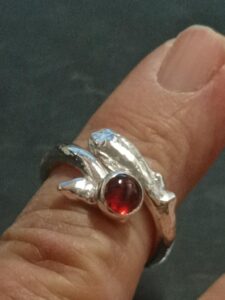
The Apple Ring called for a single cabochon stone—carefully chosen not to overpower the band, but to accentuate its twin nature.
For some, the choice was clear.
Those who carried the harvest energy—the closing of cycles, the honoring of endings—chose the deep crimson garnet. A stone as red as the apples heavy on the tree’s boughs, full of grounded wisdom, courage, and the bittersweet acceptance of time’s passing.
Others, drawn toward beginnings, renewal, and untapped potential, chose the vibrant green peridot. Like spring trapped in crystal, pulsing with hope and opening doors yet unseen.
And then there were those whose hearts spoke differently.
Some requested amethyst—seeking clarity in chaos. Some chose turquoise—for protection on uncertain paths. Others desired jade—for balance, or moonstone—for unseen guidance.
Bob allowed it.
The power was always in the silver. The stone merely tuned the frequency of the bearer’s intention.
Each stone was bezel-set directly into the thick silver spiral, nestled as if grown there.
No two rings were alike.
Bob held the finished Apple Ring beneath the lantern’s warm glow.
The spiral band of Moonlight Silver still sang faintly—a song he could not explain, only feel. The stone gleamed at its heart, like an eye open to multiple worlds.
As always, there was no maker’s mark.
“The mountain doesn’t sign its trees,” he once told Fuji. “Why should I?”
The mountain whispered its approval through the wind slicing past the studio eaves.
Unlike his standard pieces, Bob did not place the Apple Rings in his main shop display.
They were not advertised.
Instead, a small wooden shelf near the old studio window—cracked and warped with age—held only a few such rings at any time.
A tiny hand-lettered card sat beneath them:
“Two seasons. One tree. The harvest waits for who it calls.”
The seekers who found them rarely arrived by accident.
In the quiet of evening, with the forge cooled and the tea kettle silent, Bob often sat by the open window and pondered the tree’s secret.
He never claimed to know its full truth.
Some whispered that it was a lost seed from Idunn’s orchard, scattered by the fading Norse gods into strange corners of newer lands. Others insisted it was tied to the Hesperides, that golden apple myth bleeding through unseen cracks into Colorado’s high places.
But Bob’s gut told him the truth was older still.
Older than myths.
Older than language.
The Rockies themselves were young in geologic terms, but beneath them pulsed ley lines that carried memory far beyond humanity’s reach. The tree had rooted itself directly into one such line—a fracture in reality where time looped and wove, allowing the red and green apples to coexist. A fixed point. A stabilized paradox.
And the twig?
A byproduct of that paradox. A material echo of duality—caught mid-bloom, between ripening and birth.
Its spiral wasn’t random. It was deliberate.
A loop that held origin and conclusion inside itself.
Of course, none of this would have been possible without Bob’s long pact with the Mountain itself.
Years ago, beneath a violent thundersnow, he had stood on a high ridgeline and offered his quiet vow: to honor, to craft, but never to take more than was given.
Since then, the Mountain had granted him glimpses into these thinner places—where myth and matter merge.
He didn’t ask for more. He didn’t demand. He simply listened.
And sometimes, when the timing aligned, the Mountain nudged him.
Today’s ring was the latest answer to that gentle push.
In the end, Bob understood that the Apple Ring served a subtle, sacred function.
For some wearers, it grounded them during emotional transitions—helping them balance the bittersweet nature of endings and beginnings.
For others, it amplified creative energy—unlocking new doors as old ones closed.
And for a rare few, the ring acted as a kind of stabilizer—an anchor for travelers who brushed unknowingly against the edges of overlapping realities.
The wearer rarely knew which role the ring was playing.
But the Mountain did.
And that was enough.
As dusk settled, Bob glanced once more at the finished Apple Ring resting on the shelf. Moonlight struck the cabochon, igniting its hidden depths.
Another would come. A seeker.
Not because of marketing. Not because of trend.
But because the Tree, the Mountain, and the ring itself would whisper to them. And when they arrived, Bob would know.
He smiled faintly.
“As always,” he said softly to the empty studio, “I simply follow.”